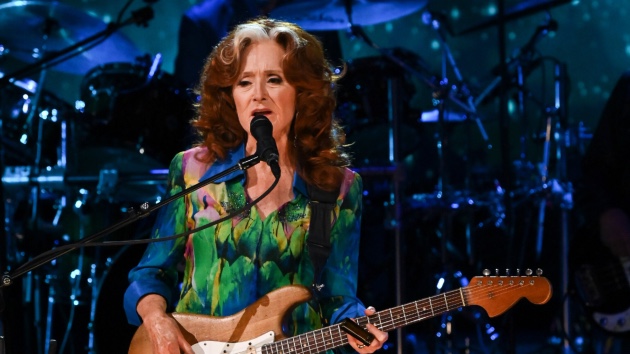
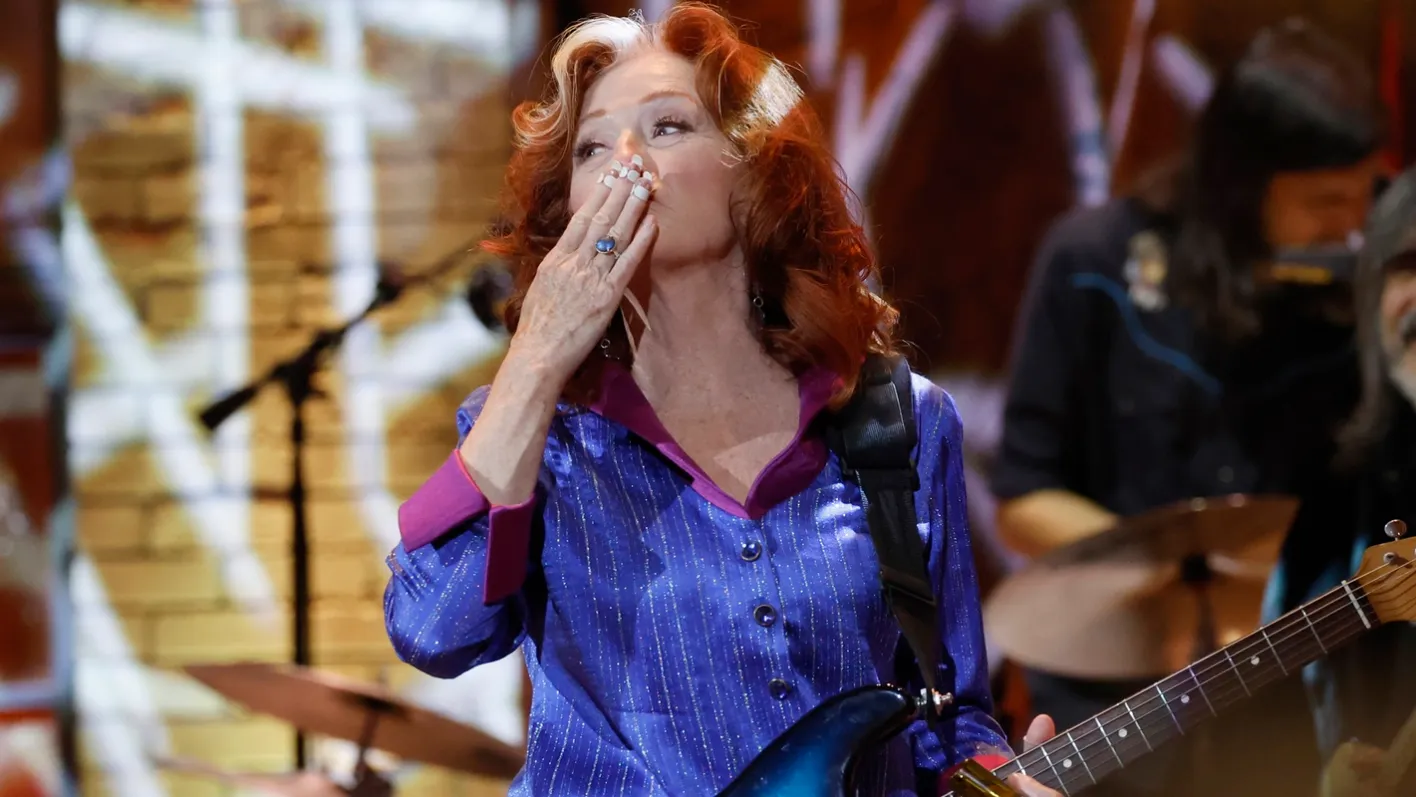
Bonnie Raitt, who kicked off her 2012 summer tour Sunday at the New Orleans Jazz Fest, did not start slow. After her introduction by festival producer Quint Davis – “Ladies and gentlemen, the great Raitt!” – she tore straight into what was to be pretty much 90 straight minutes of hard-hitting, sharp-toothed rock ‘n’ roll, taking no prisoners with a vicious bottleneck guitar and that sandpaper-and-smoke voice, which seems to age like a good Scotch. At nearly the very end of the 2012 fest, the guitar goddess delivered one of its most memorable shows.
Raitt, who as Davis pointed out in his introduction, was the first non-New Orleans-dwelling artist to perform at Jazz Fest, is no stranger to the city. Her shiny, zebra-striped turquoise shirt, she said, was intended to “honor the spirit of Ernie K-Doe. We drove by the Mother-in-Law Lounge on the way here.” She praised John Mooney and the Malone Brothers’ Saturday performances at Jazz Fest with a “man, it was slammin’.”
“In my long and notorious life,” she said, “I’ve been so glad I always have New Orleans to come back to.”
The guitarist was flanked by a band of veterans. Drummer Ricky Fataar has been with her since 1981; bassist James “Hutch” Hutchinson since 1983, when the two were introduced by the Neville Brothers. Second guitarist George Marinelli joined 20 years ago; road soundman Paul Middleton has been around for 25. Together, they occupied the stage like the old buddies they are, relaxed, chatty and engaging with the crowd, and making it look easy with the music.
Raitt played old-school hits like John Prine’s “Angel From Montgomery,” which she popularized in her 1974 “Streetlights” album, and, of course, “Something To Talk About,” from 1991’s “Luck of the Draw.” But for the most part, the set was drawn from her 2012 release “Slipstream” – her first studio album in seven years.
{{layout-builder.replace-title}}
{{layout-builder.replace-menu-description}}
{{svg_quality_icon}}
{{quality-options}}
1
bonnie raitt–angel from montgomery–jazzfest 2012
https://i.ytimg.com/vi/gY1m3VCQ4dw/mqdefault.jpg
{{svg_quality_icon}}
{{quality-options}}
Preservation Hall Jazz Band at the 2012 New Orleans Jazz and Heritage Festival May 6, 2012 celebr read more
2
Jazz Fest 2012 Preservation Hall Jazz Band with Allen Toussaint and Bonnie Raitt
https://i.ytimg.com/vi/PJgtNTci5dM/mqdefault.jpg
Preservation Hall Jazz Band at the 2012 New Orleans Jazz and Heritage Festival May 6, 2012 celebr read more
{{svg_quality_icon}}
{{quality-options}}
Bonnie Raitt with Mike Finnigan, John Cleary and Allen Toussant
3
I Believe I’m In Love With You
https://i.ytimg.com/vi/cUAku25YsOo/mqdefault.jpg
Bonnie Raitt with Mike Finnigan, John Cleary and Allen Toussant
{{svg_quality_icon}}
{{quality-options}}
Bonnie plays Gerry Rafferty at Jazz fest 2012.
4
Right Down The Line
https://i.ytimg.com/vi/CSGwZBq08a8/mqdefault.jpg
Bonnie plays Gerry Rafferty at Jazz fest 2012.
{{svg_quality_icon}}
{{quality-options}}
Bonnie Raitt performs "I Believe I’m in Love with You" as a duet with her former keyboa read more
5
2012-05-06: Bonnie Raitt/Jon Cleary/Allen Toussaint, I Believe I’m in Love with You , JazzFest
https://i.ytimg.com/vi/Dp5THDmjfFo/mqdefault.jpg
Bonnie Raitt performs "I Believe I’m in Love with You" as a duet with her former keyboa read more
{{svg_quality_icon}}
{{quality-options}}
6
bonnie raitt at jazz fest, 05 06 2012
https://i.ytimg.com/vi/_-qg3LQpvSs/mqdefault.jpg
{{svg_quality_icon}}
{{quality-options}}
Jazz Fest 2012 111 Bonnie Raitt @ Gentilly Stage
7
Jazz Fest 2012 111 Bonnie Raitt @ Gentilly Stage
https://i.ytimg.com/vi/baFlZzk1mFs/mqdefault.jpg
Jazz Fest 2012 111 Bonnie Raitt @ Gentilly Stage
bonnie raitt–angel from montgomery–jazzfest 2012
Jazz Fest 2012 Preservation Hall Jazz Band with Allen Toussaint and Bonnie Raitt
Preservation Hall Jazz Band at the 2012 New Orleans Jazz and Heritage Festival May 6, 2012 celebrating their 50th Anniversary with guests Allen Toussaint and Bonnie Raitt.
I Believe I’m In Love With You
Bonnie Raitt with Mike Finnigan, John Cleary and Allen Toussant
Right Down The Line
Bonnie plays Gerry Rafferty at Jazz fest 2012.
2012-05-06: Bonnie Raitt/Jon Cleary/Allen Toussaint, I Believe I’m in Love with You , JazzFest
Bonnie Raitt performs "I Believe I’m in Love with You" as a duet with her former keyboardist Jon Cleary and special surprise guest Allen Toussaint New Orleans Jazz & Heritage Festival 2012 Gentilly Stage Sunday, May 6, 2012 3:45 PM
bonnie raitt at jazz fest, 05 06 2012
Jazz Fest 2012 111 Bonnie Raitt @ Gentilly Stage
Jazz Fest 2012 111 Bonnie Raitt @ Gentilly Stage
“Slipstream” was recorded after a tough year for Raitt, during which she lost her parents, her brother and a best friend. She doesn’t write much, and for “Slipstream,” she chose songs that reflected her pain, and her emergence from it. Some of the album tracks are for an artist who is experiencing loss, and some are for an artist who has known enough of it to treasure love and joy when she finds it. (And at least one – “Down to You,” which she co-wrote with Randall Bramblett and performed Sunday at Jazz Fest, is about putting the first and second experiences together and arriving at a third perspective: taking no mess. As the set’s penultimate song, she rocked it.)
Bonnie Raitt, backed by Allen Toussaint takes a bow after her set at the Gentilly stage during the last day of the second week of the New Orleans Jazz Fest, Sunday May 6, 2012
Bonnie Raitt performs with the Preservation Hall Jazz Band with Allen Toussaint during the 2012 New Orleans Jazz & Heritage Festival at the Fair Grounds Race Course on May 6, 2012 in New Orleans, Louisiana
Bonnie Raitt performs with the Preservation Hall Jazz Band during the 2012 New Orleans Jazz & Heritage Festival at the Fair Grounds Race Course on May 6, 2012 in New Orleans, Louisiana
Bonnie Raitt performs with the Preservation Hall Jazz Band during the 2012 New Orleans Jazz & Heritage Festival at the Fair Grounds Race Course on May 6, 2012 in New Orleans, Louisiana
Bonnie Raitt performs with the Preservation Hall Jazz Band during the 2012 New Orleans Jazz & Heritage Festival at the Fair Grounds Race Course on May 6, 2012 in New Orleans, Louisiana
Bonnie Raitt performs at the Gentilly Stage during the last day of the second week of the New Orleans Jazz Fest, Sunday May 6, 2012
Bonnie Raitt performs at the Gentilly Stage during the last day of the second week of the New Orleans Jazz Fest, Sunday May 6, 2012
Bonnie Raitt performs at the Gentilly Stage during the last day of the second week of the New Orleans Jazz Fest, Sunday May 6, 2012
Bonnie Raitt
Bonnie Raitt performs on bottleneck guitar at the Gentilly Stage during the last day of the second week of the New Orleans Jazz Fest, Sunday May 6, 2012
Bonnie Raitt performs at the Gentilly Stage during the last day of the second week of the New Orleans Jazz Fest, Sunday May 6, 2012
Bonnie Raitt performs as Quint Davis watches from the wings during the last day of the second week of the New Orleans Jazz Fest, Sunday May 6, 2012
Bonnie Raitt performs during the last day of the second week of the New Orleans Jazz Fest, Sunday May 6, 2012
Allen Toussaint and Bonnie Raitt performing during the 2012 New Orleans Jazz & Heritage Festival at the Fair Grounds Race Course on May 6, 2012 in New Orleans, Louisiana.
Ricky Fataar, George Marinelli, James ‘Hutch’ Hutchinson, Bonnie Raitt, Allen Toussaint, Jon Cleary and Mike Finnigan at NO Jazzfest 2012
Maria Muldair, Bonnie Raitt and Steve Earle with The Preservation Hall Jazz Band
New Orleans Jazz and Heritage Festival – Bonnie Raitt, 9 time Grammy award winner with Maria Maldaur (Midnight at the Oasis), Steve Earle, guitar, Mark Braud, centarian trumpet player ‘Uncle’ Lionel Ferbos and clarinetist Charlie Gabriel of the ‘Preservation Hall and Friends’ ensemble. New Orleans, Louisiana, USA. May 6, 2012.
Bonnie Raitt sits in with The Preservation Hall Jazz Band during there 50th. Annversary performance at the 2012 New Orleans Jazz & Heritage Festival Day 7 at the Fair Grounds Race Course on May 6, 2012 in New Orleans, Louisiana.
Bonnie Raitt sits in with The Preservation Hall Jazz Band during there 50th. Annversary performance at the 2012 New Orleans Jazz & Heritage Festival Day 7 at the Fair Grounds Race Course on May 6, 2012 in New Orleans, Louisiana.
Bonnie & Irma Thomas at New Orleans Jazzfest 2012
Bonnie with show host Paul Ingles at New Orleans Jazzfest 2012
New Orleans Jazz & Heritage Festival 2012 – Poster
Rain sprinkled the crowd as the band turned Bob Dylan’s “Million Miles” into a gritty, low-down blues, complete with slinky barroom piano solo from keyboardist Mike Finnegan. Before “Can’t Fail Me Now,” another “Slipstream” track written by Loudon Wainwright and Joe Henry, Raitt and Marinelli had to pause to re-tune due to the wetness.
But the sun emerged as if on a timer for one of the show’s few quiet moments. Rays beamed down as Raitt sat atop a stool sans guitar, hands folded in her lap, for the hushed ballad “I Can’t Make You Love Me.” Smartphones flew into the air to capture the performance; most folks sang along. After a set of high-octane joking and rocking, it was a lovely interlude of pure emotion.
There are two ways to carry old practices forward: Preserve or adapt. Both approaches have their ups and downs. Mere preservation can turn something hard, laying on the sheen of authenticity that masks death within. Adaptation can dilute a thing’s essence so thoroughly as to render it unrecognizable.
The most skillful practitioners of a tradition — the blues, for example — swim between these two lanes with a fluidity which belies the thought and effort that makes their work so smooth. Bonnie Raitt has been doing this since 1971, when she emerged as a redheaded hope for a musical style that had already been co-opted by many an overblown classic rocker. With a voice as buttery as grits and a remarkable capacity for playing bottleneck guitar, Raitt quickly earned her place on the dais with forebears like Sippie Wallace and Howlin’ Wolf. But she also had a great pop sense, finding kinship with contemporary songwriters like Jackson Browne.
Fast forward more than four decades, and Raitt still moves forward with grace and substance, showing how the blues remain relevant, both to her personally and in the larger world. Slipstream is the guitarist and singer’s first release since 2005, inaugurating her label, Redwing. It represents a regrouping after Raitt’s loss of both parents, her brother and her best friend, and was inspired by her own struggle to reclaim the private life she’d given to her music, as well as the larger American crisis of the current recession. Produced mostly by Raitt herself, with four outstanding tracks helmed by master of atmospherics Joe Henry, it’s warmly contemporary, while still strongly rooted in the blues moods and techniques that Raitt has always treasured.
Slipstream provides plenty of the many-sided adult-contemporary pop that made Raitt a huge star in the late 1980s with hits like “Something to Talk About.” Chosen with Raitt’s usual impeccable taste from the cream of her songwriting circle (including Randall Bramblett, Paul Brady and Al Anderson), the bulk of Slipstream serves Raitt’s lifelong project of expressing how blues idioms apply to the life of the modern woman. There’s a reggae take on Gerry Rafferty‘s yacht-rock favorite “Right Down the Line;” Bramblett’s “Used to Rule the World,” a sidelong glance at the American Dream that Sharon Jones would love; an almost Western ballad about fame and drugs, “Marriage Made in Hollywood” (Brady’s original sounds more Irish); and Anderson and Bonnie Bishop’s perfectly despondent “Not Cause I Wanted To,” a modern rambling-woman’s blues that allows Raitt to demonstrate her unmatchable gift for making regret beautiful.
In all of these songs and more, the production sounds clean and intimate, while the guitars — Raitt’s, Anderson’s and tourmate George Marinelli’s — take up as much room as the vocals. This is a plus. Raitt’s chops are subtly honed and her responsiveness to her bandmates turns Slipstream into a rewarding group dialogue. The talk gets most serious, though, in the four songs Henry produced, three of which also feature electric Zen masters Bill Frisell and Greg Leisz.
It’s simply a thrill to hear Raitt in her element, exchanging guitar licks and lines with Frisell and Leisz. Two Bob Dylan covers, both culled from 1997’s Time Out of Mind, allow the musicians to wax cinematic on basic blues forms. Henry’s own “You Can’t Fail Me Now,” co-written with Loudon Wainwright III for the soundtrack to Knocked Up, gains a gospel flavor here. This is preservation as quiet, personally driven innovation, with new shades of meaning shot through familiar phrases.
In these evocative moments and throughout Slipstream, Raitt and her fellow players never break a sweat about fitting in with current pop trends; they’re doing what they love, and it’s utterly relevant because it represents their well-considered lives. Raitt’s gift for expressing emotions on a real, human scale is what makes her so beloved. On Slipstream, she takes on some of the hardest, and she doesn’t fail us now.
The warmth and vigor of Bonnie Raitt‘s voice throughout her new album Slipstream, even when she’s covering an oldie such as Gerry Rafferty’s “Right Down the Line,” is vital and fresh — urgent, even. Raitt has always possessed a gift for taking a familiar phrase and rendering it in a manner that compels a listener to think anew about what the words really mean.
NPR Music - Bonnie Raitt - Slipstream - A Barnstorming Good Time
Bonnie Raitt - Slipstream - A Barnstorming Good Time
tip: most convenient way to listen while browsing along is to use the popup button of the player.
Raitt has always mixed folk with blues, rock and the sort of funk that she’d probably link to Lowell George and Little Feat, and that I’d say is as respectful of beat and groove as any of the R&B artists she admires. You can hear it in her slide-guitar playing throughout Slipstream, and particularly the way she sets up the rhythm with her band and then slides her voice in like a letter going into an envelope addressed to you.
I know that if you’re going to praise a Bonnie Raitt album, you’re supposed to work in some comparison to her greatest commercial success, 1989’s Grammy-winning Nick of Time. But my praise is more precise: This is Raitt’s best album since 1975’s underrated Home Plate. I’m not just pulling that out for obscurity’s sake, either: Slipstream captures the kind of barnstorming fervor that can turn in the space of a song into a slow boil, the roiling storm of emotions contained within her cover of Bob Dylan‘s “Million Miles.”
I mentioned Raitt’s vocals at the start of this review, and I’m going to end there, too. It’s not that I’m ageist enough to think that someone in her 60s can sing as fluidly as Raitt does here — heck, her blues heroes were doing it a few decades beyond that. But it is rare for a performer who has maintained a 40-year career to sound so unfazed, so careful to avoid artistic short-cuts, so lacking in cynicism. She has the guile and shrewdness of a long-time pro, but it’s the purity of this beautiful mongrel music that gives it its great life.
Bandana Blues is and will always be a labor of love. Please help Spinner deal with the costs of hosting & bandwidth. Visit www.bandanablues.com and hit the tipjar. Any amount is much appreciated, no matter how small. Thank you.
Bonnie Raitt is nothing if not loyal. And when she caught wind of the fact that Mike Reid and I were writing and recording together, she was quick to volunteer to sing on our song “The Bridge.” It’s one of my favorite songs Mike and I have written. And I can no longer imagine it without her heroic spirit present. ~ Joe Henry
Released on: 2025-09-05 Producer: Joe Henry Music Publisher: Rivers and Roads Music (ASCAP - admin by Endurance Music Group) Music Publisher: Mule Rider (ASCAP) Music Publisher: Blue Raincoat Music (ASCAP) ℗ 2025 Work Song Inc. marketed and distributed by Thirty Tigers
{{svg_quality_icon}}
{{quality-options}}
1
http://i3.ytimg.com/vi/VWNoTHkp6_k/hqdefault.jpg
Prison Bound Blues · Bonnie Raitt
Bonnie has contributed a new recording of "Prison Bound Blues" written by Leroy Carr to a project called Better Than Jail, an extraordinary new album benefiting Free Hearts and Equal Justice USA. Better Than Jail is available everywhere today and features covers of iconic prison songs from Steve Earle, Taj Mahal,Margo Price, The War and Treaty and many more. The album seeks to raise awareness and support for the urgent need to reduce the harm of the criminal justice system. https://found.ee/BetterThanJail.
I'm so proud to have joined in with so many illustrious artists in creating this very special album in support of rural prison reform. Overlooked for far too long, this issue cuts across all cultural and political divides and deserves all our focused attention to finally bring about some swift and meaningful action. Better Than Jail is one of the most inspired and heartfelt albums I've been blessed to be a part of and I hope it sets a fire in hearts far and wide to join in our efforts." ~ Bonnie Raitt
Released on: 2024-10-04 Executive Producer: Brian Hunt Producer: Kenny Greenberg Producer: Wally Wilson Producer: Bonnie Raitt Recording Engineer: Jason Lehning at Sound Emporium Mastering Engineer: Alex McCollough at True East Mastering Production Assistant: Shannon Finnegan Mixer: Justin Niebank at Hounds Ear Music Publisher: Universal Music Corp. Composer, Lyricist: Leroy Carr ℗ Believe Entertainment Group and Wyatt Road Records
{{svg_quality_icon}}
{{quality-options}}
1
http://i3.ytimg.com/vi/xC2BJuQbO8w/hqdefault.jpg
The Fabulous Thunderbirds - Nothing in Rambling Ft. Bonnie Raitt, Taj Mahal, Keb' Mo' & Mick Fleetwood
In celebration of the band’s 50th Anniversary, The Fabulous Thunderbirds have just released Struck Down, their first studio album in eight years on Stony Plain Records. The ten-track album includes a wonderful cover of Memphis Minnie’s “Nothing in Rambling,” featuring longtime friends, T-Birds founding member Kim Wilson, along with Bonnie, Keb’ Mo’, Taj Mahal and Mick Fleetwood. — BRHQ
{{svg_quality_icon}}
{{quality-options}}
1
http://i3.ytimg.com/vi/YmW-bgcbvQI/hqdefault.jpg
Little Feat - Long Distance Call
“I’ve always loved Little Feat and this new incarnation of the band is bringing some serious heat, cred and new blood to their enduring legacy. Every Feat fan loves us some Sam. I’m so glad he’s now gotten a chance to step out front and center and put his spin on these wonderful blues songs. I loved singing "Long Distance Call" with him, always one of my favorites, and Scott slayed on slide. Know you’ll enjoy hanging out with us at Sam’s Place!" -- Bonnie Raitt
“Long Distance Call” was written by blues legend, Muddy Waters. It has Sam Clayton and Bonnie Raitt on vocals, Scott Sharrard on Dobro, Fred Tackett on acoustic guitar, Tony Leone on drums, and Michael “The Bull” LoBue on harmonica. The album also features Bill Payne on piano and Kenny Gradney on bass.
Little Feat have composed an album that’s their love letter to the blues entitled, ‘Sam’s Place.’ “Long Distance Call” plus many other blues classics are on this album. You can stream and order ‘Sam’s Place’ here: https://orcd.co/samsplace
Broken Hearts & Dirty Windows: Songs of John Prine, Vol. 2, the anticipated new John Prine tribute record from Oh Boy Records, is out today. Stream/purchase HERE.
Created as a celebration of Prine’s life and career, the album features new renditions of some of Prine’s most beloved songs performed by Brandi Carlile (“I Remember Everything”), Tyler Childers (“Yes I Guess They Oughta Name A Drink After You”), Iris DeMent (“One Red Rose”), Emmylou Harris (“Hello In There”), Jason Isbell (“Souvenirs”), Valerie June (“Summer’s End”), Margo Price (“Sweet Revenge”), Bonnie Raitt (“Angel From Montgomery”), Nathaniel Rateliff & The Night Sweats (“Pretty Good”), Amanda Shires (“Saddle in the Rain”), Sturgill Simpson(“Paradise”) and John Paul White (“Sam Stone”). Proceeds from the album will benefit twelve different non-profit organizations, one selected by each of the featured artists.
{{svg_quality_icon}}
{{quality-options}}
1
http://i3.ytimg.com/vi/Z71L4JdrVBY/hqdefault.jpg
Bonnie Raitt - Write Me a Few of Your Lines/Kokomo Blues
60 years anniversary celebration of Arhoolie
December 10, 2020
{{svg_quality_icon}}
{{quality-options}}
1
Arhoolie Foundation celebrates it's 60th anniversary (1960-2020) with an online broadcast.
Bonnie Raitt - Shadow of Doubt
Hardly Strictly Bluegrass Festival
October 3, 2020
Hardly Strictly Bluegrass celebrates it's 20th anniversary with an online broadcast titled “Let The Music Play On”.
{{svg_quality_icon}}
{{quality-options}}
1
http://i3.ytimg.com/vi/hCJa0505jZk/hqdefault.jpg
Bonnie Raitt & Boz Scaggs - You Don't Know Like I Know
Farm Aid 2020 On the Road
Sam & Dave classic written by Isaac Hayes and David Porter.
{{svg_quality_icon}}
{{quality-options}}
1
http://i3.ytimg.com/vi/jXG6ULcK-qs/hqdefault.jpg
Sheryl Crow & Bonnie Raitt - Everything Is Broken
[Eric Clapton’s Crossroads 2019]
Eric Clapton, one of the world’s pre-eminent blues/rock guitarists, once again summoned an all-star team of six-string heroes for his fifth Crossroads Guitar Festival in 2019. Held at the American Airlines Center in Dallas, Texas, the two-day concert event raised funds for the Crossroads Centre in Antigua, the chemical dependency treatment and education facility that Clapton founded in 1998.
{{svg_quality_icon}}
{{quality-options}}
1
http://i3.ytimg.com/vi/yHeBLEo4TOM/hqdefault.jpg
'A Tribute To Mose Allison'
Celebrates The Music Of An Exciting Jazz Master
Raitt contributed to a new album, If You're Going To The City: A Tribute To Mose Allison, which celebrates the late singer and pianist, who famously blended the rough-edged blues of the Mississippi Delta with the 1950s jazz of New York City.
NPR's Lulu Garcia-Navarro talks to Bonnie Raitt about her friendship with the Mose Allison. They're also joined by Amy Allison — his daughter, who executive produced the album — about selecting an unexpected list of artists to contribute songs to the album.
Recorded on tour June 3, 2017 - Centennial Hall, London - Ontario Canada





 Users Today : 256