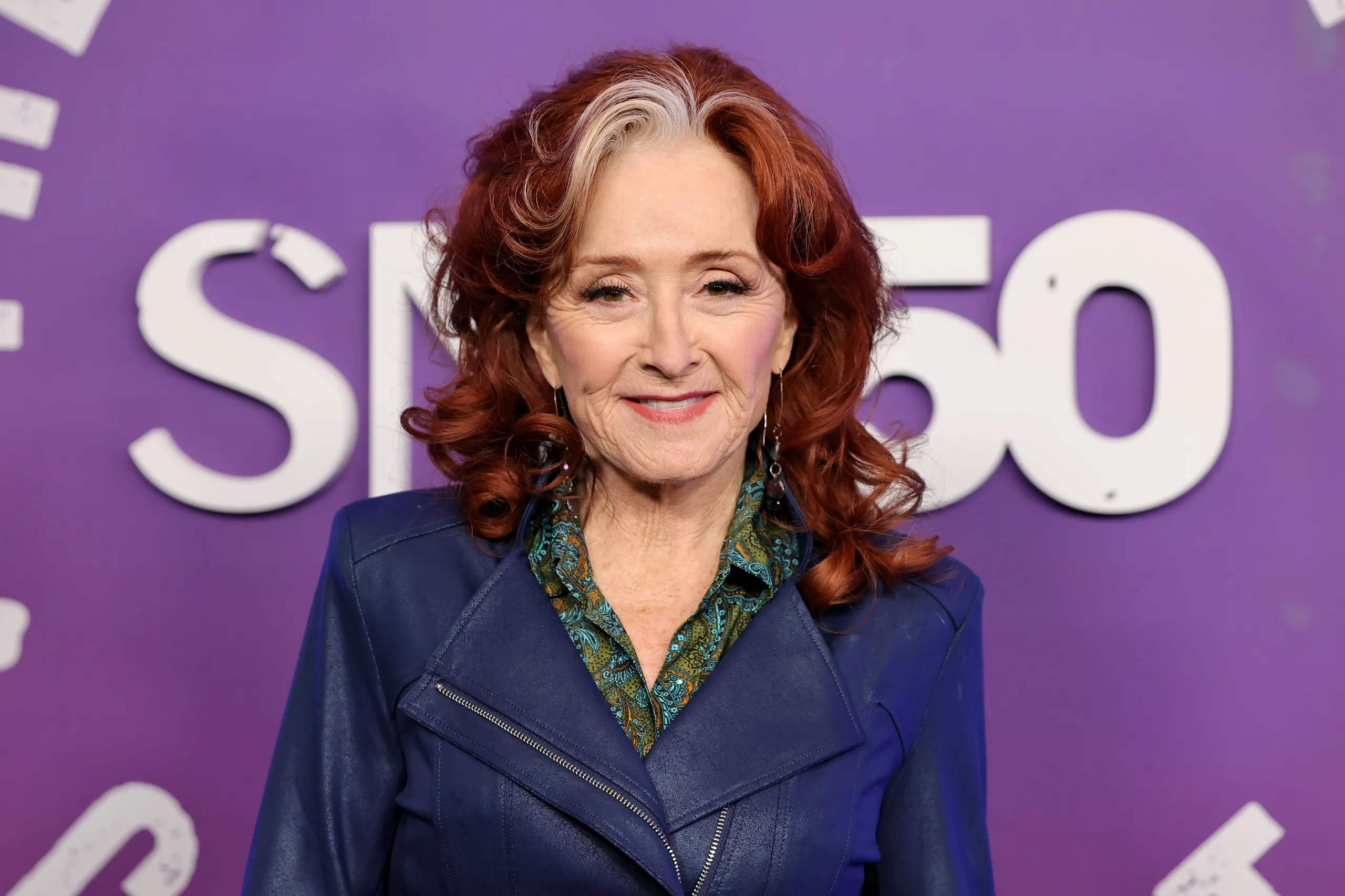
The 72-year-old singer and songwriter delivers her signature blend of sensitive folk, slow-burn blues, and catchy pop to a sold-out audience.
On Saturday night in Portland, Bonnie Raitt couldn’t stop repeating how happy she was to be back on tour performing music before an appreciative crowd. “The Road’s My Middle Name,” she enthusiastically sang at one point.
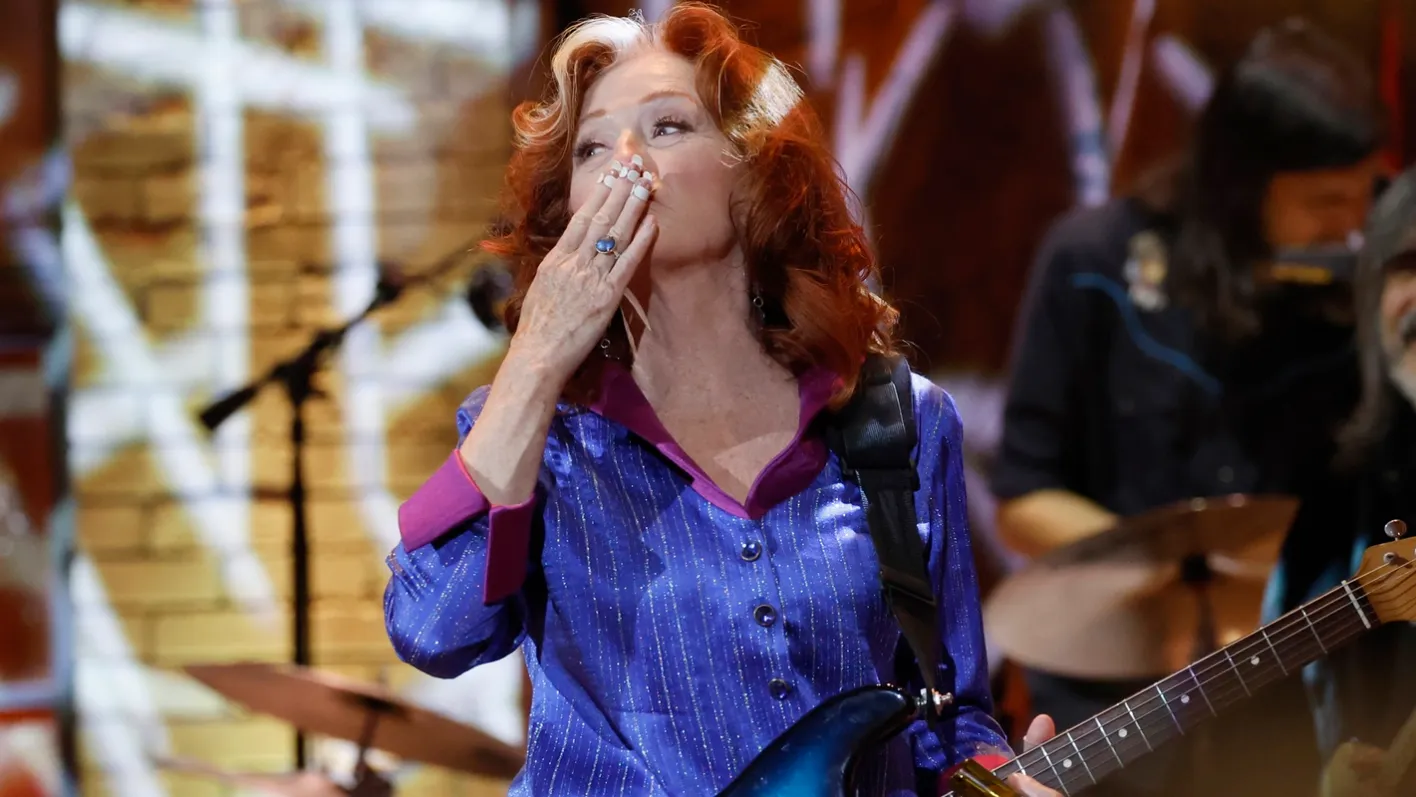
At the sold-out concert at Merrill Auditorium, the 72-year-old singer/songwriter/guitarist confirmed why she is the winner of multiple awards and an inductee into the Rock & Roll Hall of Fame. Her signature blend of sensitive folk, slow-burn blues, and catchy pop (along with a few other things) was delivered through her distinctively soulful voice to a crowd that seemed to be feeling it as much as she was, even though they were perhaps not yet familiar with the songs from her new album – “Just Like That…” – which was released only a day before the show.
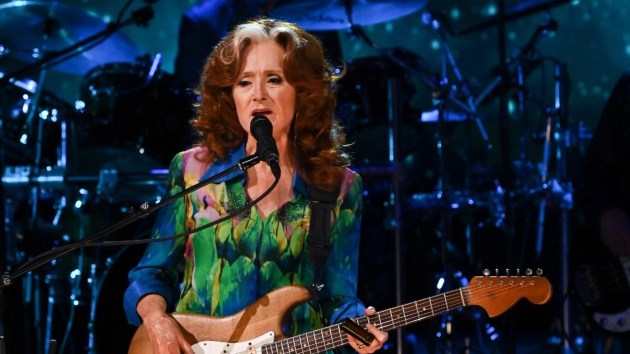
Bandmates and collaborators James “Hutch” Hutchinson (bass), Ricky Fataar (drums), Duke Levine (guitar and mandolin), George Marinelli (guitar), and Glenn Patscha (keyboards) provided strong support to the guitar-slinging redhead at center stage.
The performance began with “Made Up Mind,” the lead tune on the new disc. Its chronicling of a relationship ending with a sad determination fits perfectly with the longstanding emotional realism in Raitt’s work. It was highlighted by her expressive slide guitar playing, which is almost like an extension of her voice by this point.
Bonnie Raitt visits Bull Moose record shop on Record Store Day 2022 for a Q&A!
Press Herald music columnist Aimsel Ponti interviews music legend Bonnie Raitt in front of a live audience at the Scarborough location of Maine record store chain Bull Moose on Saturday, Record Store Day, before Raitt’s sold-out show at Merrill Auditorium that night.
In the same lyrical vein but delivered as a feisty blues, “Blame It On Me” turns the tables on the fault-finding in a breakup. The tune sets up the final result: a broken heart which she is more than willing to “blame … on you.”
The singer’s roots in folk music were well represented by a tribute to her friend, the recently passed John Prine, whom she referenced on several occasions during the almost two-hour show. Seated with an acoustic guitar in hand, she intoned Prine’s classic “Angel from Montgomery” and was visibly moved by the close.
The title piece from the new album, a Raitt original, also was moving in its storytelling of a mother reunited, in a sense, with her departed son. Another original, “Waitin’ for You to Blow,” featuring a bubbly organ solo from Patscha, made a seductively funky case for the struggles of recovery. Her take on the power ballad “I Can’t Make You Love Me” was a touching highlight, Raitt’s voice soaring to the rafters of the acoustically friendly hall.
“Back Around,” a blues rooted in Malian music, had Raitt adding the sharp chill of slide steel guitar to the mix. The reggae pulse of “Have a Heart” was infectious while Raitt’s take on the classic “Something to Talk About” emerged from an updated group intro.
“Livin’ For the Ones,” a Raitt/Marinelli tribute to lost friends, rocked out hard with weaving guitar lines way up in the mix. At the other extreme, “Nick of Time,” with Raitt at the keyboard, was a breezy pop treat that the singer said made her think that summer is on the way.
References to both the war in Ukraine and some homeless people she met earlier in the day in Portland showed that Raitt has not lost her passion for causes far and near. All the while, she continues to make the case for the many powers of good music.
Opening the evening with a brief set was a sextet that originated in the same mid-20th century era that produced Raitt.
NRBQ has defied labels over the years. Perhaps because of that, the group has endured as a fun treat to hear and see. Who else can open with a Duke Ellington riff, follow with some good-time rockabilly and country twang, then throw in a classic Afro-Cuban song before closing with a near-perfect rock rave-up?
About The Author
Steve Feeney
Steve Feeney is a Maine native who attended schools in Maine, New Hampshire and Massachusetts. He began writing professionally after earning a Masters Degree in American and New England Studies from the University of Southern Maine. Steve currently writes freelance theater, dance and music reviews for the Portland Press Herald/Maine Sunday Telegram as well as ArtsFuse.org and BroadwayWorld.com. He also writes the occasional poem, play or short story and has had a few of them published/performed.
By George VargaArmed with one of the most deeply felt albums of her storied career, “Just Like That…”, Bonnie Raitt is hitting the road for her first tour since before the COVID-19 pandemic shutdown. (Ken Friedman / Courtesy Shorefire Media)
The new Lifetime Achievement Grammy Award winner is eager to hit the road again. During the COVID-19 pandemic shutdown, she paid her production crew after her tours were canceled. ‘It was the right thing to do,’ she says
Bonnie Raitt can pinpoint exactly how she has impacted her most devoted listeners.
And it has little to do with her eight Grammy Award wins between 1990 and 1992, her 2000 induction into the Rock & Roll Hall of Fame, the Lifetime Achievement Grammy she received earlier this month, or her being the first female musician ever honored by Fender with a signature series of Stratocaster electric guitars back in 1995.
“The two greatest compliments I get, to this day, are: ‘You are one of the few musicians my mom and I can share’,” Raitt said, her voice tinged with pride.
“The other is: ‘I’ve never seen my husband cry, until we go to your show, and you sing ‘Angel from Montgomery’ or ‘I Can’t Make You Love Me.’ They send me handwritten letters, and it is absolutely gratifying.”
Raitt may soon be getting a fresh slew of fan mail from grateful listeners.
“Just Like That …,” her first new studio album in six years, is both one of the most heartfelt and most daring works in her storied 51-year recording career.
Raitt’s always-expressive singing is more soulful and nuanced than ever, while her songwriting achieves new levels of craft and sophistication. The music is exquisitely crafted but also isn’t over-thought or over-played. It sounds very much like the work of an iconic artist who is at the top of her game and still pushing to forge new creative paths that build on her past accomplishments.
As an added bonus, the almost telepathic interplay with her band members belies the fact they could not make music with each other for an extended period because of the COVID-19 pandemic. When Raitt and her fellow musicians reconvened last year in a woodsy recording studio north of San Francisco, they had a shared sense of gratitude and celebration that is evident in each note that is played and sung on “Just Like That…”
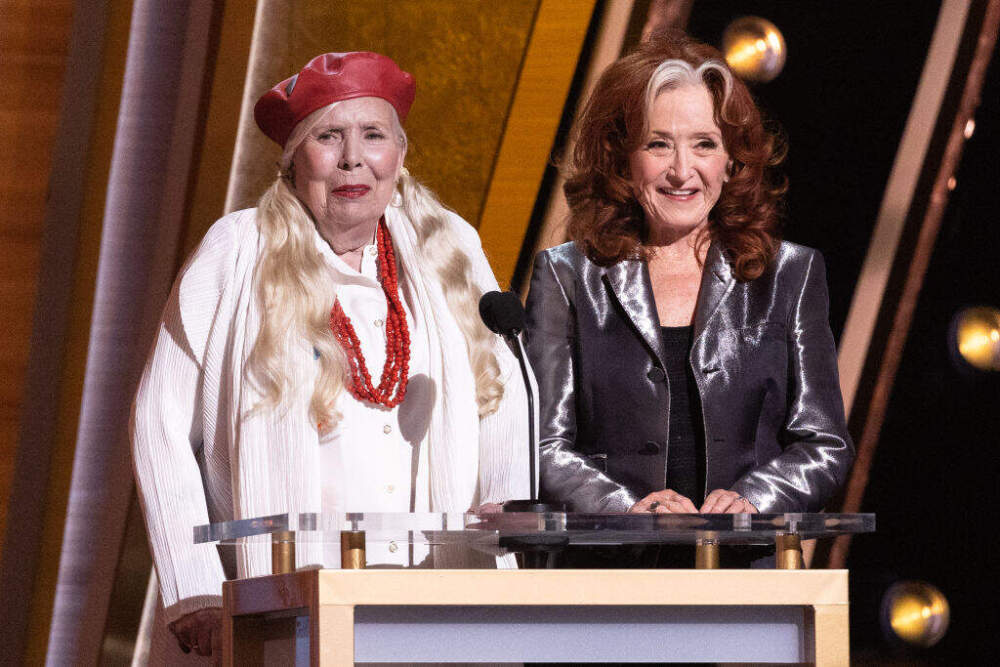
Joni Mitchell and Bonnie Raitt presented an award during the 64th Annual Grammy Awards telecast in Las Vegas on April 3. (Matt Winkelmeyer / Getty Images)
‘I am so thrilled’
“I can feel it in the tracks on the album how thrilled we are to be playing together again,” said Raitt, whose “Just Like That …” tour with fellow Rock & Rolla Hall of Fame inductee Mavis Staples includes a Sept. 27 San Diego concert at The Rady Shell at Jacobs Park.
“You can’t underestimate the impact of having canceled four or five tours, or of two years of not playing together. Now we’re getting ready for a tour, and we all have vaccines in our bodies.
“So many times, it looked like we would have the record done and go out on a tour, but didn’t. As sad as I am about all the things there are to be sad about in the world, I am so thrilled we now have that chance again.”
Raitt is quick to note that the pandemic did not affect her nearly as much as the concert tour production crew members and theater, arena and club employees whose livelihoods evaporated overnight.
“Forget the joy of collaborating and being on the road, although that’s a huge loss,” she said. “But the loss of all the income and security for the people I work with was much bigger. So, the least I could do is take the income I have earned over the years and spread it to the people I worked with.
“Because we thought we were going to tour Canada three or four times with James (Taylor), I had to reserve and hold my tour crew, which works six to eight months in a normal year. When my tour was postponed several times, paying them was the right thing to do. When the tour was canceled altogether, it was still the right thing to do.
“We’re all a family. And I can’t think of a better use of my income than to spread it around to the people who helped me get here in the first place.”
Bonnie Raitt performs at the 2020 Grammy Awards, shortly before the COVID-19 shutdown of live events. The telecast featured her performing a truncated version of “Angel from Montgomery,” the classic John Prine song that Raitt recorded the definitive version of back in the 1970s. Prine, who was in the Grammy audience that night, died in April 2020 from complications related to COVID-19. (Matt Sayles /Invision/AP)
On the road again, finally
With her 2022 “Just Like That …” tour — her first since 2019 — Raitt is looking forward to reconnecting with her crew and fans in person. It will be her first opportunity to perform songs from her new album live, and the first for audiences to hear her new material in person.
Four of the standout numbers from “Just Like That …” — the title track, “Down the Hall,” “Waiting for You to Blow” and the Rolling Stones’ flavored “Living for the Ones” — rank among the most moving Raitt has ever written.
Set to a vintage jazz-funk electric piano vamp, “Waiting For You to Blow” is a wry song about resisting the temptations to backslide into unhealthy lifestyle choices. That’s a particularly resonant topic for Raitt — who has been clean and sober since 1988 — although the song addresses various temptations with a knowing wink under its serious message.
“I’m really proud of ‘Waiting For You to Blow’ because I wanted to try something new for me, a mixture of ‘70s funk and jazz,” Raitt said. “l love Eddie Harris, Les McCann and The Crusaders, and I wanted to hybridize that style of jazz-funk and put to lyrics about a serious subject that had a sardonic satirical bent to them.
“Sometimes, it’s nice to take life’s boogie-man, set it to a good funk groove and laugh at the human condition. So, if you have a little devil on your shoulder, whether you’re in recovery or not — those things that make you eat too much or not tell truth — this song addresses those little character defects that say to you: ‘Come on, nobody will know you stayed up an extra three hours last night’.”
“Down the Hall” was inspired by a pre-pandemic New York Times magazine article Raitt read about a prison hospice program, while “Just Like That’s” title track grew out of a Bay Area news report that chronicled how two families beset by tragedies were connected by an organ transplant.
“I was inspired by those two stories and putting myself in the third person,” said Raitt, whose late father was Broadway musical star John Raitt.
“I usually write my ballads on electric piano. I wanted to go back to the power of doing all those acoustic guitar songs, which brought back how much I loved all those early John Prine, Jackson Browne and Bob Dylan records where they played their guitars and told those stories.
“I was also inspired by growing up watching my dad sing in his touring musical theater companies. He sang those beautiful Rodgers and Hart songs where you can crawl into those characters.”
She paused for emphasis.
“I didn’t write ‘Down the Hall’ and ‘Just Like That’ to be connected, but they are two songs about the power of redemption and grace. The last few years have had so much vitriol, hatred and toxicity in this country, more than I’ve ever seen. These stories I based the songs on moved me so deeply and I’m so proud to share them.”
Raitt is a great believer in giving each song she records — whether written by her or someone else — ample time to gestate and evolve.
The fact that, since 2011, her albums have come out on her own label, Redwing, ensures she does not face the deadline pressures that are often a fact of life for many artists in the music industry.
“Like I would have let a record company tell me anything!” Raitt said with a laugh. “I told both labels that I was with (before Redwing): ‘I’ll decide what I write, what I record, with who, when it comes out, and be in charge of my music. And I will work my tail off, tour and do a lot of interviews.’
“In terms of my own songwriting, I write on assignment. When I know that I have seven or eight songs of other people’s that I want to do, I have them percolating for as long as they need to.
“Like, (NRBQ band co-founder) Al Anderson’s ‘Something’s Got a Hold of My Heart,’ I’ve had waiting for 30 years for me to put on the right record. The Toots and the Maytals’ song, ‘Love So Strong,’ which is on my new album, I’ve had (waiting to do) since 2016.
“When I have a batch of songs (by other writers) framed out, I look at what other things I want to say. And one of the ways I stretched on this album was with the ‘story songs’ — ‘Down the Hall’ and ‘Just Like That.’ I mostly write for myself.”
On the song “Living for the Ones,” which she co-wrote with her longtime guitarist George Marinelli, Raitt was also writing for family members and close friends who have passed away. The music rocks with fervor, while the lyrics examine issues of mortality with sensitivity and insight gained from personal experience and loss.
“ ‘Living for the Ones’ is the one song on my new album that I wrote during the pandemic,” she said. “That’s how I started feeling when I lost my brother in 2009 and he couldn’t walk or see in last six months of his life. Whenever you’re living with somebody who is losing the ability to live, you very quickly stop complaining about your own pains. So I had a lot of practice (for the pandemic).”
Bonnie Raitt’s new album, “Just Like That …,” is one of the most accomplished works of her career. It is her latest release on Redwing Records, the label she founded in 2011. (Associated Press)
A storied career, etched in blues
Raitt was just 21 when her self-titled debut album was released in 1971.
She earned almost instant acclaim for her impassioned singing, her striking instrumental prowess as a bottleneck guitarist and her precocious command of earthy American music styles, from Delta blues, folk and honkytonk to Dixieland, vintage R&B and country.
Equally impressive was her ability to deliver definitive interpretations of songs written by other writers, a talent that has been a constant throughout her career.
Raitt’s command at performing a variety of blues styles with such conviction and skill came from her love for the music, but even more so from being mentored by Mississippi Fred McDowell, Sippie Wallace and other masters she befriended as a blues-obsessed teenaged musician.
Or, as Raitt explained in a 2000 Union-Tribune interview: “I just loved Delta blues. I never looked at it in terms of musical genre or gender. It did tickle Fred McDowell that I was so passionate about blues. I already knew how to play, so he was mostly shaking his head in wonder, as did most of the blues people. They got a kick out of it. It didn’t bother them that I was a girl. They liked it any time White kids picked up on the blues.
“And my relation with them was really on a personal level, as buddies and mentors. It was more like hanging with them taught me some life lessons about how to be a woman. There were lessons about how they treated women and how they acted as parents, so what I learned from them had more to do with life than music. To have access to that many (blues) legends was the greatest gift in my life.”
Raitt built a devoted following that grew with each new album and tour. But broad mainstream success eluded her until her 10th album, “Nick of Time,” came out in 1989.
It earned her three Grammy Awards, including Album of the Year, Best Female Rock Vocal and Best Female Pop Vocal. She accepted a fourth Grammy the same day for Best Traditional Blues for her sizzling duet on “I’m in the Mood” with blues legend John Lee Hooker.
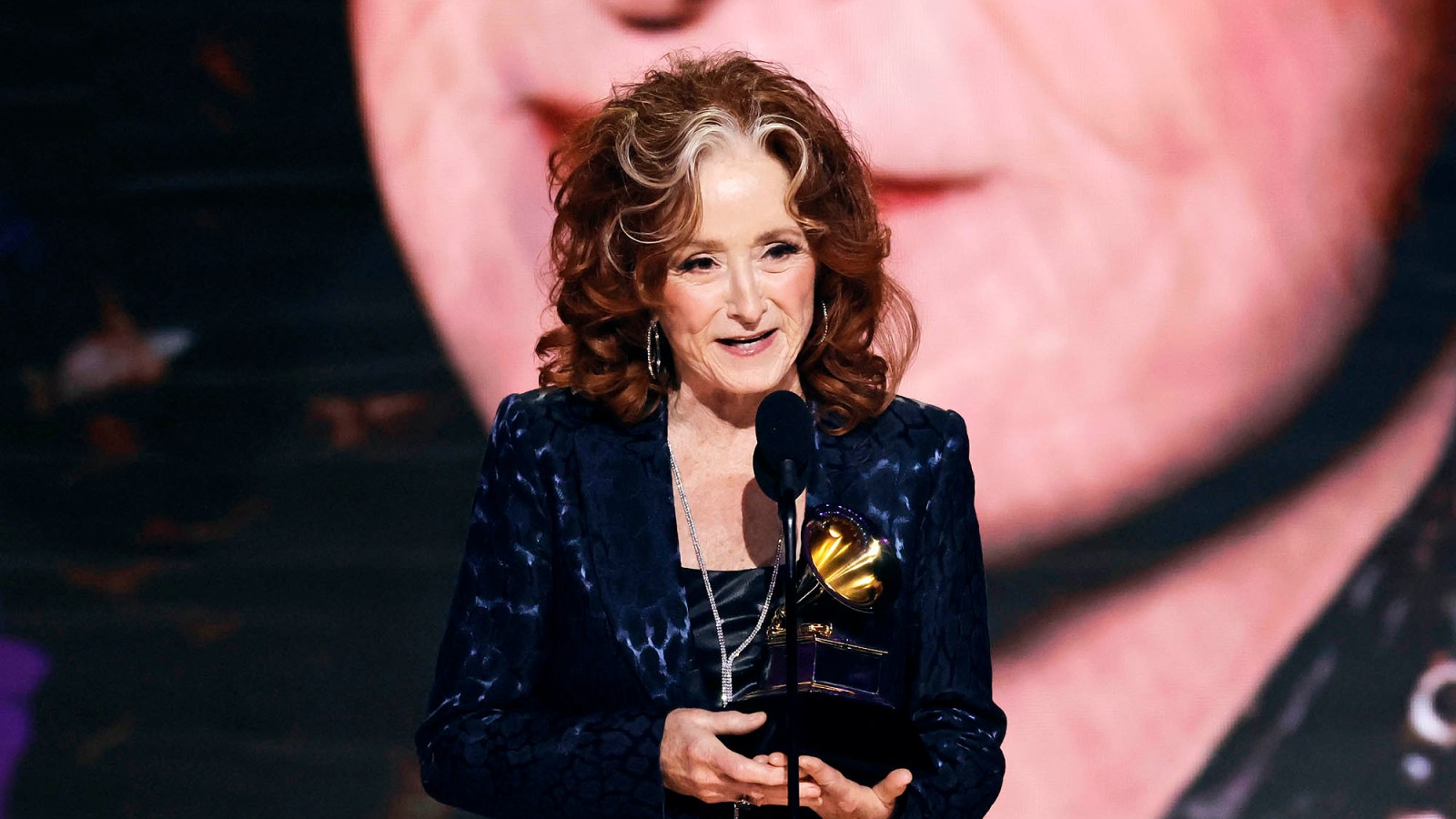
On April 13, “Nick of Time” was inducted into the Library of Congress’ National Recording Registry. On April 3, Raitt received her Lifetime Achievement Grammy Award in Las Vegas. It was presented a year late, because of the pandemic, and minus any ceremony or speech.
“I’m glad that I’m getting this award when I’m still mobile,” said Raitt, 72. “I know that I am appreciated whether anybody gives me the (Lifetime Achievement Grammy) or I make a speech.”
In March, she received Billboard magazine’s Women in Music Icon Award in Los Angeles. It honors artists of “extraordinary accomplishment, who have made historic contributions.”
Raitt, who co-founded Musicians United for Safe Energy in 1979 and the Rhythm and Blues Foundation in 1988, used her Icon acceptance speech to speak out on issues near and dear to her.
“Let us keep fighting to bring more equity and opportunity to women in all aspects of our industry and society at large,” she said, before thanking “my mom and dad for inspiring my love of music and standing up for what’s right.”
A longtime social activist who was raised as a pacifist by her Quaker parents, Raitt also addressed the war in Ukraine during her Icon speech, telling the audience: “My heart is heavy for the people of Ukraine, and I know the Russian people are not in agreement — so many of them — with what’s being done. I pray for all the people who are working hard for peace, (and for) the man who started the war. May he have a transformation.”
She concluded her remarks by saying: “I can’t think of a better tribute to thank you than heading back out on the road soon doing what I love, with a new album and finally over this pandemic. Stay safe everybody. … Here’s to the people of Ukraine. Here’s to all of you celebrating women in music.”
This year’s Billboard awards ceremony was postponed from 2021 because of the COVID-19 pandemic. The event also spotlighted such young artists as Olivia Rodrigo, Phoebe Bridgers, Karol G and Summer Walker.
“Billboard honored me because I’ve been around 50 years and been an example for women guitar players and, hopefully, band leaders, and for mixing music with activism and championing (other) songwriters and the blues and rhythm-and-blues that we, as artists, owe so much to,” Raitt, a Burbank native, said.
“I’m very proud of my being acknowledged if it makes people pay attention to those things. Not that I take it for granted, but it makes it important to ring those bells again. And I hope that younger people, who don’t know who I am, will say: ‘Wow, look what she accomplished. She didn’t worry about speaking out. She didn’t compromise’.”
Raitt’s multigenerational appeal was underscored in her conversations with some of the other honorees at the Billboard event.
“To have all these younger women, who are from much more commercial music genres than I’m involved with, come up and say to me that their moms played ‘I Can’t Make You Love Me,’ and that they grew up singing it, made me very proud,” she said.
In a 1998 Union-Tribune interview, Raitt — then 48 — said: “I feel much more secure at this age than I did in my early 20s.”
How does she feel now, 24 years later?
“Iconic! But you have to write ‘Iconic, she said with a laugh’,” said Raitt, who indeed was laughing. She then grew more serious.
“I feel very appreciated and respected, and that is really a beautiful way to feel at any time. I probably felt like that in 1998 because of the ‘Nick of Time’ Grammy-win, and the ensuing greater appreciation of who I am and what I do has never stopped meaning so much to me.
“So, I feel confident I’m appreciated. And that’s a great way to feel no matter what job you have or what age you are. And with my getting a Lifetime Achievement Award from the Grammys, I could (pass away) tomorrow and know I would have been appreciated.”
San Diego Union-Tribune music critic George Varga began drumming in rock bands at 12 and writing professionally about music at 15. A Louisiana native who grew up mostly in Germany, Varga has earned three Pulitzer Prize nominations for his writing at the U-T and is a voting member of the Rock and Roll Hall of Fame. In addition to providing live coverage of the Grammy Awards and festivals from Coachella and KAABOO to the 1994 edition of Woodstock, he has interviewed everyone from Miles Davis, Britney Spears and (over a game of chess) Ray Charles to Willie Nelson, Kanye West and Pulitzer Prize-winning composer Anthony Davis. A triple first-prize winner for criticism and arts writing at the 2022 San Diego Press Club awards, Varga is also a contributing writer for Jazz Times magazine and has written for Billboard, Spin and other publications. After attending San Diego City College and San Diego State University, he created and taught the 2002 UC San Diego Extension course, “Jazz in a Post-Ken-Burns World.” Varga has written liner notes for more than a dozen albums, including by jazz sax greats James Moody and Michael Brecker, and contributed two chapters to the book, “Dylan: Disc By Disc.”
Touring behind her new album “Just Like That,” with guests like Mavis Staples, Raitt says, “I wanted to pack the bill with some legendary performers that probably won’t be around forever — including me”
Actually, she can make us love her, and Bonnie Raitt has been doing it since her self-titled debut album in 1971. A slew of Grammys for “Nick of Time” in 1990 spurred a reboot of her career that’s never waned, particularly when it comes to her live appeal. She just started an eight-month tour behind her 18th studio album, “Just Like That,” another soul-stirring mixture of greasy, good-time blues-rock and heartrending state-of-the-world balladry.
How is it, back out on the road?
We just played our first date last night in Modesto, and I can’t even tell you — it was all I could do not to just break down, I was so excited. I was just in the zone again. If you take somebody that’s been on the road for 50 years and then don’t give ‘em a live audience for two and a half years… I had to stop and restart a song last night, because I was playing it at a 1980s Elvis Costello tempo! I had to drop it back down to Chuck Berry.
You are one of the very few major artists who’s had a career in the limelight that long who never had any regrettable moments of compromise. You went indie eventually, but even on major labels, you never seemed to do anything that wasn’t you.
As a 21-year-old (in 1971), my condition of signing to any record label was that I didn’t want to have anybody tell me what or when to record, or have to work with someone that I didn’t pick, or be told how to look. I said, “I have no plans to be a commercial singles artist — I’m a stone-FM-album cut kind of a person, along with the Meters and Grateful Dead and Little Feat and Randy (Newman) and Ry (Cooder).” And that’s why I went with Warner Bros. Then with Warner Communications (taking over the label as a conglomerate), the big-bucks guys came in — and the 1980s was not a great decade for people in our type of music. I was penalized for not going in the direction they thought I should go. There can be little ways that they don’t support you to the level they did: They don’t put the records in the stores. They don’t get you the placement PR-wise. They don’t push your single as much. Famously, Van Morrison, T Bone Burnett, Arlo Guthrie and I were canned on Pearl Harbor Day of 1983, right before I was going out on tour with Stevie Ray Vaughan and had finished a new album. When Joe Smith called and I went to Capitol (at the end of the ’80s), I said, again, “I don’t want you to tell me what to record.” The awards (for “Nick of Time”) really validated my musical direction. But it was the Grammys that gave me the response, not the People’s Choice or American Music Awards. I wasn’t a top 40 act.
How did you keep busy in the pandemic?
Immediately upon the shutdown, the benefit requests came in. The election cycle was foremost in my mind. And I was always going to be tithing a lot of my income and my time supporting Democratic candidates and safe energy. Income stream for things like Farm Aid and gun control and anti-death penalty and Native American causes fell out, so I got more busy than I’ve ever been before trying to manage the requests coming in for “Would you please do a song for this benefit, from your living room?” It was fun to sing duets virtually with Jackson Browne, and that opens up a whole new income stream for doing good in the world. I have to say, I enjoy playing “Nick of Time” solo from a little room in my house; it was kind of new and refreshing. And doing a duet of Sam & Dave songs with Boz Scaggs in another part of the Bay area, that was kind of fun too. But nothing beats actually hearing that audience clap. And when 30 people are asking you to raise money, it becomes a full-time job, being diplomatic and trying to not only pick which ones you’re going to help, but to decline friends that really were in financial straits. So when people asked me, “How was it, being off?,” I just said, ”If anything, I can’t wait to have a new album and get on the road, so I can get a break!”
I’m just grateful that everybody felt safe enough — and we asked them not to put up cameras, and they didn’t, which was great. I was worried, because in the interim years, a lot more people expect that you’re OK with the whole audience holding up the phone. You know, I’m sort of grateful that people filmed parts of my other shows here and there. But as a singer, it’s really hard to dig deep when people are thinking it’s only existing if they capture it. And what about the people sitting next to you? I mean, how come you get to do it, but they don’t? I’m one of those old-school people that, when I start “I Can’t Make You Love Me,” I can’t sing it if there’s somebody aiming an iPad at me.
In the liner notes, you list some of the important people we’ve lost. What’s it like singing John Prine’s “Angel From Montgomery” on tour after losing him?
It was very moving last night, and when I told the audience that this was going to be the first time performing it live (since his death), and how much I miss John, and how much I owe him for his life and his work and his friendship, we had a moment there. And similarly with Toots Hibbert from the Maytals: I did his song (“Love So Strong”), which I was supposed to do as a duet on this album with him; we lost him (in 2020) as well. It was a very holy moment to remember John and honor him, and or us to celebrate Toots Hibbert, who is one of the greatest artists of all time. John Prine had the best reception of any record of his whole career right before he passed. And it was just so tragic that he had to go after overcoming so many health challenges, but thank God he had the year that he had before he was taken. And, you know, before COVID, Allen Toussaint and Mose Alison were close friends of mine. So it’s only in the last couple of years, the people I listed, and there were some I had to leave off. Ed Cherney (engineer behind Raitt’s Capitol albums) was cancer. Some other people — I’ve had two suicides and my nephew died of a heart disease. And you know, it’s partly the time I’m in — I’m in my seventies — but oh my God, I don’t know about you, but it’s just so many people that needlessly died of COVID. That’s what is so upsetting. And have needlessly died in Ukraine. Not just for myself, my band and crew, but for the audience, we need this music live. We need it. I know from the medicine that last night was.
You have a song on this album devoted to recovery, “Waitin’ for You to Blow.” Your album “Nick of Time” was partly about achieving that in your life. Why did you return to the subject now?
At my rock bottom, I wasn’t crawling around a lot in my career, my health, my life — I was didn’t run over anybody or go to jail. And I was very lucky that sobriety took, or I took to it, and it was life-changing, spiritually and physically and artistically. I was really grateful that if I was going to get that kind of career boost, as I said in my (Grammys) acceptance speech, that it was brought to me at a time when I could handle it. Because I don’t know about you, but I look at Taylor Swift and Beyonce and Adele and Billie Eilish and Ed Sheeran and people are handling incredible early success with the guidance and experience of people decades older, and I’m just so happy to see that. Because I don’t think I could have handled it. I didn’t seek it and I wouldn’t have wanted a hit record. I actually turned down songs that would have made me a star, and turned down offers of management. I just didn’t want to be that in that pressure. I was in it for the long run, and to be like my jazz and folk contemporaries, and my dad even — planning to be do this into my eighties or so.
You do have an amazing role model for career and performance longevity in your dad (Broadway and film star John Raitt), who toured till he was 86, I think.
Yeah, he did occasional concerts his last couple of years. I mean, the only reason he didn’t work more is because his audience wasn’t alive! I don’t mean to laugh at that. I just mean he was really outlived a lot of his audience, and there weren’t as many opportunities. And, we got to perform together and have dual scholarship programs at the Thornton School of Music; that was really thrilling. And he sang great right up until the end. And I mean, if you watched the Tony Bennett special with Lady Gaga, I stood up and gave him a standing ovation in my house. That’s how much I love that he still was able to do that show. And Mick and Keith — oh my God, what an inspiration. And Mavis. don’t see any sign of any of us retiring. I mean, Bruce Springsteen and Sting — people are at the top of their form right now, I think.
Getting back to recovery — how much more do you know now than you did when you were publicly discussing it as a fairly new thing in 1990?
I would say that after 35 years of sobriety, as anyone in recovery knows, you’re never recovered. And in fact, a lot of people slip back. It’s a daily practice to take inventory of how you’re behaving and what faults are creeping up in personality quirks. Or things you could call and quirks, but they could also be ways that are hurtful — that you need to pay attention to how you’re living your life, not just morally in the world, but in your everyday interactions with your loved ones and your colleagues, but with yourself. And so I wrote that new song “Waiting for You to Blow” about the ways that we kid ourselves about the little devil on our shoulders. Especially during the pandemic, it was like, yeah, you can stay in bed and call in sick. You can have another three pieces of pie instead of dinner. You can watch movies all night and sleep it off the next day. You know, we’re all human, we’re all dealing with an unprecedented amount of stress and anxiety, so it’s a constant surveillance. You have to pay attention to your goals and your health and take care of yourself. And so that’s what I’ve learned primarily, is let myself be human and know I’m not perfect, but still not sway too far from a road that is balanced and healthy and considered and kind, and be true to my mission of why I’m here on the earth and be of service, you know?
I think it’s been really important to have set my compass and set my sail for some higher purpose, and that I try to allow myself some slack and cheat days and all that and forgive myself when I mess up. And what’s important is perspective, allowing yourself enough time to have fun and be out in nature and appreciate life and not be so career- or goal-oriented. You don’t care what people think about you as much. And it’s easy for me to say, because I’ve had incredibly good reviews and reception and validation the whole time that I still can’t believe I get, though I worked to earn that. And I don’t sway from my being true to my own integrity about politics and what I spend my time and my money on, and I never record anything or tour with people that I don’t think are really of the highest quality.
The audience you’re getting on this tour has waited several years to see you, after so many delays.
I knew that even if it was another three years, they’d probably still hold on to their ticket. And, you know, talk about appreciating each other. I don’t think there’s ever been a show that felt like last night. I can barely verbalize it, because it just happened. But none of us could go to sleep on the bus, we were so excited. And I told the audience, “I wish we could just keep playing for a couple more hours.” In the roughest period of our entire lives, it’s a miracle every single day that we get to wake up and look out and see the sun rise and sun set and be safe and not bombed…
It’s a great slew of opening acts you have this summer.
Lucinda Williams I’d never even toured with, so this is going to be a thrill for me because I’m a huge fan of hers. And then to give the first two weeks over to one of my favorite bands ever, NRBQ, and then finish the tour with Marc Cohn in the fall, it’s like a dream come true for me. And Mavis Staples is like family to me. I think we sold 4,000 seats in one day for Red Rocks. We did 40 dates together on my “Slipstream” tour a few years ago, and I didn’t know she’d want to do it again, but the last three or four albums she’s put out are some of the best records ever that she’s ever made, and among the best of the releases of the last 10 years. She’s on fire, and she’s 83 now. So especially coming out of the pandemic when nobody could go to these shows, I wanted to pack the bill with some legendary performers that probably won’t be around forever — including me.
On the new album, in “Living for the Ones,” you wrote, “I can barely raise my head off the pillow… Some days I never get out of bed. I don’t think we’ll get back to how we used to.” Is that something you could have written at any time, or specific to this one?
Every lyric on that song was very specific to how I’m getting through. That’s absolutely pandemic related — but it was also the election, Black Lives Matter, the climate crisis — a confluence of nightmares that I’ve never had in my life. I don’t know about you, but I’ve never experienced a time when I was this upset and dreading and anxious and heartbroken and heartsick. I really thought we’d made some progress, between the environment and climate and Black justice and the MeToo movement. The rising up of people in the street for Black Lives Matter was very encouraging, and so was Greta (Thunberg) and all the climate activists of this generation. I’m really hopeful in many ways, but it’s been very tough to look at the world and know that this is what we’ve wrought, and the progress isn’t what we thought. So I’ve never had more of a mission to go back out on the road to bring joy and relief to people.
Chris Willman is Senior Music Writer and Chief Music Critic at Variety. He joined the publication in 2018 and is based in Los Angeles. Willman began his career at the Los Angeles Times, going on to spend 13 years at Entertainment Weekly as a senior writer and critic. He has been a regular contributor to Billboard, the Hollywood Reporter and TV Guide; his work has additionally appeared in Rolling Stone, New York Magazine, Spin, Parade and other publications. He is the author of the 2005 book “Rednecks & Bluenecks: The Politics of Country Music,” cited by Stephen King as one of the three best music books of all time. Since joining Variety, he has received eight first-place honors from the National Arts & Entertainment Journalism Awards and seven from the SoCal Journalism Awards. The L.A. Press Club named him its Entertainment Journalist of the Year in 2020.
Bandana Blues is and will always be a labor of love. Please help Spinner deal with the costs of hosting & bandwidth. Visit www.bandanablues.com and hit the tipjar. Any amount is much appreciated, no matter how small. Thank you.
Bonnie Raitt is nothing if not loyal. And when she caught wind of the fact that Mike Reid and I were writing and recording together, she was quick to volunteer to sing on our song “The Bridge.” It’s one of my favorite songs Mike and I have written. And I can no longer imagine it without her heroic spirit present. ~ Joe Henry
Released on: 2025-09-05 Producer: Joe Henry Music Publisher: Rivers and Roads Music (ASCAP - admin by Endurance Music Group) Music Publisher: Mule Rider (ASCAP) Music Publisher: Blue Raincoat Music (ASCAP) ℗ 2025 Work Song Inc. marketed and distributed by Thirty Tigers
{{svg_quality_icon}}
{{quality-options}}
1
http://i3.ytimg.com/vi/VWNoTHkp6_k/hqdefault.jpg
Prison Bound Blues · Bonnie Raitt
Bonnie has contributed a new recording of "Prison Bound Blues" written by Leroy Carr to a project called Better Than Jail, an extraordinary new album benefiting Free Hearts and Equal Justice USA. Better Than Jail is available everywhere today and features covers of iconic prison songs from Steve Earle, Taj Mahal,Margo Price, The War and Treaty and many more. The album seeks to raise awareness and support for the urgent need to reduce the harm of the criminal justice system. https://found.ee/BetterThanJail.
I'm so proud to have joined in with so many illustrious artists in creating this very special album in support of rural prison reform. Overlooked for far too long, this issue cuts across all cultural and political divides and deserves all our focused attention to finally bring about some swift and meaningful action. Better Than Jail is one of the most inspired and heartfelt albums I've been blessed to be a part of and I hope it sets a fire in hearts far and wide to join in our efforts." ~ Bonnie Raitt
Released on: 2024-10-04 Executive Producer: Brian Hunt Producer: Kenny Greenberg Producer: Wally Wilson Producer: Bonnie Raitt Recording Engineer: Jason Lehning at Sound Emporium Mastering Engineer: Alex McCollough at True East Mastering Production Assistant: Shannon Finnegan Mixer: Justin Niebank at Hounds Ear Music Publisher: Universal Music Corp. Composer, Lyricist: Leroy Carr ℗ Believe Entertainment Group and Wyatt Road Records
{{svg_quality_icon}}
{{quality-options}}
1
http://i3.ytimg.com/vi/xC2BJuQbO8w/hqdefault.jpg
The Fabulous Thunderbirds - Nothing in Rambling Ft. Bonnie Raitt, Taj Mahal, Keb' Mo' & Mick Fleetwood
In celebration of the band’s 50th Anniversary, The Fabulous Thunderbirds have just released Struck Down, their first studio album in eight years on Stony Plain Records. The ten-track album includes a wonderful cover of Memphis Minnie’s “Nothing in Rambling,” featuring longtime friends, T-Birds founding member Kim Wilson, along with Bonnie, Keb’ Mo’, Taj Mahal and Mick Fleetwood. — BRHQ
{{svg_quality_icon}}
{{quality-options}}
1
http://i3.ytimg.com/vi/YmW-bgcbvQI/hqdefault.jpg
Little Feat - Long Distance Call
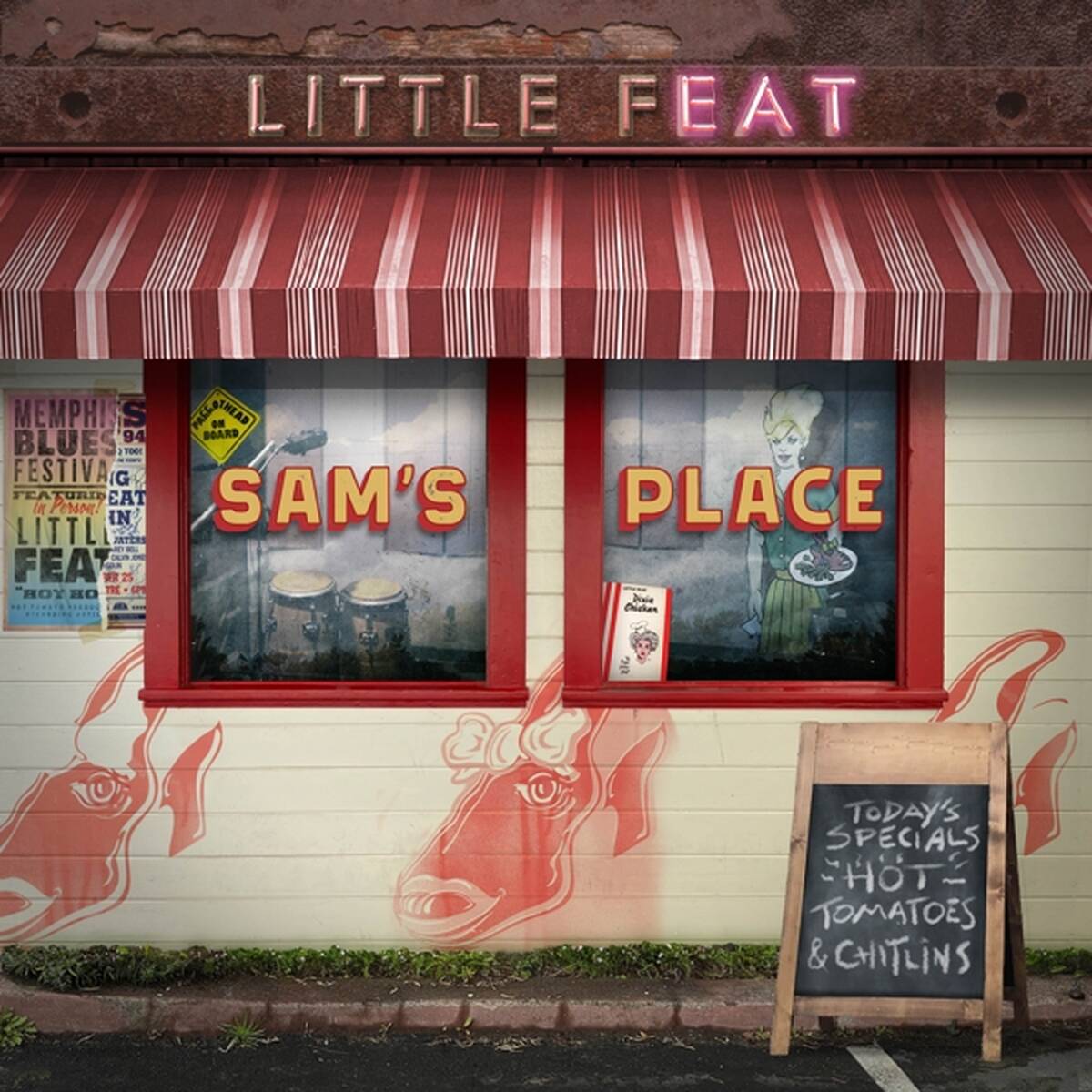
“I’ve always loved Little Feat and this new incarnation of the band is bringing some serious heat, cred and new blood to their enduring legacy. Every Feat fan loves us some Sam. I’m so glad he’s now gotten a chance to step out front and center and put his spin on these wonderful blues songs. I loved singing "Long Distance Call" with him, always one of my favorites, and Scott slayed on slide. Know you’ll enjoy hanging out with us at Sam’s Place!" -- Bonnie Raitt
“Long Distance Call” was written by blues legend, Muddy Waters. It has Sam Clayton and Bonnie Raitt on vocals, Scott Sharrard on Dobro, Fred Tackett on acoustic guitar, Tony Leone on drums, and Michael “The Bull” LoBue on harmonica. The album also features Bill Payne on piano and Kenny Gradney on bass.
Little Feat have composed an album that’s their love letter to the blues entitled, ‘Sam’s Place.’ “Long Distance Call” plus many other blues classics are on this album. You can stream and order ‘Sam’s Place’ here: https://orcd.co/samsplace
Broken Hearts & Dirty Windows: Songs of John Prine, Vol. 2, the anticipated new John Prine tribute record from Oh Boy Records, is out today. Stream/purchase HERE.
Created as a celebration of Prine’s life and career, the album features new renditions of some of Prine’s most beloved songs performed by Brandi Carlile (“I Remember Everything”), Tyler Childers (“Yes I Guess They Oughta Name A Drink After You”), Iris DeMent (“One Red Rose”), Emmylou Harris (“Hello In There”), Jason Isbell (“Souvenirs”), Valerie June (“Summer’s End”), Margo Price (“Sweet Revenge”), Bonnie Raitt (“Angel From Montgomery”), Nathaniel Rateliff & The Night Sweats (“Pretty Good”), Amanda Shires (“Saddle in the Rain”), Sturgill Simpson(“Paradise”) and John Paul White (“Sam Stone”). Proceeds from the album will benefit twelve different non-profit organizations, one selected by each of the featured artists.
{{svg_quality_icon}}
{{quality-options}}
1
http://i3.ytimg.com/vi/Z71L4JdrVBY/hqdefault.jpg
Bonnie Raitt - Write Me a Few of Your Lines/Kokomo Blues
60 years anniversary celebration of Arhoolie
December 10, 2020
{{svg_quality_icon}}
{{quality-options}}
1
Arhoolie Foundation celebrates it's 60th anniversary (1960-2020) with an online broadcast.
Bonnie Raitt - Shadow of Doubt
Hardly Strictly Bluegrass Festival
October 3, 2020
Hardly Strictly Bluegrass celebrates it's 20th anniversary with an online broadcast titled “Let The Music Play On”.
{{svg_quality_icon}}
{{quality-options}}
1
http://i3.ytimg.com/vi/hCJa0505jZk/hqdefault.jpg
Bonnie Raitt & Boz Scaggs - You Don't Know Like I Know
Farm Aid 2020 On the Road
Sam & Dave classic written by Isaac Hayes and David Porter.
{{svg_quality_icon}}
{{quality-options}}
1
http://i3.ytimg.com/vi/jXG6ULcK-qs/hqdefault.jpg
Sheryl Crow & Bonnie Raitt - Everything Is Broken
[Eric Clapton’s Crossroads 2019]
Eric Clapton, one of the world’s pre-eminent blues/rock guitarists, once again summoned an all-star team of six-string heroes for his fifth Crossroads Guitar Festival in 2019. Held at the American Airlines Center in Dallas, Texas, the two-day concert event raised funds for the Crossroads Centre in Antigua, the chemical dependency treatment and education facility that Clapton founded in 1998.
{{svg_quality_icon}}
{{quality-options}}
1
http://i3.ytimg.com/vi/yHeBLEo4TOM/hqdefault.jpg
'A Tribute To Mose Allison'
Celebrates The Music Of An Exciting Jazz Master
Raitt contributed to a new album, If You're Going To The City: A Tribute To Mose Allison, which celebrates the late singer and pianist, who famously blended the rough-edged blues of the Mississippi Delta with the 1950s jazz of New York City.
NPR's Lulu Garcia-Navarro talks to Bonnie Raitt about her friendship with the Mose Allison. They're also joined by Amy Allison — his daughter, who executive produced the album — about selecting an unexpected list of artists to contribute songs to the album.
Recorded on tour June 3, 2017 - Centennial Hall, London - Ontario Canada











 Users Today : 63