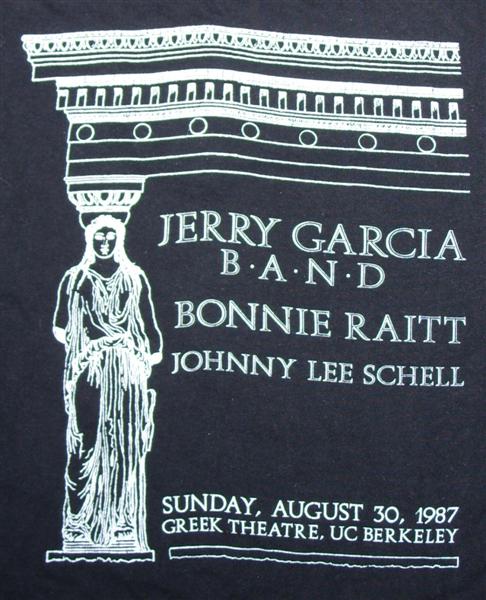
August 30, 1987: Greek Theater, UC Berkeley, Berkeley, CA: Jerry Garcia Band/Bonnie Raitt
Jerry Garcia Band with special guest Bonnie Raitt – Greek Theatre, University of California – Berkeley – 8/30/1987
The Keystone Berkeley had closed in 1984, and the Keystone Palo Alto in 1986. The Stone in San Francisco would remain open for a few more years under Herrera ownership, but Garcia had simply outgrown the venue, and his last show there was May 31, 1987. The migration by Garcia to the BGP empire can now be seen as significant, but at the time it just seemed practical. On Halloween 1986, the Jerry Garcia Band and Kingfish with Bob Weir had played the Henry J. Kaiser Convention Center, the first JGB concert in Keystone territory (San Francisco, Alameda County or Palo Alto) in a while. Now, of course, we can see it as the shape of things to come.
The Jerry Garcia Acoustic Band had played a benefit at the Fillmore on March 18, 1987. According to legend, this led to the conversation between Graham and Garcia where Jerry told Bill “take us to Broadway”, and The Jerry Garcia Band ended up playing two weeks at the Lunt-Fontanne Theater in October 1987. The Garcia Band debuted at The Warfield in November of that year, and from then on all Bay Area Garcia shows were BGP events. In August of 1987, the Jerry Garcia Band headlined the Greek Theater at UC Berkeley. Now, we can see it as part of a pattern of Bill Graham taking over the promotion of Garcia Band California shows. At the time, however, it just seemed like a welcome and cool event, and it certainly was that.
The Grateful Dead had been playing a three day weekend run at the Greek Theater since 1981, and the shows were one of the highlights of the Grateful Dead year. The Greek Theater and Frost Amphitheater are the two best venues in the Bay Area of any appreciable size, and by the late 1980s people would come from all over the country and the world for the Greek shows. Tickets were impossible, and the crowds outside the Greek were so large, that they would broadcast the shows on the local radio (KPFA-fm) in order to discourage people from coming to the venue. The Dead had played June 19-21, 1987 to the usual rapturous reception, but by that time I had given up on the whole ruckus and passed on going. Like many people, when I found out that there would be a single Garcia Band show, without all the out-of-towners, it seemed like an early Christmas gift.
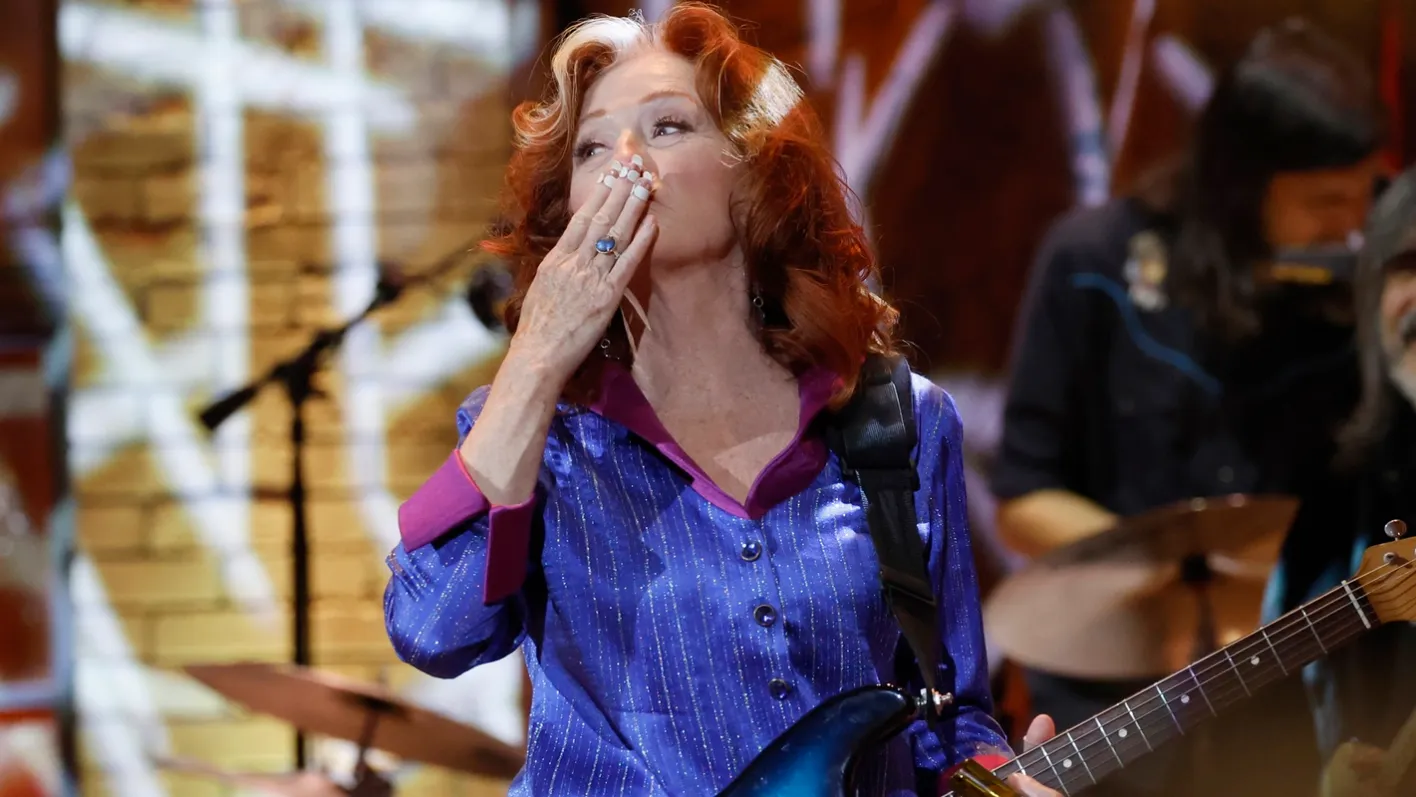
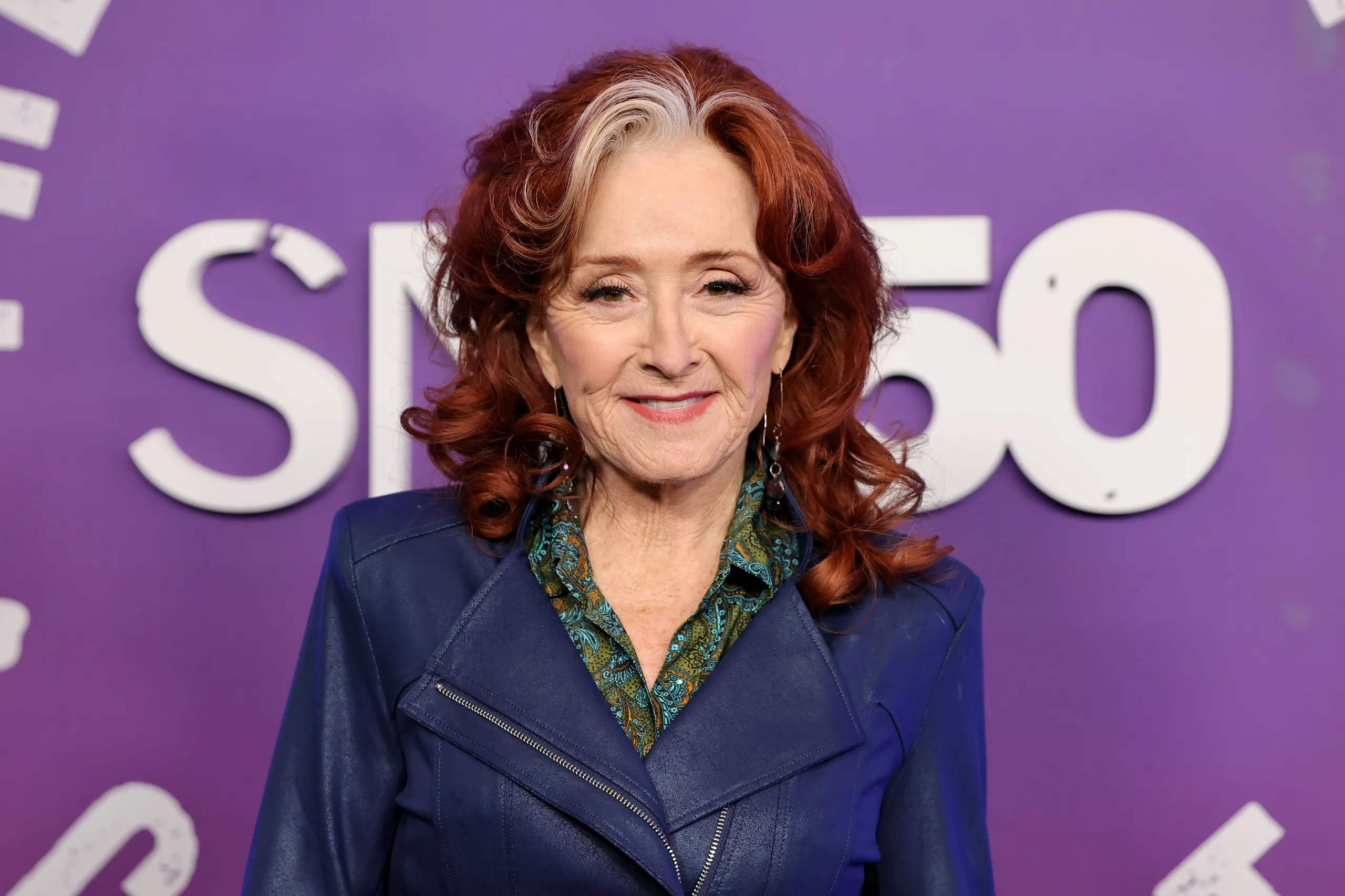
Intriguingly, the 1987 Greek Theater show was going to be opened by Bonnie Raitt. I had many of her albums and had always wanted to see her, and here she was opening a show I was going to see anyway. It’s interesting to consider the implications of Bonnie Raitt sharing the bill with Jerry Garcia. In Summer 1987, the 7500-capacity Greek Theater was a big step up for Garcia in the Bay Area. In the Bay Area, the Grateful Dead and Jerry Garcia had played so regularly, that there was no excitement associated with a JGB concert. I don’t think that Bonnie Raitt’s presence was necessarily selling more tickets to a Garcia show, per se, but her presence made a lot of people think “I should go to this Garcia show, even if I just saw the Dead or Jerry earlier this year.” It worked, as the show was sold out as far as I know, and we were blessed with beautiful Sunday afternoon weather as well.
Bonnie Raitt, Headlining Thursday at Valley Forge Music Fair in Moscow
By JONATHAN TAKIFF, Daily News Staff Writer
Launch into a conversation with Bonnie Raitt and you’ll be amazed where it can lead: From the new Russian spirit of Glasnost (openness) to the CIA-drug- smuggling scandal to her latest musical collaborations with the Purple Wonder, Prince.
{{layout-builder.replace-title}}
{{layout-builder.replace-menu-description}}
{{svg_quality_icon}}
{{quality-options}}
1
Bonnie Raitt – Three Time Looser – A Rock “n” Roll Summit – Russia 1987
Our Move – American-Soviet Concert for PeaceIzmaylovo Stadium Moscow 04.07.1987
{{svg_quality_icon}}
{{quality-options}}
3
Arriving in Moscow USSR (part 1) – Warm Welcome at the North River Terminal
http://img.youtube.com/vi/fwgpt-7JZqw/0.jpg
Arriving in Moscow, David Stein, Americans react to Moscow, Musicians "Ain"t Gonna Study war no more," Circle Dancing, folk songs, V. Anopova shows sketches of Walk participants.
{{svg_quality_icon}}
{{quality-options}}
4
Arriving in Moscow USSR (part 2) – Press Conference, Walking through Red Square
http://img.youtube.com/vi/QXlb2bVUj-g/0.jpg
Arrival in Moscow, Press Conference at SPC , Walk & Concert, wild shots of red Square, Interview w/walkers & Standby"s, American & Soviet flag walk around Red square, Circle by buses at Red Square in Circle with Jean Kasum & Soviet gentlemen.
{{svg_quality_icon}}
{{quality-options}}
5
Arriving in Moscow USSR (part 3) – Making a Circle on Red Square, Concert Setup and Interviews
http://img.youtube.com/vi/jMKaFu08z5s/0.jpg
Circle near Red Square, Moscow shopping with F. Segal, Collective Vision, concert backstage set-up at Ismailovo Stadium, interview with Carlos Santana w/F. Segal, A. Segal, Sasha.
{{svg_quality_icon}}
{{quality-options}}
6
Arriving in Moscow USSR (part 4) – Interviews and Concert Negotiations
http://img.youtube.com/vi/xrG1MI1N1j8/0.jpg
Carlos Santana interview MTV, fans at fence, B. Graham Concert camera position negotiations.
{{svg_quality_icon}}
{{quality-options}}
7
Arriving in Moscow USSR (part 5) – Interviews and Marching in Moscow
http://img.youtube.com/vi/gihtH0Kg_N4/0.jpg
Doobie Drummer meets Autograph, Steve Wozniak (Apple) interview, Doobie Bros. MTV S. Smithe, marching through Moscow streets.
{{svg_quality_icon}}
{{quality-options}}
8
Arriving in Moscow USSR (part 6) – Peace Vigil and Other Interviews
http://img.youtube.com/vi/V_kvOCHb41Q/0.jpg
Interview with Peace Vigil members & B. Mandel, Logan & Nadine & Andre Discussions, Dimitri Comments.
{{svg_quality_icon}}
{{quality-options}}
9
Arriving in Moscow USSR (part 7) – Culminating Walk and Concert Kick-Off
http://img.youtube.com/vi/fTfd0zTjJ44/0.jpg
Peace Marchers enter the Ismailovo Stadium, M. Cone talks about Collective Vision, Casey Kasum meets Radio Moscow, culminating walk around the stadium, speeches & flowers at concert opening.
{{svg_quality_icon}}
{{quality-options}}
10
Come Together: The 1987 American Soviet Peace Walk
http://img.youtube.com/vi/teEUWnlEgDs/0.jpg
***Версия на Русском языке / Russian language version: http://youtu.be/BVk0-LRB3A4"Come Together" is a documentary about the American Soviet Peace Walk from Leningrad to Moscow in the summer of 1987.The aim of the Walk was to help end the Cold War between the U.S. and the U.S.S.R., by "ending the arms race nobody wants."About 250 American and 250 Soviet citizens took part, walking over 450 kilometers from the city of Leningrad (now St. Petersburg) to Russia"s capital of Moscow.The documentary also includes footage from the first-ever joint U.S.-Soviet rock concert on July 4, 1987, which marked the culmination of the Peace Walk."Come Together" was jointly produced by the American and Soviet filmmakers. The film has been digitized and made available online by the International Peace Walk (IPW) Inc. and the Our Move Archive ( http://ourmove.org).This material is intended for non-commercial, educational purposes only, with the goal of promoting learning, research, and activism in the area of nuclear nonproliferation, peace, and citizen diplomacy.—————–Credits:Co-producer, Co-director, Cameraperson: Cathy ZheutlinCameraperson: Edis JurcysCo-director: Dmitri Devyatkinand others..*****************************Welcome to the online video archive for the Project on the History of the American-Soviet
American Soviet Peace Walk: A 450-mile peace walk from Leningrad (now Saint Petersburg) to Moscow in the USSR took place from June 15 to July 8, 1987. The walk, intended to promote peace and help end the nuclear arms race, was organized by the International Peace Walk, Inc.
Bonnie Raitt – Three Time Looser – A Rock “n” Roll Summit – Russia 1987
Our Move – American-Soviet Concert for PeaceIzmaylovo Stadium Moscow 04.07.1987
Arriving in Moscow USSR (part 1) – Warm Welcome at the North River Terminal
Arriving in Moscow, David Stein, Americans react to Moscow, Musicians "Ain"t Gonna Study war no more," Circle Dancing, folk songs, V. Anopova shows sketches of Walk participants.
Arriving in Moscow USSR (part 2) – Press Conference, Walking through Red Square
Arrival in Moscow, Press Conference at SPC , Walk & Concert, wild shots of red Square, Interview w/walkers & Standby"s, American & Soviet flag walk around Red square, Circle by buses at Red Square in Circle with Jean Kasum & Soviet gentlemen.
Arriving in Moscow USSR (part 3) – Making a Circle on Red Square, Concert Setup and Interviews
Circle near Red Square, Moscow shopping with F. Segal, Collective Vision, concert backstage set-up at Ismailovo Stadium, interview with Carlos Santana w/F. Segal, A. Segal, Sasha.
Arriving in Moscow USSR (part 4) – Interviews and Concert Negotiations
Carlos Santana interview MTV, fans at fence, B. Graham Concert camera position negotiations.
Arriving in Moscow USSR (part 5) – Interviews and Marching in Moscow
Doobie Drummer meets Autograph, Steve Wozniak (Apple) interview, Doobie Bros. MTV S. Smithe, marching through Moscow streets.
Arriving in Moscow USSR (part 6) – Peace Vigil and Other Interviews
Interview with Peace Vigil members & B. Mandel, Logan & Nadine & Andre Discussions, Dimitri Comments.
Arriving in Moscow USSR (part 7) – Culminating Walk and Concert Kick-Off
Peace Marchers enter the Ismailovo Stadium, M. Cone talks about Collective Vision, Casey Kasum meets Radio Moscow, culminating walk around the stadium, speeches & flowers at concert opening.
Come Together: The 1987 American Soviet Peace Walk
***Версия на Русском языке / Russian language version: http://youtu.be/BVk0-LRB3A4"Come Together" is a documentary about the American Soviet Peace Walk from Leningrad to Moscow in the summer of 1987.The aim of the Walk was to help end the Cold War between the U.S. and the U.S.S.R., by "ending the arms race nobody wants."About 250 American and 250 Soviet citizens took part, walking over 450 kilometers from the city of Leningrad (now St. Petersburg) to Russia"s capital of Moscow.The documentary also includes footage from the first-ever joint U.S.-Soviet rock concert on July 4, 1987, which marked the culmination of the Peace Walk."Come Together" was jointly produced by the American and Soviet filmmakers. The film has been digitized and made available online by the International Peace Walk (IPW) Inc. and the Our Move Archive ( http://ourmove.org).This material is intended for non-commercial, educational purposes only, with the goal of promoting learning, research, and activism in the area of nuclear nonproliferation, peace, and citizen diplomacy.—————–Credits:Co-producer, Co-director, Cameraperson: Cathy ZheutlinCameraperson: Edis JurcysCo-director: Dmitri Devyatkinand others..*****************************Welcome to the online video archive for the Project on the History of the American-Soviet Citizen Diplomacy Movement.This channel features the largest online video archive of historic footage documenting an international citizen diplomacy program of the Cold War era: the American-Soviet Peace Walks.The Our Move project ( http://ourmove.org) supports citizen diplomacy through electronic publishing and archiving, facilitating collaboration, and engaging in educational outreach for peace and WMD nonproliferation.At the heart of Our Move are historic American-Soviet Peace Walks in the USSR and the USA in late 1980s.This material is intended for non-commercial, educational purposes only, in the name of peace, one step at a time.*****************************
Carlos Santana Moscow 1987
Evening Magazine San Francisco.
American Soviet Peace Walk 1987
American Soviet Peace Walk: A 450-mile peace walk from Leningrad (now Saint Petersburg) to Moscow in the USSR took place from June 15 to July 8, 1987. The walk, intended to promote peace and help end the nuclear arms race, was organized by the International Peace Walk, Inc.
Headlining Thursday at Valley Forge Music Fair, Bonnie Raitt was among the first American rockers (and the only female guitarist) to perform in an historic, July 4 U.S./U.S.S.R. music blowout at Moscow’s Dynamo Stadium. Celebrating the conclusion of the Soviet-American Walk for Peace from Leningrad to Moscow, the show also featured the Doobie Brothers (minus Mike McDonald), Santana and James Taylor along with the top Russian group Autograph. Come fall, a video of the event will materialize here, first on Showtime pay cable.
“It was a real soulful type of day,” recalls Raitt. “At the end, the Western and Soviet bands were all trading lyrics on ‘Midnight Hour’ and ‘Johnny B Goode’ and ‘Give Peace a Chance,’ and everybody was in tears. For an old peace activist like myself to be there, it was like a dream come true.”
Bonnie Raitt with RoseMary Butler in U.S.S.R. 1987
Raitt jokes that her brief stay in Moscow “was like four days at the Moscow Department of Motor Vehicles” – as the troupe was hearded en mass from hotel to stadium to a gawking session at Red Square, “where some of us beatniks – especially (long haired) guitarist Lee Sklar – got some really strange looks from the locals.”
As Billy Joel is now discovering, Raitt says the Russian concert audience is “more reserved than we’d have liked. There was room for 40,000 people in the stadium, but the officials only let 20,000 in because they were scared of violence. They also had too much security. And the way the free tickets were doled out was suspect. Some portions of the audience were much more into the music than others.
Show Schedule
Bonnie Raitt was among the first American rockers to perform in a historic U.S./U.S.S.R. music blowout at Moscow’s Dynamo Stadium. July 4, 1987
In 1987 two hundred Americans were given permission by the Russian government to enter the “Iron Curtain” and take an anti-nuclear walk from Leningrad to Moscow. Bill Graham was asked to produce a show commemorating the end of the walk; he got Apple Co-founder Steve Wozniak to pay the bill. The show took place on the 4th of July with four Russian bands and four American bands sharing the stage.
“But it ended up being fine. The people who cared moved down front, and the girls were sitting on the guys’ shoulders, and people were bouncing up and down, just like here. I had to pinch myself to remember where I was. If not for the Hungarian food and the Swedish sound and lights and the Russian stagehands, we could just as well have been performing in the States.”
Did Raitt feel shortchanged by the brevity of her visit? “Not really. back when I was in high school, I spent a whole month touring the Soviet Union and another month in Eastern Europe. Coincidentally, James Taylor went on the exact same trip, the summer after I did.”
On other liberal fronts, Raitt says she and Jackson Browne have just finished a month of benefits for the Cristic Institute, a California-based fact finding organization which has a law suit pending to draw out “the connection between C.I.A.-condoned drug smuggling and the Iran-Contra affair. It goes back to the U.S. shadow government which has been using drug money since the Bay of Pigs to support covert operations,” asserts Raitt. “And it’s a shame the facts are coming out so slowly. All these ‘Olliewood’ supporters would be shocked to discover that their ‘patriotic’ man is partly responsible for the heroin and cocaine that’s getting into our neighborhoods.”
Seguing to apolitical matters, Raitt confirms that she has, indeed been recording music under the supervision of Prince. “We had some friends in common in Minneapolis, and I think his girlfriends turned him on to me,” says the bluesy belter. “At the start of the year, he called up and said he’d like to produce and write an album’s worth of songs with me. Then I got sidelined with a ripped ligament in my thumb. Then he got tight for time. But he did find time to write three songs for me which we recorded before he went off to Europe.
“The guy’s a genius,” says Raitt of Prince. “It’s scary how fast he works, and how many ideas he comes up with. I think it’s safe to say the recordings came out sounding more like me than like him. He really dug into my rhythm and blues roots. You still hear my slide guitar, though some of his idiosyncratic signature sound is also evident.
“But I’m not changing my name to Bon-E.,” she promises. “I’m not flouncing around in underwear. And I haven’t been offered the opening slot in his show.”
Raitt On The Road The Bluesy Rocker, At Valley Forge Tonight, Talks Of Tours, Politics And Prince
By John Milward, Special to The Inquirer
Posted: August 06, 1987
Personal to the diehard fan who will inevitably call out for “Blender Blues” tonight when Bonnie Raitt plays the Valley Forge Music Fair: Forget it.
“When I’m of Sippie Wallace’s generation, I’ll whip it out again,” says Raitt with a laugh, referring to the blues singer who died last year at the age of 88 and whose “Women Be Wise” was the last track on Raitt’s 1971 debut album.
“Blender Blues” was born in Philadelphia. “I did it as a joke at the Second Fret and the Main Point: ‘Let me be your blender. I can whip, chop and puree.’ Well, tapes of that got on the radio, and wherever I’d go, there’d be somebody wanting the song. They started billing me as Bonnie ‘Blender’ Raitt.”
Hubba, hubba. Maybe it’s not so peculiar that the long-reigning queen of folkie blues-and-roll is recording with Prince. After all, the woman does get around. That long-ago first album, Bonnie Raitt, was recorded on the shores of Minnesota’s Lake Minnetonka, the same body of water to which Apollonia thought she’d been whisked by Prince in Purple Rain. And just this Fourth of July, Raitt was in Moscow with a troupe that included James Taylor, the Doobie Brothers, Santana and a slew of Soviet performers for a concert to celebrate the end of an international peace march.
“I had to keep pinching myself backstage,” she recalls, “because it kept feeling like one of those all-day benefits, like Farm Aid or something. But every once in a while, we’d look over and see these musicians in Cossack uniforms.
“There’d never been a woman playing electric guitar in Russia,” continues the woman who’s proud to call herself a political activist, “so when I came out and played ‘Three Time Loser,’ they just stood up with their mouths open.”
Glasnost may have made the Soviet Union relatively more open to Western musical influences, but one suspects that the Soviets are glad not to be negotiating arms treaties with promoter Bill Graham, who pulled together the American portion of the program in a matter of weeks.
“Graham threatened to pull the show five minutes before it went on,” says Raitt, “because they wanted to put the crowd 200 yards from the stage. One of the great anecdotes I heard was that the Soviet officials realized that as long as Bill Graham was between the stage and the audience, nothing would happen.”
The result sounds downright revolutionary: “It was the first time they could run out on the field, throw Frisbees and act like a crowd at a Grateful Dead concert.”
At home, Raitt’s politics are considerably more partisan. She was an organizing member of the Musicians United for Safe Energy, which staged a 1979 benefit concert and film to fund grassroots anti-nuclear groups. In June, she and pal Jackson Browne staged a series of California benefits designed to focus attention on Central American issues. Claims Raitt: “The boys who brought you the Tower Commission are really involved in trading cocaine for arms.”
Raitt’s mixture of music and politics is nothing new. She dropped out of Radcliffe to sing the blues and work briefly for the American Friends Service Committee. The daughter of musical-comedy actor John Raitt has been singing for her supper ever since. Raitt retains an extremely supportive baby-boom audience that generally discovered her in college. She typically sells a couple of hundred thousand records, and hit gold in 1977 when Sweet Forgiveness spun off a hit remake of Del Shannon’s “Runaway.”
Still, it’s a continuing struggle for her to keep a band on the road. These days, she and guitarist Johnny Lee Schell perform periodic acoustic concerts to subsidize her band. And while Raitt says she has occasionally earned money from recording (she’s released nine albums), and adds that records add credibility and promotional push to her tours, live shows are what earn her a living.
In the superstar ’80s, when record labels are generally guided by a best- seller mentality, medium-selling acts are feeling the squeeze. Raitt, who had recorded with Warner Bros. throughout her career, has recently weathered hard times with the company and is now without a contract.
“I made an album Tongue in Groove that was never released,” reveals Raitt, “because they wanted to renegotiate the terms of my contract. When that was done, we updated the album with new tracks produced by Bill Payne, and released it as Nine Lives. After all that, they didn’t promote the record or even release a compact disc. So I went through my savings to keep the band on the road, and ended up thinking, ‘Thanks a lot, guys – 14 years of loyalties apparently don’t mean much.’ “
Nobody doubts that Raitt has the vocal and instrumental talent to have a hit, but true to her bohemian background, she wants it her way. Her resolve was strengthened earlier this year when, during an acoustic tour of Colorado, she fell during a skiing lesson, ripped a ligament in her right thumb and was forced to take a two-month break.
“Vacations are a great way to reorient your priorities,” she says of the respite during which she bought a bicycle, maintained a healthy diet and reacquainted herself with life off the road. “As you get into your late 30s,” sighs the 38-year-old singer, “things that were fun in your 20s begin to take a harder toll on your body.”
It was at this point, reportedly at the urging of an old girlfriend, that Prince called to say that he’d like to work with Raitt. Though recording was delayed by Raitt’s recuperation, she finally flew to Minneapolis and the duo recorded three tracks in as many days, producing what Raitt describes as ”good, funky R&B and a reggae ballad.”
“He’s very attuned to women musicians,” deadpans Raitt, aware that some might be shocked at her unlikely collaborator. “He’s also smart enough to know that I won’t sing, ‘Let me be your sex dog.’ Obviously, I won’t turn into anything completely different than what I’ve been for the last 20 years.
“The common ground, however, is that we’re both musicians, and have a common respect for each other’s chops (technical abilities). There’s also an attitude of asking somebody to treat you right that goes through both our music.”
Due to his impending tour, Prince may not be able to complete an entire album with her, but Raitt is not overly concerned. “America uses up culture like tissue paper,” she says, recalling an early-’70s cover of Time where singer-songwriter James Taylor was proclaimed as a harbinger of things to come. But, she says, “there will always be women in rock and singer- songwriters. Fads don’t always come and go. Sometimes, they stick around.”
Laid-Back Listeners at Moscow Fete : 1st American-Soviet Rock Concert Held
KATHLEEN HENDRIX | Times Staff Writer
July 05, 1987
MOSCOW — The world’s first joint rock concert by U.S. and Soviet performers took place at Ismailovo Stadium here on American Independence Day, a seven-hour event produced by San Francisco impresario Bill Graham and conducted under a blanket of heavy security.
Yet a laid-back attitude prevailed among music lovers, and the concert ended with a rousing performance by Carlos Santana that set the crowd to dancing, with a few fans riding on the shoulders of others in precarious, two-tier maneuvers.
The concert, sponsored jointly by the Soviet Peace Committee and International Peace Walk, an American organization, marked the end of a Soviet-American walk from Leningrad to Moscow by about 400 Soviet and U.S. citizens in support of ending the arms race.
Besides Santana, it featured U.S. performers James Taylor, Bonnie Raitt and the Doobie Brothers, as well as several Soviet performers, including the rock group Autograph.
Concerned, if not fearful, about a large crowd of young people, the Soviet authorities placed several limitations on the event.
At least 150 military transport trucks ringed the stadium. Uniformed militia, soldiers and hundreds of other security personnel attired in matching blue jogging suits and caps were everywhere. The heavy security led to speculation among the Americans that Kremlin leader Michail S. Gorbatsjov would appear. He did not, but he sent greetings, conveyed through Genrikh Borovik, chairman of the Soviet Peace Committee.
The Americans, peace walkers and tourists alike, were taken aback by the security measures as well as by the makeup and relatively small size of the audience. The entire top half of the 30,000-seat stadium was closed. Volunteers had decorated the empty seats with bunches of balloons and streamers spelling out the word peace in English and Russian.
Looking up at the empty space in disbelief, one American tourist, Patricia Nardo of Sherman Oaks said, “Well, I hope the balloons enjoy the concert.”
Moreover, the bulk of 25,000 grandstand tickets distributed were handed out by the Soviet Peace Committee. There was a marked contrast between the fans sitting on the ground in the center field and the largely impassive listeners in the stadium seats, many of whom appeared to be bureaucrats. Halfway through the concert, the available grandstand seats were nearly empty.
“This was not the crowd I expected,” peace walker Carole Shakely of Hermosa Beach said, nodding toward the stadium seats. “Although, I suppose if I were the Soviet government, this is who I’d have given the tickets to also.”
Deafening Music
But on the field, throughout the long afternoon and evening, an almost typical Fourth of July mood prevailed. People sat or stretched out on mats; a few dozed, only half-listening to some of the deafening music. Others strolled around the track, bought junk food or played volleyball, basketball and the bean bag game of hacky sack.
The security measures didn’t get in the way of some rock lovers. Sitting with a friend on a green mat on the turf within a few yards of the stage, Michael Schwab, 23, of Munich, said he arranged his vacation to coincide with the arrival of the peace walk. He said he failed, however, to get a ticket that would let him on the field. How did he get there?
“We jumped the fence,” he said. “That’s what everybody does here. That’s how it goes in Russia.”
The crowd seemed to appreciate most of the music, and if the Americans were chilled by the heavy show of security, the Soviet fans were describing the event as “wonderful.”
One Soviet youth who had read about the concert only Saturday morning and paid 10 rubles for a free ticket found himself confined to the grandstand area.
‘It’s Wonderful’
He ran up to some Americans, telling them “It’s wonderful. But I am alone up here. These people don’t like the music.”
The Americans gave him a pass to the field, and he disappeared into the crowd.
By the time Santana came on as the final act, the general mood of the few thousand still there was euphoric. They clapped, sang, stamped, danced and called for more. The entire troupe of performers came on for a finale and ended with a version of John Lennon’s “Give Peace a Chance.”
Afterward, producer Graham, lingering on stage as the stadium emptied, said that he couldn’t feel better and that the concert had exceeded his expectations. He sounded philosophical about the obvious limitations.
“We had to roll with certain realities,” he said, mentioning the Soviets’ uneasiness with a free-form event and a large crowd.
“I think a lot of these people got their pores opened that they needed to have opened.”
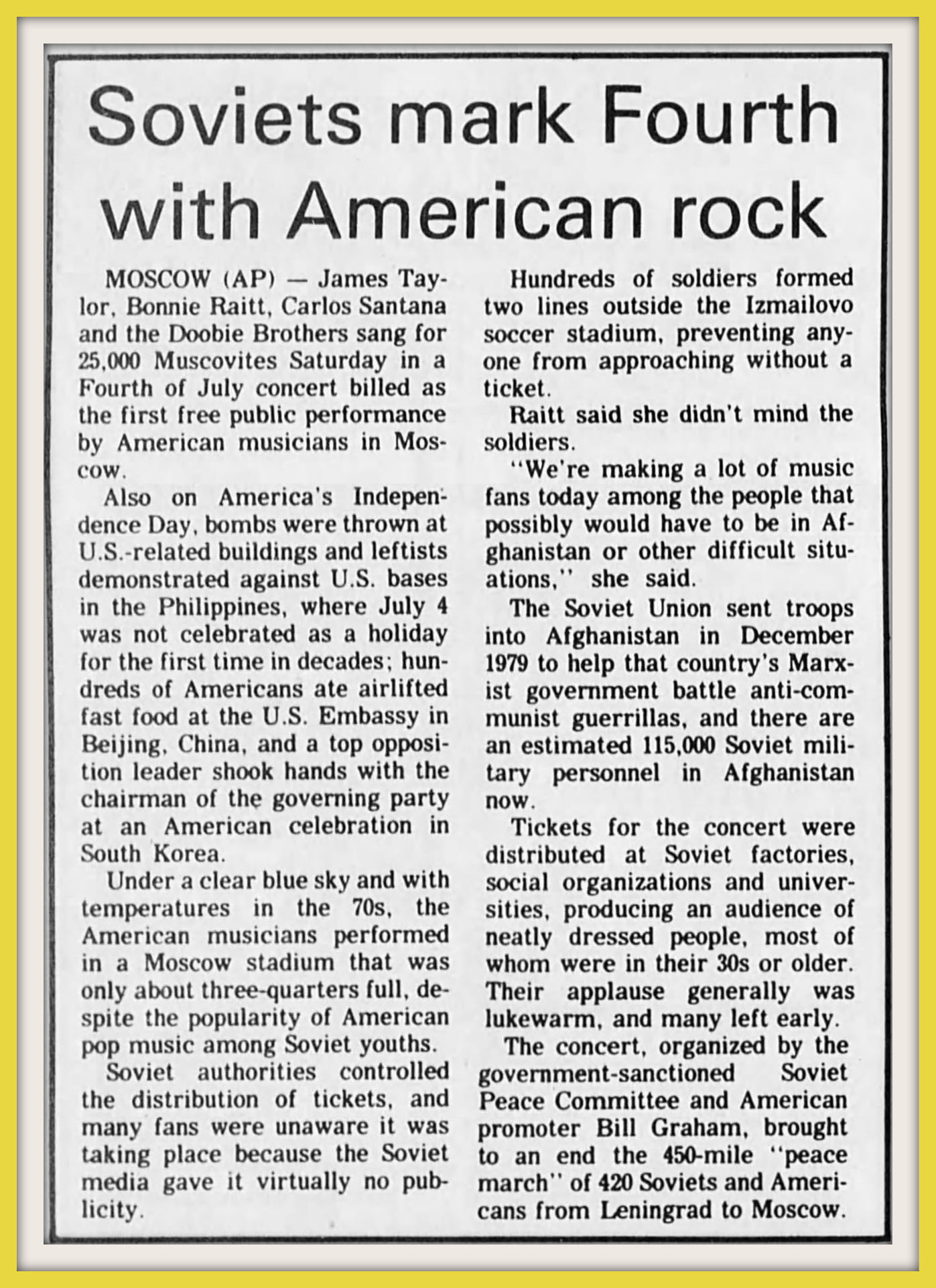
MOSCOW (AP) — James Taylor, Bonnie Raitt, Carlos Santana and the Doobie Brothers sang for 25,000 Muscovites Saturday in a Fourth of July concert billed as the first free public performance by American musicians in Moscow.
Also on America s Independence Day, bombs were thrown at U.S.-related buildings and leftists demonstrated against U.S. bases in the Philippines, where July 4 was not celebrated as a holiday for the first time in decades; hundreds of Americans ate airlifted fast food at the U.S. Embassy in Beijing, China, and a top opposition leader shook hands with the chairman of the governing party at an American celebration in South Korea.
Under a clear blue sky and with temperatures in the 70s, the American musicians performed in a Moscow stadium that was only about three-quarters full, despite the popularity of American pop music among Soviet youths.
Soviet authorities controlled the distribution of tickets, and many fans were unaware it was taking place because the Soviet media gave it virtually no publicity.
Hundreds of soldiers formed two lines outside the Izmailovo soccer stadium, preventing anyone from approaching without a ticket.
Raitt said she didn’t mind the soldiers.
“We’re making a lot of music fans today among the people that possibly would have to be in Afghanistan or other difficult situations,” she said.
The Soviet Union sent troops into Afghanistan in December 1979 to help that country’s Marxist government battle anti-communist guerrillas, and there are an estimated 115,000 Soviet military personnel in Afghanistan now.
Tickets for the concert were distributed at Soviet factories, social organizations and universities, producing an audience of neatly dressed people, most of whom were in their 30s or older. Their applause generally was lukewarm, and many left early.
The concert, organized by the government-sanctioned Soviet Peace Committee and American promoter Bill Graham, brought to an end the 450-mile “peace march’’ of 420 Soviets and Americans from Leningrad to Moscow.
Austinites looking for another excuse to party found a good one Monday at the fifth annual Riverfest, which attracted thousands of young and old alike. The credit for youngest in attendance probably goes to 7-week-old Cherie Ann Hardy of Austin. No one was willing to take credit for being the oldest. “She enjoys the music,” said mom Gail Hardy as her husband, Tony, tried to cool off the infant whose hair was plastered to her head with sweat.
Keeping cool was almost as important to the other estimated 10,000 music aficionados who gathered at Auditorium Shores to listen to the LeRoi Brothers; Bill Carter and the Blame; Nick Lowe; Bonnie Raitt; Omar and the Howlers; Gregg Allman; Robert Cray; and the headliner, the Fabulous Thunderbirds. Not all the celebrities were performing. Actress Margot Kidder and Dennis Quaid, who has been filming D.O.A. around Central Texas, were seen hanging around backsatage. The music seemed to be incidental at times as the audience kept itself entertained by tossing footballs, Frisbees and Hackey Sacks and cooled off either by eliminating a lot of clothing or by consuming large quantities of refreshments.
Many seemed to opt for both. One beer distributor estimated about 3,600 cases of the brew would be consumed by the end of the day. It was kept cold by 1,200 bags of ice, each weighing about 40 pounds. Television camera crews posed themselves strategically in front of scantily clad bodies in quest of the per- Kent ‘Omar’ Dykes works up to a howl for a crowd estimated at 10,000 at Monday’s Riverfest. Staff photo by Zach Ryall fect tan and there were cameras aplenty.
Charles Comer, publicist for the Thunderbirds, said coverage was provided by MTV; Video Hits; Much Music out of Canada; Fox TV of Canada; the local ABC, NBC and CBS affiliates; and crews from Sweden and Norway. Not everyone was thrilled to be at the Riverfest. Kimber Avery of Austin: was upset at not being allowed to bring a cooler filled with food and refreshment onto the grounds after paying $13 for tickets. She and a group of friends set up camp just outside the entrance to consume their sandwiches and drinks. “The prices are ridiculous,” she said as she sat near the curb of the street.
“Can you imagine $2 for a beer?” Some didn’t even bother trying to get in. Blankets dotted the slopes around Palmer Auditorium as those who wanted to listen to music without paying set up camp. Others decided renting canoes and hanging around the banks of the river was preferable, although it meant getting a rear view of the action on stage.
Bandana Blues is and will always be a labor of love. Please help Spinner deal with the costs of hosting & bandwidth. Visit www.bandanablues.com and hit the tipjar. Any amount is much appreciated, no matter how small. Thank you.
Bonnie Raitt is nothing if not loyal. And when she caught wind of the fact that Mike Reid and I were writing and recording together, she was quick to volunteer to sing on our song “The Bridge.” It’s one of my favorite songs Mike and I have written. And I can no longer imagine it without her heroic spirit present. ~ Joe Henry
Released on: 2025-09-05 Producer: Joe Henry Music Publisher: Rivers and Roads Music (ASCAP - admin by Endurance Music Group) Music Publisher: Mule Rider (ASCAP) Music Publisher: Blue Raincoat Music (ASCAP) ℗ 2025 Work Song Inc. marketed and distributed by Thirty Tigers
{{svg_quality_icon}}
{{quality-options}}
1
http://i3.ytimg.com/vi/VWNoTHkp6_k/hqdefault.jpg
Prison Bound Blues · Bonnie Raitt
Bonnie has contributed a new recording of "Prison Bound Blues" written by Leroy Carr to a project called Better Than Jail, an extraordinary new album benefiting Free Hearts and Equal Justice USA. Better Than Jail is available everywhere today and features covers of iconic prison songs from Steve Earle, Taj Mahal,Margo Price, The War and Treaty and many more. The album seeks to raise awareness and support for the urgent need to reduce the harm of the criminal justice system. https://found.ee/BetterThanJail.
I'm so proud to have joined in with so many illustrious artists in creating this very special album in support of rural prison reform. Overlooked for far too long, this issue cuts across all cultural and political divides and deserves all our focused attention to finally bring about some swift and meaningful action. Better Than Jail is one of the most inspired and heartfelt albums I've been blessed to be a part of and I hope it sets a fire in hearts far and wide to join in our efforts." ~ Bonnie Raitt
Released on: 2024-10-04 Executive Producer: Brian Hunt Producer: Kenny Greenberg Producer: Wally Wilson Producer: Bonnie Raitt Recording Engineer: Jason Lehning at Sound Emporium Mastering Engineer: Alex McCollough at True East Mastering Production Assistant: Shannon Finnegan Mixer: Justin Niebank at Hounds Ear Music Publisher: Universal Music Corp. Composer, Lyricist: Leroy Carr ℗ Believe Entertainment Group and Wyatt Road Records
{{svg_quality_icon}}
{{quality-options}}
1
http://i3.ytimg.com/vi/xC2BJuQbO8w/hqdefault.jpg
The Fabulous Thunderbirds - Nothing in Rambling Ft. Bonnie Raitt, Taj Mahal, Keb' Mo' & Mick Fleetwood
In celebration of the band’s 50th Anniversary, The Fabulous Thunderbirds have just released Struck Down, their first studio album in eight years on Stony Plain Records. The ten-track album includes a wonderful cover of Memphis Minnie’s “Nothing in Rambling,” featuring longtime friends, T-Birds founding member Kim Wilson, along with Bonnie, Keb’ Mo’, Taj Mahal and Mick Fleetwood. — BRHQ
{{svg_quality_icon}}
{{quality-options}}
1
http://i3.ytimg.com/vi/YmW-bgcbvQI/hqdefault.jpg
Little Feat - Long Distance Call
“I’ve always loved Little Feat and this new incarnation of the band is bringing some serious heat, cred and new blood to their enduring legacy. Every Feat fan loves us some Sam. I’m so glad he’s now gotten a chance to step out front and center and put his spin on these wonderful blues songs. I loved singing "Long Distance Call" with him, always one of my favorites, and Scott slayed on slide. Know you’ll enjoy hanging out with us at Sam’s Place!" -- Bonnie Raitt
“Long Distance Call” was written by blues legend, Muddy Waters. It has Sam Clayton and Bonnie Raitt on vocals, Scott Sharrard on Dobro, Fred Tackett on acoustic guitar, Tony Leone on drums, and Michael “The Bull” LoBue on harmonica. The album also features Bill Payne on piano and Kenny Gradney on bass.
Little Feat have composed an album that’s their love letter to the blues entitled, ‘Sam’s Place.’ “Long Distance Call” plus many other blues classics are on this album. You can stream and order ‘Sam’s Place’ here: https://orcd.co/samsplace
Broken Hearts & Dirty Windows: Songs of John Prine, Vol. 2, the anticipated new John Prine tribute record from Oh Boy Records, is out today. Stream/purchase HERE.
Created as a celebration of Prine’s life and career, the album features new renditions of some of Prine’s most beloved songs performed by Brandi Carlile (“I Remember Everything”), Tyler Childers (“Yes I Guess They Oughta Name A Drink After You”), Iris DeMent (“One Red Rose”), Emmylou Harris (“Hello In There”), Jason Isbell (“Souvenirs”), Valerie June (“Summer’s End”), Margo Price (“Sweet Revenge”), Bonnie Raitt (“Angel From Montgomery”), Nathaniel Rateliff & The Night Sweats (“Pretty Good”), Amanda Shires (“Saddle in the Rain”), Sturgill Simpson(“Paradise”) and John Paul White (“Sam Stone”). Proceeds from the album will benefit twelve different non-profit organizations, one selected by each of the featured artists.
{{svg_quality_icon}}
{{quality-options}}
1
http://i3.ytimg.com/vi/Z71L4JdrVBY/hqdefault.jpg
Bonnie Raitt - Write Me a Few of Your Lines/Kokomo Blues
60 years anniversary celebration of Arhoolie
December 10, 2020
{{svg_quality_icon}}
{{quality-options}}
1
Arhoolie Foundation celebrates it's 60th anniversary (1960-2020) with an online broadcast.
Bonnie Raitt - Shadow of Doubt
Hardly Strictly Bluegrass Festival
October 3, 2020
Hardly Strictly Bluegrass celebrates it's 20th anniversary with an online broadcast titled “Let The Music Play On”.
{{svg_quality_icon}}
{{quality-options}}
1
http://i3.ytimg.com/vi/hCJa0505jZk/hqdefault.jpg
Bonnie Raitt & Boz Scaggs - You Don't Know Like I Know
Farm Aid 2020 On the Road
Sam & Dave classic written by Isaac Hayes and David Porter.
{{svg_quality_icon}}
{{quality-options}}
1
http://i3.ytimg.com/vi/jXG6ULcK-qs/hqdefault.jpg
Sheryl Crow & Bonnie Raitt - Everything Is Broken
[Eric Clapton’s Crossroads 2019]
Eric Clapton, one of the world’s pre-eminent blues/rock guitarists, once again summoned an all-star team of six-string heroes for his fifth Crossroads Guitar Festival in 2019. Held at the American Airlines Center in Dallas, Texas, the two-day concert event raised funds for the Crossroads Centre in Antigua, the chemical dependency treatment and education facility that Clapton founded in 1998.
{{svg_quality_icon}}
{{quality-options}}
1
http://i3.ytimg.com/vi/yHeBLEo4TOM/hqdefault.jpg
'A Tribute To Mose Allison'
Celebrates The Music Of An Exciting Jazz Master
Raitt contributed to a new album, If You're Going To The City: A Tribute To Mose Allison, which celebrates the late singer and pianist, who famously blended the rough-edged blues of the Mississippi Delta with the 1950s jazz of New York City.
NPR's Lulu Garcia-Navarro talks to Bonnie Raitt about her friendship with the Mose Allison. They're also joined by Amy Allison — his daughter, who executive produced the album — about selecting an unexpected list of artists to contribute songs to the album.
Recorded on tour June 3, 2017 - Centennial Hall, London - Ontario Canada

















 Users Today : 291