Event

CELEBRATING WITH: John and Bonnie Raitt; Like Father, Unlike Daughter

on February 2, 1994 No comments
buttons_01

By ALEX WITCHEL
Published: February 2, 1994

“IS that Bonnie?”

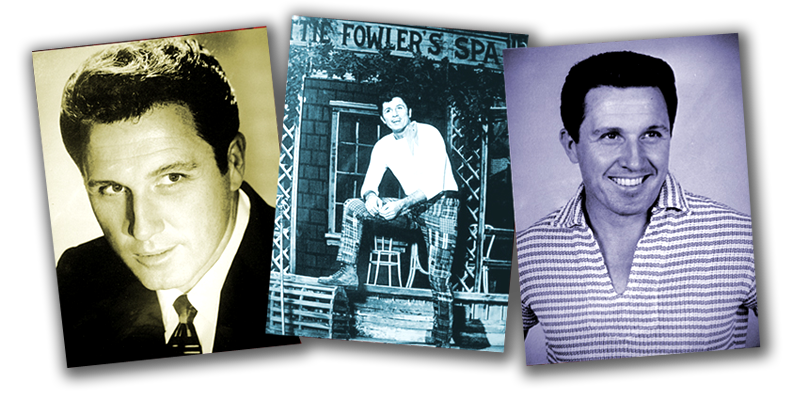
The fan is young, in his mid-20’s, and he looks at Bonnie Raitt, seven-time Grammy winner, as she walks down the street, with love in his eyes and lust in his heart. But who is that with her, that tall, still-dapper white-haired man in the black leather jacket? The fan seems puzzled. It is her father, John Raitt, who was the original Billy Bigelow in “Carousel” on Broadway in 1945 and Sid Sorokin in “The Pajama Game” in 1954, and who last week came to New York to be inducted into the Theater Hall of Fame. By his daughter.
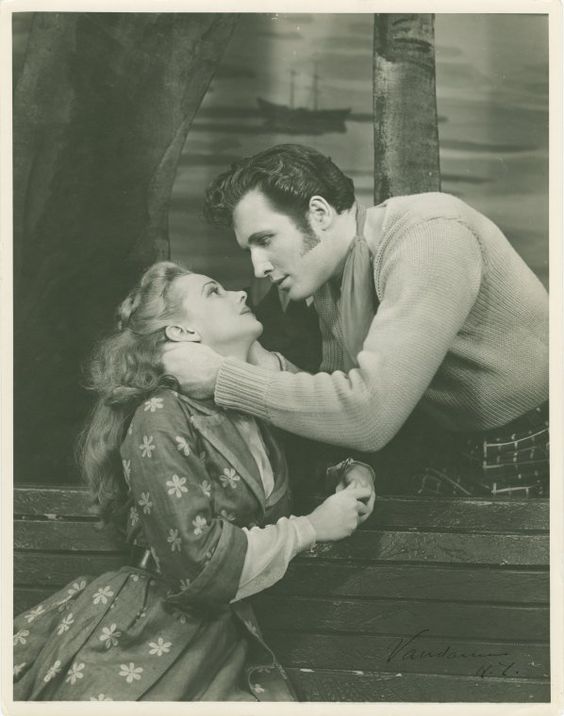
Jan Clayton (Julie Jordan) and John Raitt (Billy Bigelow) in Carousel (1945)

“I’m partial, but I still think he’s the greatest singer the musical theater ever produced,” Ms. Raitt says, in her father’s suite at the Wyndham Hotel. “He makes the character so believable. To be his daughter and watch him kill himself in ‘Carousel’ was very heavy for me. It was hard to separate. What has stood the test of time is his astounding ability to bring emotion to a song, singing from his soul with this incredible, heroic voice.”

“That’s very nice, Bonnie,” Mr. Raitt says, a little choked up.

“Nobody does it the way you do, Dad. Boohoo, I’m never going to get through this speech tonight,” she says, starting to laugh with nerves over the induction ceremonies at the Gershwin Theater, where the Theater Hall of Fame is housed. “People come up to me all the time who saw Dad in ‘Oklahoma!’ or ‘Pajama Game,’ and they say they’ll never forget it.”

Ms. Raitt’s own career path rarely felt as effortless as her father’s. She dropped out of Radcliffe College in the late 1960’s to pursue her music, and later stubbornly refused to compromise her blues-oriented rock to the industry’s more mainstream standards. And in the mid-1980’s she acknowledged and began to treat an alcohol addiction. Growing up with a dad who epitomized the romantic leading man, squeaky clean and always on the side of right, the two seem a classic in opposites.

But, at 44, Ms. Raitt has found that the world has caught up with her music and then some (her album “Nick of Time” sold four million copies in 1990, and her 1992 “Luck of the Draw” sold five million). She is also happily married to the actor Michael O’Keefe. She has come to celebrate her father today and she means it.

Mr. Raitt, who turned 77 on Saturday, is equally proud of his daughter and seems glad that she can appreciate her old man and his music.

“There’s something great about the intimacy of the legitimate theater,” he says. “I’ve played leading man roles for 54 years — never stopped.”

Ms. Raitt says: “Now he does what we call the white hair roles — ‘Zorba,’ ‘Man of La Mancha,’ ‘Shenandoah.’ Wonderful, philosophical roles that say things right to his age.”

Mr. Raitt has continued to play his larger-than-life characters for the last 25 years or so, primarily in summer stock and touring companies, while Broadway has turned host to Vegas-type spectacles with ensemble casts. He always returns to Southern California, where he has lived all his life and where Bonnie grew up.

“Lunt and Fontanne said if you want longevity, stay off both coasts and play where the people are,” he says. He has been true to his word, even playing Tevye in “Fiddler on the Roof” in Ruston, La. Well, that was a stretch, no?

“I wasn’t very good,” he admits.

“I’m sure you sang great,” Ms. Raitt says staunchly. “You did ‘Carousel’ until you were 63.”

Did he ever do ‘The King and I’? He shakes his head.

“The women would have a heart attack if he cut his hair off,” Ms. Raitt says. “My mom packed her suitcase when he cut those curls off for ‘Pajama Game.’ “

“Twenty years ago there were 40 theaters across the country that could afford me,” he says. “Only about 12 are left.” He sighs. “It’s the VCR’s.”

Undaunted, Mr. Raitt still tours a one-man show of his greatest hits and anecdotes, “An Evening With John Raitt,” and this Saturday night he will bring it to the Brooklyn Center for the Performing Arts.

“At his show,” Ms. Raitt says, “I sit in the audience and watch the women’s necks swooning a little and their husbands all say, ‘It’s not his hair, it’s not his teeth,’ and I say, ‘Oh, yes it is.’ Afterward he’ll sit and sign autographs for anyone who wants them. That lack of a stuck-up attitude has always been inspirational. He’s never snobby about taking theater out to the hinterlands.”

But he’s still competitive. Has he seen the Royal National Theater production of “Carousel,” due to open at the Vivian Beaumont in March, starring Michael Hayden, a 30-year-old actor winning raves for his Billy Bigelow? No, Mr. Raitt says, his eyes as flat as his voice. It seems impossible for him to imagine anyone else in the role. And with good reason.

“When I first came to New York to audition for the national tour of ‘Oklahoma!’ Rodgers and Hammerstein were there,” he says. “I asked to warm up first and sang in English from ‘The Barber of Seville.’ Dick and Oscar later said my doing that prompted the writing of ‘Soliloquy’ in Carousel. They said, ‘He may be our boy for the next show.’ “

Ms. Raitt says: “In the 40’s they made Billy Bigelow bigger than life, but now the reality is that he’s a pretty dysfunctional guy. I could see Al Pacino doing him in the film. I’m waiting for Ziggy Marley to play Billy Bigelow, and then I’ll see it.”

The phone rings. “Flowers coming up,” Mr. Raitt says. “Maybe they’re from the Hall of Fame people.”

“They might be from my husband,” she says.

Actually, they’re from Mary Martin.

“Your star shines bright on this historic day,” the note begins before going on to send love from the actress, who performed a famous television special of “Annie Get Your Gun” with Mr. Raitt in 1957 — and from Gene Kilgore, her secretary. Mr. Raitt doesn’t find it at all remarkable that a woman who died in 1991 has just sent him flowers.

“In my show, I always pay tribute to her,” he says. “An audience couldn’t possibly love her as much as she loved them.”

He points at his daughter. “You know, she got a lovely review from the critic in Boston when we did ‘An Evening at the Pops,’ ” he says, referring to a 1992 concert that was broadcast on PBS. Included in the program were their duets of Ms. Raitt’s “Blowing Away,” and “Hey There” from “The Pajama Game.”

“That man said she could be the next Mary Martin if she wanted to,” Mr. Raitt says.

Ms. Raitt smiles. Clearly, she doesn’t.

“I was always drawn to the blues,” she says. “Alberta Hunter at the Cookery was a life-changing experience. I only wanted to get enriched as a performer as I got older, to have an audience which got older, too, and would come to see me when I’m 80. And I didn’t have a legit trained voice. My love was Bob Dylan. But,” she concedes to her father, “as I got older I realized a good ballad was a good ballad.”

He is considerate in turn. “On the 50th anniversary of ‘Oklahoma!’ last spring I sang the title song on the stage of the St. James before a preview of ‘Tommy.’ I said, ‘Most of you people know me as Bonnie’s father.’ “

Rosemary Raitt comes in from the bedroom. She and Mr. Raitt were college sweethearts but didn’t marry then because she was Catholic and Mr. Raitt was Presbyterian (he later became a Quaker, and a conscientious objector during World War II). He first married Marjorie Haydock, with whom he had Bonnie; her older brother, Steven, who is a sound technician and designer, and her younger brother, David, a musician and builder of yurts, which are Mongolian round houses. After the couple divorced he married Kathleen Landry, and when they divorced, 14 years ago, Mr. Raitt heard from a close friend in his hometown of Santa Ana, Calif., that Rosemary had been widowed.

“Having played Zorba, I believe in grabbing at life,” Mr. Raitt says. “So I called and this lovely voice answered. ‘I’m free now,’ I told her, ‘and coming to dinner.’ First she had the typical woman’s response, that her hair was in curlers. And I said, ‘How long will it take you to get ready?’ And she said 45 minutes. Then I got nervous because the last time she had seen me I was a dark, curly-headed guy.

She was nervous, too, and she said to me, ‘What do you see?’ And I said, ‘The same eyes.’ About two weeks later I brought my suitcases and said ‘I’m spending the rest of my life with you.’ So in 1981 we were married, 41 years later. Bonnie sang one of her songs at our wedding.”

“It was ‘Safe In Your Arms,’ ” Ms. Raitt recalls. “I could hardly get it out.”

He returned the favor by singing “My Heart’s Darling” from the Broadway show “Three Wishes for Jamie” at her wedding in 1991. The memory prompts him to sing a verse right now.

“It stopped the show opening night,” he claims.

“It stopped the wedding, Dad,” she counters.

The first time Ms. Raitt saw her father on stage she was 5 years old. “It was ‘Pajama Game’ on Broadway and I remember being backstage with you and Eddie Foy putting on makeup and running around in your underwear,” she says.

As she speaks, he says, “I never had my kids backstage.”

They laugh. Certainly, after all these years their differences are apparent. But how are they similar?

They both look blank. “Well,” Ms. Raitt finally says, “I think we have the same dedication when it comes to our talent.” He nods. “I don’t want to get another job and neither do you,” she says. “We’ll do anything to keep this gig.”

Of the 1,060 performances of “The Pajama Game” Mr. Raitt played on Broadway, he missed only one, because of laryngitis. Ms. Raitt says that in 22 years she has missed only two shows. “On stage the adrenaline suppresses the illness and you can sing yourself well,” she says. “I’ve got good genes.”

And what was the downside of having a leading-man father who looked so perfect and always did the right thing?

“It was hard to let him be a human being,” she says without hesitation, “and he’d be gone on tour for weeks.” She looks at him, and though his face doesn’t change, in that moment they seem to mutually agree to drop the downside, pronto.

“He was always so athletic, handsome, youthful,” she goes on lightly, “not the stern dad type. He was hipper than other dads, with sideburns, all buff. And we had really cool cars.”

So, on this day of reflection, does he have any regrets?

“No,” he says. “I always held out for quality shows. I am most proud of what I maintained in my career, bringing theater to the people who can’t usually get to see it, without insulting their intelligence.”

“He never sold out for a quick buck,” Ms. Raitt says. “If he did Vegas he would have been a bigger star, but he didn’t want to sing for drunks and hecklers, and neither do I. To this day I’d rather play small college audiences than big clubs. I always thought there was something really cool about being the underdog and playing just for the people who want to hear it. To have a nice moderate career for a long time versus a big, splashy one for a short time. I was always angry that people weren’t writing shows for my dad. But by the 70’s, that leading man type of hero wasn’t in vogue to write shows around.”

Later that night, at the Hall of Fame induction that honored the era when those shows were written, Ms. Raitt spoke eloquently. After Mr. Raitt thanked her, he encouraged the audience to sing along with him the last 16 bars of “Oklahoma!” People looked uneasy. But he started without them, his voice forceful and strong. And as he swung his arm high in the air with an imaginary lasso, his daughter watched him turn young again, and vital, and the theater was filled with life.
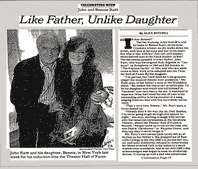
Photos: John Raitt and his daughter, Bonnie, in New York last week for his induction into the Theater Hall of Fame. (Sara Krulwich/The New York Times) (pg. C1); John Raitt in 1966, with his children Bonnie and Steven and their mother, Marjorie, in his dressing room at the Mark Hellinger Theater, when he was appearing in “A Joyful Noise.” (United Press International) (pg. C8)
(Edit: saved this article but couldn’t retrieve the photos)


Source: © Copyright The New York Times
Info: The Theater Hall of Fame

But wait, there's more!

Convention Gives Way at Southland Festivals : Keeping Folk Music Where It Belongs–in the Public Domain

on June 7, 1993 No comments
By ROBERT HILBURN

You expect to hear the names of such folk music landmarks as Woody Guthrie, Leadbelly and the Weavers invoked at a folk festival. But Elvis Presley?

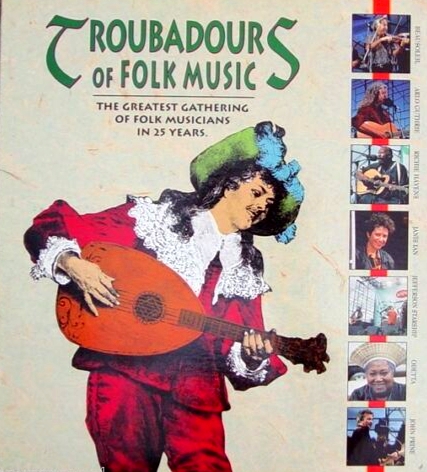
It was Woody’s son, Arlo Guthrie, who brought up Elvis during the opening day of the “Troubadours of Folk” festival Saturday at UCLA’s Drake Stadium–and his story and song proved one of the most illuminating moments in the sometimes unwieldy but generally endearing 11-hour affair, which ended around 10 p.m.

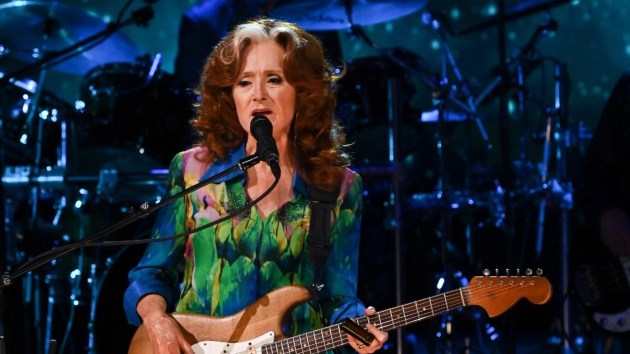
Bonnie Raitt with John Prine during their performance at the Troubadours of Folk Festival at Drake Stadium on the UCLA campus,  LA, CA - June 5, 1993
+ 10
Bonnie Raitt with John Prine during their performance at the Troubadours of Folk Festival at Drake Stadium on the UCLA campus,  LA, CA - June 5, 1993
Bonnie Raitt with John Prine in Los Angeles June 5, 1993

Joni Mitchell and John Prine contributed the day’s most rewarding performances, and guest appearances by Bonnie Raitt and Tom Petty added glamour, but Guthrie’s story about Elvis defined the magic that is folk music.

Guthrie told of being with folk music icon Pete Seeger at a European festival after the fall of the Berlin Wall. Knowing that many in the crowd of 30,000 couldn’t speak English, Seeger sang folk classics so familiar around the world that the audience had no trouble singing along.

{{svg_quality_icon}}
{{quality-options}}

John Prine – “Live at the Troubadours of Folk Festival 1993” UCLA, Los Angeles, CA. 1993-06-05

This is a nice John Prine concert recorded by Rick Williams. John introduced “Ain’t Hurtin’ Nobody” as a new song, written just a couple of weeks ago. Also nice to hear Bonnie Raitt joining Prine on a couple of songs.

00:00 Intro
00:20 Spanish Pipedream
03:33 Picture Show
07:49 You Got Gold
12:31 All the Best
16:59 Angel From Montgomery [w/ Bonnie Raitt]
22:21 Ain’t Hurtin’ Nobody [w/ Bonnie Raitt]
28:21 My Old Man (Steve Goodman cover)
32:51 It’s a Big Old Goofy World

John Prine – acoustic guitar, vocals
Bill Bonk – harmonica, electric guitar, mandolin
Phil Parlapiano – keyboards, accordion, mandolin, slide guitar
Benmont Tench – keyboards
Howie Epstein – bass
Debra Dobkin – percussion
Bonnie Raitt – vocals on “Angel From Montgomery” and “Ain’t Hurtin’ Nobody”
Lili Haydn – fiddle on “My Old Man”

After doing the obvious ones, including “We Shall Overcome,” Seeger good-naturedly challenged Arlo to come up with some more folk tunes with similar universality. Seeger, a folk purist, bristled when Guthrie said he was going to sing a Presley song.

As Guthrie began “Can’t Help Falling in Love,” the story went, the audience joined in as easily as before. Guthrie glanced over at Seeger, who was aghast. However, Seeger then slowly stepped to the microphone with his banjo–and began playing the song that he, too, knew so well.

The point, Guthrie said Saturday, is to forget all the definitions of folk music–and the snobbery that grows out of the idea that the music is the private property of a select group of artists or fans. One should simply look for songs that bind people together by underscoring their mutual humanity and heart.

Embed from Getty Images

More photo’s of the festival…

Guthrie then sang the Presley ballad and was joined by much of the crowd, which was estimated at 6,000–a turnout probably reduced from the organizers’ 15,000 goal by the threat of rain.

Saturday’s lineup–ranging from Janis Ian and Ted Hawkins to Leon Redbone and the Kingston Trio–echoed the message of Guthrie’s story. In fact, the show, which was taped for a PBS special, served as such a valuable primer on the breadth of folk music that it was fitting that the event–with its accompanying crafts exhibits and issue booths–was held on a university campus.

In her well-received, mid-afternoon set, Judy Collins touched on both matters of the heart and the conscience, opening with the romantic longing of her ‘60s hit “Someday Soon,” then focusing on the idealistic “Last Night I Had the Strangest Dream.”

The Folksmen, who followed, are the Spinal Tap gang in the striped shirts associated with the Kingston Trio and with the slightly archivist aura associated with the collegiate, hootenanny boom of the ‘60s. While in the right context the humor may prove as uproarious as the trio’s classic assault on heavy-metal music, it seemed underdeveloped Saturday.

Roger McGuinn, who was a Chicago folkie before moving to Los Angeles in the mid-’60s and helping pioneer folk-rock with the Byrds, was joined on various numbers by Richard Thompson, Odetta and Petty as he exhibited a winning respect for the folk music form on songs from both his Byrds and solo days.

After Guthrie, the Jefferson Starship delivered an “unplugged” edition that may reflect some wing of folk music. But there was no need to take more than an hour (including stage set-up time) to document their ham-fisted approach on a day when far more important artists were limited to 30 minutes or less.

If there were strong nostalgia components to many of the day’s performances and a strong ‘60s-wannabes vibe to the mostly thirtysomething and above crowd, Eric Andersen injected a ‘90s reality with a striking new song about the rise of neo-Nazi sentiments in Europe.

Similarly, the sets by Prine and Mitchell–two master songwriters–included a few old favorites, but concentrated on new material.

Backed by a four-piece band that included Benmont Tench on keyboards and Howie Epstein on bass, Prine sang two songs from his last album, the Grammy-winning “The Missing Years,” and one new, unrecorded tune. He was joined by Raitt on the new song and on “Angel From Montgomery,” which she recorded years ago.

It was late (almost 9 p.m.) and cold by the time Mitchell came on stage with her guitar for a rare performance that featured several new, unrecorded compositions–tunes that confirmed that Mitchell, whose “Night Ride Home” album last year was her most acclaimed in years, is going through another productive period.

In a surprise twist near the end of her set, she even gave Arlo Guthrie something to tell Pete Seeger about. She sang a song called “How Do You Stop,” which she learned from a 1986 album by another great folk-singer . . . James Brown.


Troubadours of Folk Music (TV Special 1996)

Source: © Copyright Los Angeles Times

But wait, there's more!

Bonnie Raitt does not want to be a pop star
Rock music’s great survivor tops the charts on her own terms

on August 23, 1991 No comments
By Ken Tucker

It’s four minutes before the taping of The Arsenio Hall Show, and Bonnie Raitt has lost something.

”Where’s my honey?” she asks plaintively, striding down a Hall hall. Following Raitt is her manager, Danny Goldberg, who has his own problems. He’s not sure he wants a reporter hanging around in the nervous minutes before the taping; then, too, another of his clients, Rickie Lee Jones, has shown up suddenly, and he wants to make sure she receives some of his dutiful attention as well. Nonetheless, Goldberg narrows his eyes and tries to concentrate on Raitt’s question.

”Now, Bonnie,” he says with a grim smile, ”by ‘honey,’ do you mean the stuff that soothes your throat, or that wonderful husband of yours?”

Raitt and Goldberg turn a corner in the maze of this Paramount television studio in Hollywood and the question is abruptly answered. ”There he is!” Raitt hoots, nearly bumping into actor, writer, and, yes, a real honey of a husband, Michael O’Keefe, who has been roaming the halls looking for his honey. They kiss, they grin, they look like what they are: newlyweds, married since April.

Everyone retreats to a tiny dressing room, where Goldberg is happy to report that in next week’s Billboard Raitt’s new album, Luck of the Draw, will remain a hit top-10-with-a-bullet success. With the first single from the album, ”Something to Talk About,” moving into the Top 40, Raitt has her second smash in a row — and her amazing comeback continues.

Before Bonnie Raitt released Nick of Time in 1989, she had received strong critical praise and the fervent admiration of a loyal following, yet in 18 years only two of her 11 albums had sold the 500,000 copies needed to make them gold records. Nick of Time changed all that by selling more than 2 million copies and bringing her a remarkable three Grammy awards — Album of the Year and best female vocals in both the rock and pop categories. At a time when many pop icons would rather prance and pose than play music, Raitt has come to stand for something more than just the great songs and progressive attitude that have always been her hallmarks. For the baby-boomer audience that has grown up with her and for the legion of younger fans she’s now attracting, the veteran of folk, blues, rock, hard times, and hard-won triumph transcends stardom: She embodies an emotional and artistic honesty and a survival instinct to be admired. And because of that, ironically, Bonnie Raitt has become a star at last.

She didn’t set out to be a pop star or even, exactly, a pop singer. Despite being the daughter of musical-comedy star John Raitt (Carousel, The Pajama Game), Raitt never embraced mainstream show biz. Given a guitar at the age of 8, she got hooked on folk music and the blues. By the time she was a teenager attending Radcliffe, she was moving up through the late-’60s Boston and Philadelphia folk scenes to establish her distinctive combination of bottleneck-guitar playing and no-bull frankness about romance, heartbreak, and bitterness.

From the start, Raitt was more wittily eclectic than any of her folk or blues heroes — her first two albums, Bonnie Raitt (1971) and Give It Up (1972), included songs from the Marvelettes, Robert Johnson, and Jackson Browne. Working out of Los Angeles, she struggled to achieve the commercial breakthrough that singer-songwriter contemporaries like Browne, Joni Mitchell, and the Eagles were enjoying, but without compromising her adventurous aesthetic. She made great music, but one after another, the albums flopped. The closest she came to a hit was a No. 57 single in 1977 — a cover of Del Shannon’s ”Runaway” that didn’t begin to suggest the depth and passion that her fervent following knew characterized her best work. The modest success of a song so atypical of her style seemed to throw her. ”Why the hell was that a hit?” she still asks. ”It made no sense to me.”

What followed was a series of increasingly uneven releases, each containing a few glowing high points. It wasn’t until Don Was, who produced Nick of Time, that she connected with someone who knew how to extract hits from her while clearing the way for her to make the straightforward, soulful music she’d always wanted.

”It touched me so much that Don was a real fan,” she says of the coleader of the group Was (Not Was), ”that he knew my work and respected it, and wasn’t trying to make me over into something else. I was able to use my past as a bedrock, and build something new on it.”

The out-of-nowhere triumph of Nick of Time has expanded her audience so dramatically that she is both surprised (again) and grateful. ”It’s unbelievable the way people react to me now,” Raitt says, laughing. ”It’s like I’ve become some living proof that there is justice in the world.”

At the Arsenio taping, Raitt and O’Keefe barely react to the good news about Luck‘s continuing commercial success, because her honey has Raitt in stitches doing a masterful impersonation of Martin Short doing a masterful impersonation of Bob Dylan as a rabbi. It’s easy to see why they get along: They’re both fast-talking wiseacres who like to discuss everything except the music biz, and their conversation zips from Zen (O’Keefe is a serious student of the stuff) to Berkeley in the Sixties, a PBS documentary they had loved the night before.

The taping goes well (Arsenio:””What does (winning all those Grammys) mean to you?” Bonnie: ”What it means is I get to smile a lot more”), and Raitt and her touring band perform rousing versions of two new Luck songs, ”Something to Talk About” and ”I Can’t Make You Love Me.” Backstage, the green room is filled with hangers — on and the show’s other guests, including Twin Peaks‘ Lara Flynn Boyle, out to promote her new film, Mobsters. Boyle is wearing a black sequined minidress which three women, any one of whom might be her mother, take turns yanking at, foolishly optimistic about the chances of forcing it to reach midway down her thighs.

”You look fabulous,” says one of the women.

Boyle, staring at the monitor as Raitt performs, murmurs, ”Yeah, well, I wish I looked as good as she sings.”

Raitt is sitting in a dark little grotto of a hotel restaurant off Sunset Boulevard, not far from where she and O’Keefe live, in the Hollywood hills. Relaxed and cheerful, she doesn’t look like a performer who’s just finished a month-long tour of Europe and is about to launch an extended series of American dates. Her pale skin is swirled with a mixture of freckles and wrinkles; she looks at once younger and older than her 41 years.

”I’ve always been very self-conscious about my looks,” she admits, ”and even more so now, when I’m being recognized, more and more people are coming up and talking to me and checking me out up close. I guess I feel that I look older than I feel, and in a way it’ll be a relief to reach an age where I can be all wrinkly because I’m supposed to be all wrinkly.” As a result, she seems genuinely alarmed at the prospect of being on the cover of this magazine. ”Oh, no — you don’t want me on the cover, do you?” she pleads. ”But you need young, beautiful girls to sell magazines! I mean, I’m worried your circulation will drop, and it’s such a nice young magazine!”

Indeed, Raitt’s compulsive modesty makes it difficult to secure new pictures of her — she routinely declines to be photographed — but that is the opposite of classic star vanity. ”You’re not dealing with Cher here,” says manager Goldberg. ”Bonnie is not the kind of person who thinks of herself as a walking media event, who wants to have her every move and expression documented.”

Perhaps looking to steer the subject away from her appearance, Raitt starts talking about Suzanne Pleshette, at a nearby table. ”She’s great — she’s got that rough, sexy voice,” she whispers. ”Anyone who managed to make Bob Newhart seem like an ideal husband — that’s a good actress, right?” Then Peter Boyle (The Dream Team) stops by to say hello. He and Raitt had met at various political rallies but haven’t seen each other in years. ”Hey Pete, you’ll be pleased,” says Raitt. ”I married an Irishman, and one with a great ass, too!” ”It’s an ethnic trait, I believe,” says the Irish Boyle.

After he leaves, Raitt mumbles something about the crazy world of show business, and offers opinions on everything from Roseanne Barr (”Why do people give her such a hard time? She’s a really smart, very up-front feminist. She’s always been nice to me; I barely know her, and she and Tom sent us flowers for our wedding”) to Thelma & Louise: ”Wasn’t it wonderful? I cheered and clapped involuntarily when Susan Sarandon shot that guy who was trying to rape Geena Davis — Michael looked at me like I was from the moon. I’ll bet a movie like Thelma & Louise will change some people’s lives, especially women’s, for the better.”

Raitt’s strong opinions, taken with the steely, unsentimental music on Luck, should allay any fears that her recent good fortune is turning her into a softy. Luck moves beyond the sort of my-baby-broke-my-heart songs that used to dominate Raitt records to grapple with questions of commitment and marriage. The most moving of these is ”One Part Be My Lover,” which she cowrote with O’Keefe.

”People ask me if I’ve lost my edge because of all the good things in my life now,” she says. ”Well, no matter how nice things get, I’m not gonna turn into John Denver and start writing ‘Rocky Mountain High’ — you don’t have to worry about that.”

She grins a little grimly. ”You know why I say that? Because no matter how popular I may get, I just don’t relate to the mainstream. My parents were like that, and it’s the way I felt when I was a kid, when Vietnam War protesters felt that the world was divided into Us against Them. Basically, I still feel that way, I think. The rest of the world is this jingoist, mean mess.”

If her new success has caused Raitt any problems, they have to do with adjusting to the intense examination that pop stardom brings. Soon after expressing these opinions, for example, she starts worrying whether she should be speaking out so forcefully. ”I used to express my opinions virulently — partly because I never believed people were reading what I was saying,” she says. ”But most of the time I feel a desire to be more closed-in since I got more famous. The glare of the spotlight is more powerful than I was expecting, and I can see now where spouting off about people can really hurt them. I started going out with Michael just as I was becoming more well known, and seeing my personal life written about really threw me. My life was never under that kind of scrutiny before.”

Raitt grows more somber, because she knows where this line of chatter is inevitably leading — to that most highly scrutinized aspect of her recent life: her newfound sobriety after many years of heavy drinking and fitful drugging. Her low point came about five years ago, when, having been dropped by her career-long label, Warner Bros., she was without a record contract, romantically bereft, and ”just about broke.”

”I’d go to visit my father, and I think he was really scared, because he saw me collapsing inside myself, right in front of his eyes. I mean, I wasn’t stumbling around, doing a Foster Brooks-drunk thing, but I was bloated and depressed and I wasn’t responsive. I couldn’t think beyond myself, about how miserable I was. It was easier to deal with life if I was loaded for at least half the day.”

In early ’87, Raitt finally entered a substance-abuse program. You can hear in her voice a profound relief mixed with guardedness when she speaks of it. ”You’re not supposed to talk much about these programs — that’s why they’re anonymous. But I needed to get back some self-respect. And it was as if, having taken that first step toward getting sober, I was rewarded. I got signed to Capitol and hooked up with Don Was and we made Nick of Time; then I met Michael and fell in love. Then the Grammys, and…” She takes a sip of cappuccino that’s getting cold. ”I know it sounds like a bad movie, but I’m really glad I decided to stick around and enjoy my life and the people around me.”

The people around Raitt include, most devotedly, her parents, with whom she has remained close throughout everything. They are divorced — her mother, Marjorie Haydock, lives in Connecticut, her father in Los Angeles. ”My dad is 74 and he’s out on the road, touring in Man of La Mancha. He does eight shows a week — it’s unbelievable! When we’re both in L.A., I go over to his house and swim in his pool while he jogs around it — and we sing Christmas carols to each other. Every time we do that, I wish I was videotaping it, because it’s such a crazy scene, but such a sweet one, too.” Father and daughter are considering doing a Broadway show together. ”The Double Raitts,” she laughs, ”wouldn’t that be great? I’ve talked with a Broadway production company and they think there’d be an audience for it. He’d sing some of my songs, I’d sing some of his, and we’d do a few duets.”

For now, though, there is the work of touring. Pushing aside her plate, Raitt lays her head on the table and emits a mock groan. ”Oh, it’s hard work!” Then her head pops up and she smiles. ”Before Nick of Time, I was bored with it, but not anymore, because after all those years of playing the same clubs in the same towns, I’m playing different halls — much bigger ones, with some new people in the audience who aren’t going to just be calling out for songs from my first album 20 years ago.” And, as always, Raitt tries to involve her audience with her political concerns. In a number of cities, as she has for many years, she will raise money for various left-liberal causes, ”especially abortion rights this time, that’s really the crucial issue out there right now.”

For so socially involved a performer, it’s interesting that Raitt avoids sloganeering in her work. ”I can’t write songs about what’s wrong with a country that seems to lack compassion for pain and suffering,” she says. ”I’ve never written one that works as both a statement and a piece of music. Besides, I never really know what I’m going to end up with when I write — it’s kind of haphazard. Marriage is the same thing — I have no idea what I’m doing, and that’s what makes it so exhilarating.”

Dinner is over, and Raitt goes over to compliment the pianist who has been playing discreetly dry versions of pop standards in the hotel bar. She introduces herself, but she needn’t have: ”I swear, I bought Luck of the Draw two days ago!” says the young fellow. As Raitt walks to the door, the pianist calls out, ”I’ll try playing ‘Nick of Time!”’

”Naw,” Raitt says over her shoulder, ”you’ll give yourself a hernia — it’s a real hard song to play on the piano. Stick to Cole Porter — he’s a better songwriter.”


Source: © Copyright Entertainment Weekly
But wait, there's more!