BONNIE RAITT is an intriguing talent, firmly rooted in the music of men like Otis Rush and Fred McDowell whom she met and worked with in her late teens.
She has an inherent quality in her voice, in her interpretation of a song, not just admirably suited to contemporary blues but ready to give them the kind of fearless personal exposure and involvement that has made me regard her as a walking miracle. Aside from that she is also an excellent musician – playing acoustic, electric and bottleneck with power and fire. You will have noted that where Bonnie Raitt moves I follow lauding – though not, I hope, blinded.
So far she has been an inconsistent album talent, switching producers over five sets – the best still being Taking My Time put together by John Hall with Lowell George’s spirited ear never too far away – yet never hitting the market as a viable commercial entity. After the last minor disaster Streetlights with Jerry Ragavoy, Bonnie Raitt was set to cut this next album in an optimistic mood. She’d just completed a sell-out US tour with her fine band – Freebo, Will McFarlane, Dennis Whitted and Jai Winding; she was going into the studios with Paul Rothchild whose previous struts included Paul Butterfield sessions. So far so good. She felt the album would be ‘nice, bluesy, kind of backyard music.’
Well it ain’t. Unless Ms Raitt’s backyard is a less exciting place than I’d imagined. Home Plate certainly isn’t a bad album in the general sense of the word. I suspect some people will even consider it her best so far and others will put it on as background music and settle in to it quite happily. It may even sell more than the others. But far from giving Raitt the kind of sympathetic kick that Hall gave her for Time, Rothchild seems to have been more concerned with turning her into an all-round attractive vocalist. Now this is what Bonnie isn’t. She is not one of the hundred good LA backup singers. She works best on material that gives her room to manoeuvre and feel her way in, she needs a challenge. Give her a selection of songs she can sing in her bath and she’ll turn in a competent but unstartling performance. Give her arrangements that are heavy with strings, fussy, groaning under the weight of backing vocals mixed to the front – however impressive the list may be, with Tom Waits, Emmylou Harris and Jackson Browne – and she stops bruising herself on the songs. And that’s what Rothchild has done. (If he did it with Ms Raitt’s blessing so much the worse.)
A lot of songs here are lightweight anyway – Toussaint’s ‘What’s The Boy To Do’, simply pleasant when it could have been liberated (she said she’d do a boy’s blues one day); the Halls’ ‘Good Enough’, springy when it could have been chunky; ‘Walk Out The Front Door’, unmemorable. ‘Pleasin’ Each Other’ with Jerry Jumonville’s sax solo and Souther’s ‘Run Like A Thief’, with Will McFarlane’s guitar run only to be ruined by the dreadful intrusion of the backup, come close. But the nearest she comes to getting down are on Nan Byrne’s Rabelaisian ‘Sweet & Shine Eyes’; Kin Vassy’s struggling ‘My First Night Alone Without You’, and ‘Sugar Mama’ where Bonnie plays her one and only guitar break on slide alongside Hall’s lead and the result makes you long for more.
Home Plate is a bland uneventful album – a musical marshmallow tied up with too much blue ribbon. There’s no fine intelligence overseeing it. Raitt is an honest, awkward, sometimes brilliant artist yet to realise her full potential. Rothchild has managed to make her sound bland, has knocked all the black and blue out of her voice, made her a nice white lady. I’m off to play Taking My Time.
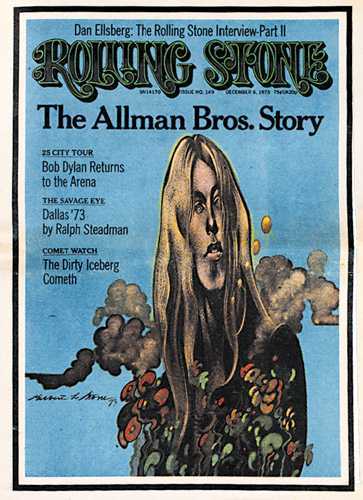
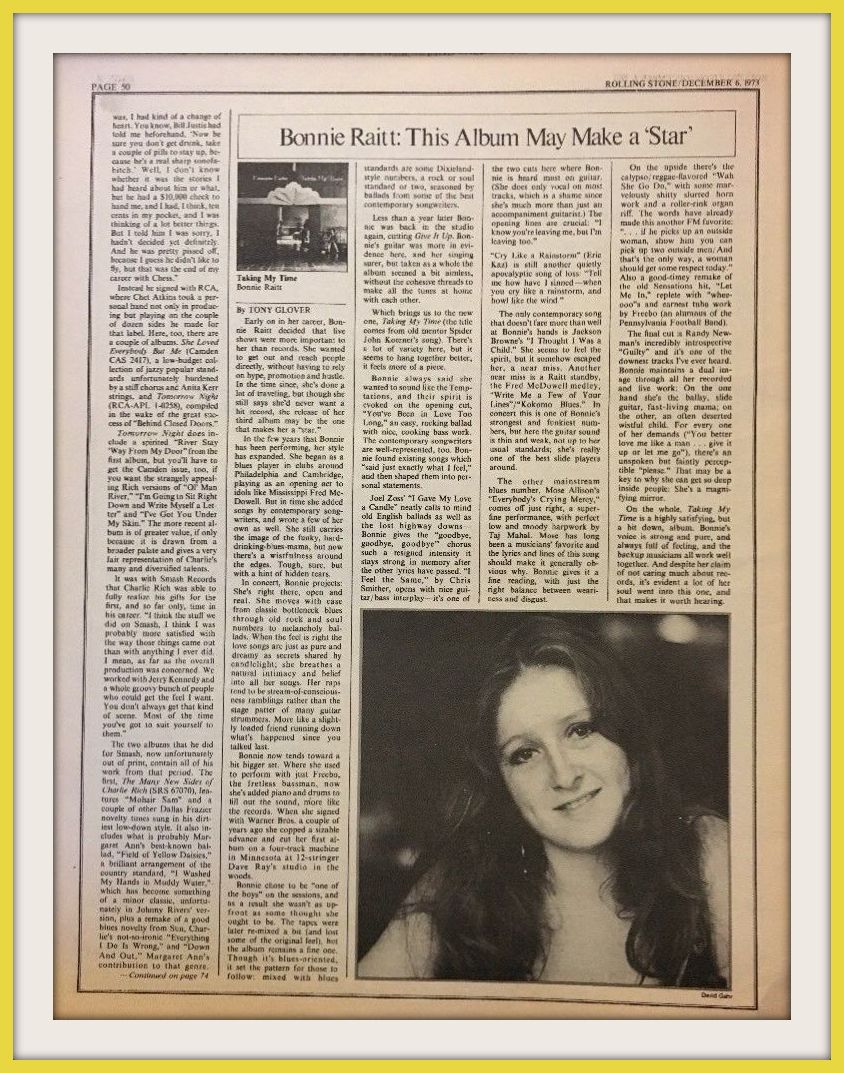
Rolling Stone #149 – December 6, 1973 By TONY GLOVER
Early on in her career, Bonnie Raitt decided that live shows were more important to her than records. She wanted to get out and reach people directly, without having to rely on hype, promotion and hustle. In the time since, she’s done a lot of traveling, but though she still says she’d never want a hit record, the release of her third album may be the one that makes her a “star.”
In the few years that Bonnie has been performing, her style has expanded. She began as a blues player in clubs around Philadelphia and Cambridge, playing as an opening act to idols like Mississippi Fred McDowell. But in time she added songs by contemporary songwriters, and wrote a few of her own as well. She still carries the image of the funky, hard-drinking-blues-mama, but now there’s a wistfulness around the edges. Tough, sure, but with a hint of hidden tears.
In concert, Bonnie projects: She’s right there, open and real. She moves with ease from classic bottleneck blues through old rock and soul numbers to melancholy ballads. When the feel is right the love songs are just as pure and dreamy as secrets shared by candlelight; she breathes a natural intimacy and belief into all her songs. Her raps tend to be stream-of-consciousness ramblings rather than the stage patter of many guitar strummers. More like a slightly loaded friend running down what’s happened since you talked last.
Bonnie now tends toward a bit bigger set. Where she used to perform with just Freebo, the fretless bassman, now she’s added piano and drums to fill out the sound, more like the records. When she signed with Warner Bros. a couple of years ago she copped a sizable advance and cut her first album on a four-track machine in Minnesota at 12-stringer Dave Ray’s studio in the woods.
Bonnie chose to be “one of the boys” on the sessions, and as a result she wasn’t as upfront as some thought she ought to be. The tapes were later re-mixed a bit (and lost some of the original feel), but the album remains a fine one. Though it’s blues-oriented, it set the pattern for those to follow: mixed with blues standards are some Dixielandstyle numbers, a rock or soul standard or two, seasoned by ballads from some of the best contemporary songwriters.
Less than a year later Bonnie was back in the studio again, cutting Give It Up. Bonnie’s guitar was more in evidence here, and her singing surer, but taken as a whole the album seemed a bit aimless, without the cohesive threads to make all the tunes at home with each other.
Which brings us to the new one, Takin’ My Time (the title comes from old mentor Spider John Koerner’s song). There’s a lot of variety here, but it seems to hang together better, it feels more of a piece.
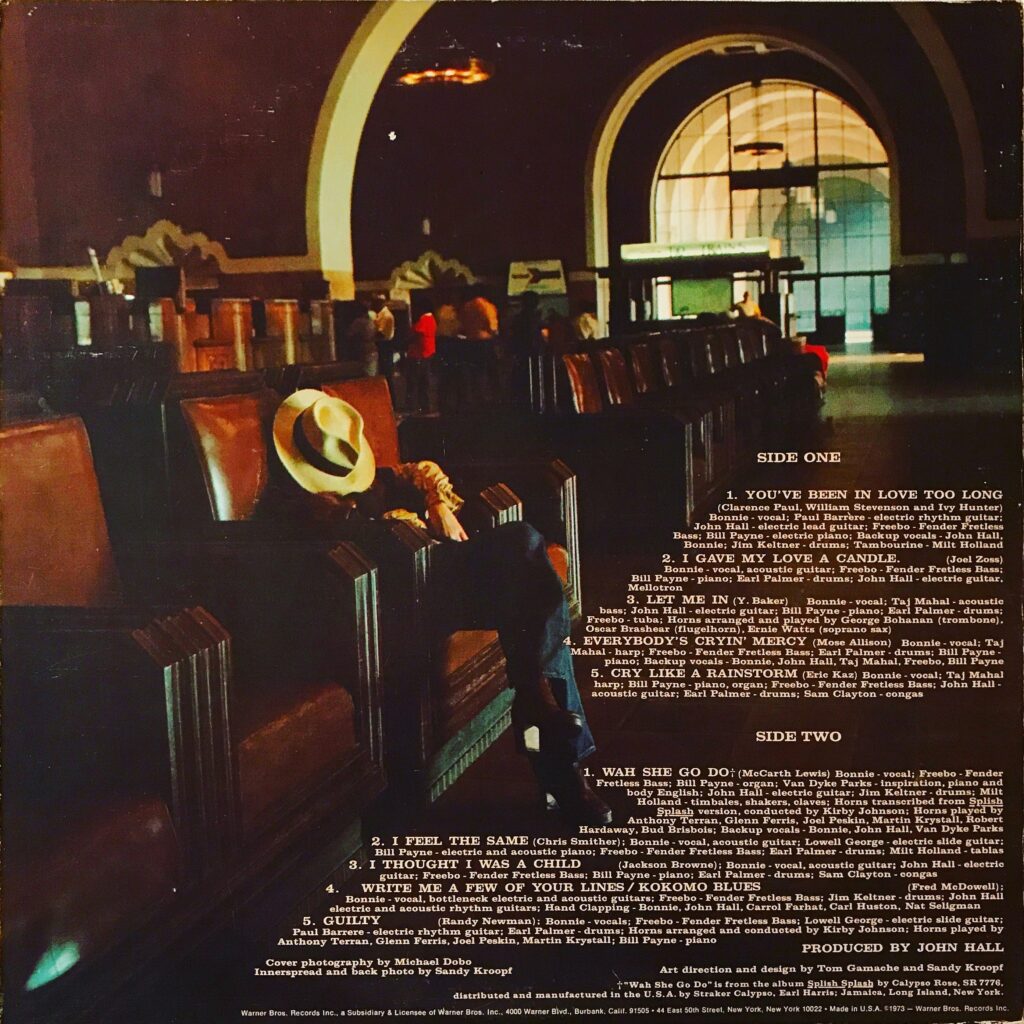
Bonnie always said she wanted to sound like the Temptations, and their spirit is evoked on the opening cut, “You’ve Been in Love Too Long,” an easy, rocking ballad with nice, cooking bass work. The contemporary songwriters are well-represented, too. Bonnie found existing songs which “said just exactly what I feel,” and then shaped them into personal statements.
Joel Zoss’ “I Gave My Love a Candle” neatly calls to mind old English ballads as well as the lost highway downs — Bonnie gives the “goodbye, goodbye, goodbye” chorus such a resigned intensity it stays strong in memory after the other lyrics have passed. “I Feel the Same,” by Chris Smither, opens with nice guitar/bass interplay — it’s one of the two cuts here where Bonnie is heard most on guitar. (She does only vocal on most tracks, which is a shame since she’s much more than just an accompaniment guitarist.) The opening lines are crucial: “I know you’re leaving me, but I’m leaving too.”
“Cry Like a Rainstorm” (Eric Kaz) is still another quietly apocalyptic song of loss: “Tell me how have I sinned — when you cry like a rainstorm, and howl like the wind.”
The only contemporary song that doesn’t fare more than well at Bonnie’s hands is Jackson Browne’s “I Thought I Was a Child.” She seems to feel the spirit, but it somehow escaped her, a near miss. Another near miss is a Raitt standby, the Fred McDowell medley, “Write Me a Few of Your Lines”/”Kokomo Blues.” In concert this is one of Bonnie’s strongest and funkiest numbers, but here the guitar sound is thin and weak, not up to her usual standards; she’s really one of the best slide players around.
The other mainstream blues number, Mose Allison’s “Everybody’s Crying Mercy,” comes off just right, a superfine performance, with perfect low and moody harpwork by Taj Mahal. Mose has long been a musicians’ favorite and the lyrics and lines of this song should make it generally obvious why. Bonnie gives it a fine reading, with just the right balance between weariness and disgust.
On the upside there’s the calypso/reggae-flavored “Wah She Go Do,” with some marvelously shitty slurred horn work and a roller-rink organ riff. The words have already made this another FM favorite: “… if he picks up an outside woman, show him you can pick up two outside men/And that’s the only way, a woman should get some respect today.” Also a good-timey remake of the old Sensations hit, “Let Me In,” replete with “wheeooo”s and earnest tuba work by Freebo (an alumnus of the Pennsylvania Football Band).
The final cut is Randy Newman’s incredibly introspective “Guilty” and it’s one of the downest tracks I’ve ever heard. Bonnie maintains a dual image through all her recorded and live work: On the one hand she’s the ballsy, slide guitar, fast-living mama; on the other, an often deserted wistful child. For every one of her demands (“You better love me like a man … give it up or let me go”), there’s an unspoken but faintly perceptible “please.” That may be a key to why she can get so deep inside people: She’s a magnifying mirror.
On the whole, Takin’ My Time is a highly satisfying, but a bit down, album. Bonnie’s voice is strong and pure, and always full of feeling, and the backup musicians all work well together. And despite her claim of not caring much about records, it’s evident a lot of her soul went into this one, and that makes it worth hearing.
Bonnie Raitt – TAKIN’ MY TIME – Warner Bros. BS-2729
by Freddy Brooks
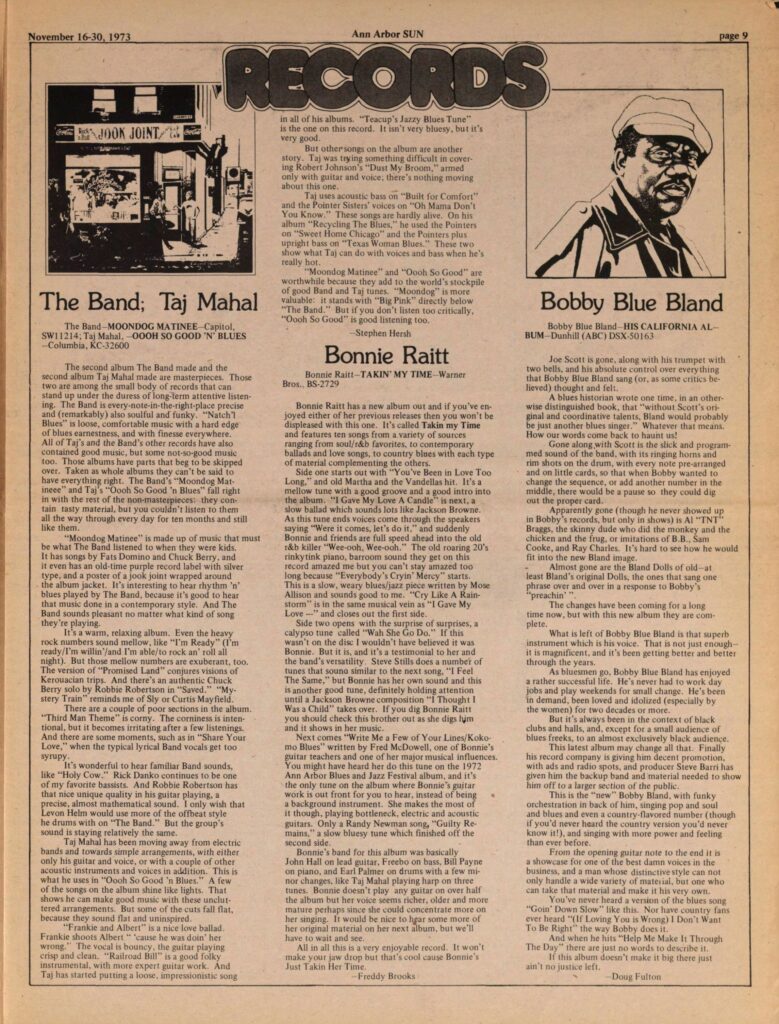
Bonnie Raitt has a new album out and if you’ve enjoyed either of her previous releases then you won’t be displeased with this one. It’s called Takin my Time and features ten songs from a variety of sources ranging from soul/r&b favorites, to contemporary ballads and love songs, to country blues with each type of material complementing the others.
Side one starts out with “You’ve Been in Love Too Long,’’ and old Martha and the Vandellas hit. It’s a mellow tune with a good groove and a good intro into the album. “I Gave My Love A Candle” is next, a slow ballad which sounds lots like Jackson Browne. As this tune ends voices come through the speakers saying “Were it comes, let’s do it,” and suddenly Bonnie and friends are full speed ahead into the old r&b killer “Wee-ooh, Wee-ooh.” The old roaring 20’s rinkytink piano, barroom sound they get on this record amazed me but you can’t stay amazed too long because “Everybody’s Cryin’ Mercy” starts. This is a slow, weary blues/jazz piece written by Mose Allison and sounds good to me. “Cry Like A Rainstorm” is in the same musical vein as “I Gave My Love —” and closes out the first side.
Side two opens with the surprise of surprises, a calypso tune called “Wah She Go Do.” If this wasn’t on the disc I wouldn’t have believed it was Bonnie. But it is, and it’s a testimonial to her and the band’s versatility. Steve Stills does a number of tunes that sound similar to the next song, “I Feel The Same,” but Bonnie has her own sound and this is another good tune, definitely holding attention until a Jackson Browne composition “I Thought I Was a Child” takes over. If you dig Bonnie Raitt you should check this brother out as she digs him and it shows in her music.
Next comes “Write Me a Few of Your Lines/Kokomo Blues” written by Fred McDowell, one of Bonnie’s guitar teachers and one of her major musical influences. You might have heard her do this tune on the 1972 Ann Arbor Blues and Jazz Festival album, and it’s the only tune on the album where Bonnie’s guitar work is out front for you to hear, instead of being a background instrument. She makes the most of it though, playing bottleneck, electric and acoustic guitars. Only a Randy Newman song, “Guilty” remains, a slow bluesy tune which finished off the second side.
Bonnie’s band for this album was basically John Hall on lead guitar, Freebo on bass, Bill Payne on piano and Earl Palmer on drums with a few minor changes, like Taj Mahal playing harp on three tunes. Bonnie doesn’t play any guitar on over half the album but her voice seems richer, older and more mature perhaps since she could concentrate more on her singing. It would be nice to hear some more of her original material on her next album, but we’ll have to wait and see.
All in all this is a very enjoyable record. It won’t make your jaw drop but that’s cool cause Bonnie’s Just Takin Her Time.
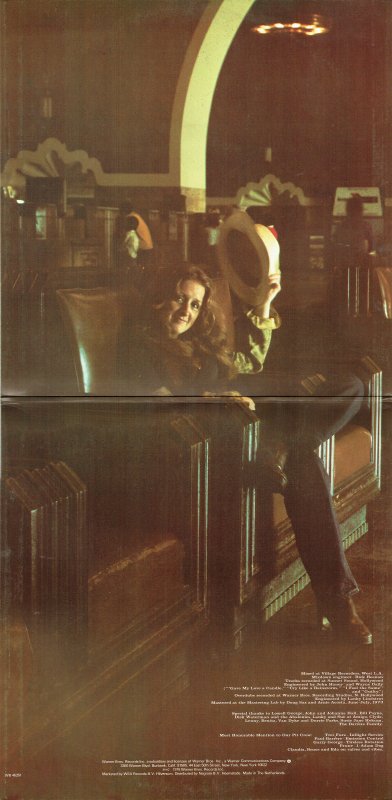
Bonnie Raitt – Takin’ My Time (1976, Gatefold, Vinyl)
View credits, reviews, tracks and shop for the 1976 Vinyl release of “Takin’ My Time” on Discogs.
Bandana Blues is and will always be a labor of love. Please help Spinner deal with the costs of hosting & bandwidth. Visit www.bandanablues.com and hit the tipjar. Any amount is much appreciated, no matter how small. Thank you.
Bonnie Raitt is nothing if not loyal. And when she caught wind of the fact that Mike Reid and I were writing and recording together, she was quick to volunteer to sing on our song “The Bridge.” It’s one of my favorite songs Mike and I have written. And I can no longer imagine it without her heroic spirit present. ~ Joe Henry
Released on: 2025-09-05 Producer: Joe Henry Music Publisher: Rivers and Roads Music (ASCAP - admin by Endurance Music Group) Music Publisher: Mule Rider (ASCAP) Music Publisher: Blue Raincoat Music (ASCAP) ℗ 2025 Work Song Inc. marketed and distributed by Thirty Tigers
{{svg_quality_icon}}
{{quality-options}}
1
http://i3.ytimg.com/vi/VWNoTHkp6_k/hqdefault.jpg
Prison Bound Blues · Bonnie Raitt
Bonnie has contributed a new recording of "Prison Bound Blues" written by Leroy Carr to a project called Better Than Jail, an extraordinary new album benefiting Free Hearts and Equal Justice USA. Better Than Jail is available everywhere today and features covers of iconic prison songs from Steve Earle, Taj Mahal,Margo Price, The War and Treaty and many more. The album seeks to raise awareness and support for the urgent need to reduce the harm of the criminal justice system. https://found.ee/BetterThanJail.
I'm so proud to have joined in with so many illustrious artists in creating this very special album in support of rural prison reform. Overlooked for far too long, this issue cuts across all cultural and political divides and deserves all our focused attention to finally bring about some swift and meaningful action. Better Than Jail is one of the most inspired and heartfelt albums I've been blessed to be a part of and I hope it sets a fire in hearts far and wide to join in our efforts." ~ Bonnie Raitt
Released on: 2024-10-04 Executive Producer: Brian Hunt Producer: Kenny Greenberg Producer: Wally Wilson Producer: Bonnie Raitt Recording Engineer: Jason Lehning at Sound Emporium Mastering Engineer: Alex McCollough at True East Mastering Production Assistant: Shannon Finnegan Mixer: Justin Niebank at Hounds Ear Music Publisher: Universal Music Corp. Composer, Lyricist: Leroy Carr ℗ Believe Entertainment Group and Wyatt Road Records
{{svg_quality_icon}}
{{quality-options}}
1
http://i3.ytimg.com/vi/xC2BJuQbO8w/hqdefault.jpg
The Fabulous Thunderbirds - Nothing in Rambling Ft. Bonnie Raitt, Taj Mahal, Keb' Mo' & Mick Fleetwood
In celebration of the band’s 50th Anniversary, The Fabulous Thunderbirds have just released Struck Down, their first studio album in eight years on Stony Plain Records. The ten-track album includes a wonderful cover of Memphis Minnie’s “Nothing in Rambling,” featuring longtime friends, T-Birds founding member Kim Wilson, along with Bonnie, Keb’ Mo’, Taj Mahal and Mick Fleetwood. — BRHQ
{{svg_quality_icon}}
{{quality-options}}
1
http://i3.ytimg.com/vi/YmW-bgcbvQI/hqdefault.jpg
Little Feat - Long Distance Call
“I’ve always loved Little Feat and this new incarnation of the band is bringing some serious heat, cred and new blood to their enduring legacy. Every Feat fan loves us some Sam. I’m so glad he’s now gotten a chance to step out front and center and put his spin on these wonderful blues songs. I loved singing "Long Distance Call" with him, always one of my favorites, and Scott slayed on slide. Know you’ll enjoy hanging out with us at Sam’s Place!" -- Bonnie Raitt
“Long Distance Call” was written by blues legend, Muddy Waters. It has Sam Clayton and Bonnie Raitt on vocals, Scott Sharrard on Dobro, Fred Tackett on acoustic guitar, Tony Leone on drums, and Michael “The Bull” LoBue on harmonica. The album also features Bill Payne on piano and Kenny Gradney on bass.
Little Feat have composed an album that’s their love letter to the blues entitled, ‘Sam’s Place.’ “Long Distance Call” plus many other blues classics are on this album. You can stream and order ‘Sam’s Place’ here: https://orcd.co/samsplace
Broken Hearts & Dirty Windows: Songs of John Prine, Vol. 2, the anticipated new John Prine tribute record from Oh Boy Records, is out today. Stream/purchase HERE.
Created as a celebration of Prine’s life and career, the album features new renditions of some of Prine’s most beloved songs performed by Brandi Carlile (“I Remember Everything”), Tyler Childers (“Yes I Guess They Oughta Name A Drink After You”), Iris DeMent (“One Red Rose”), Emmylou Harris (“Hello In There”), Jason Isbell (“Souvenirs”), Valerie June (“Summer’s End”), Margo Price (“Sweet Revenge”), Bonnie Raitt (“Angel From Montgomery”), Nathaniel Rateliff & The Night Sweats (“Pretty Good”), Amanda Shires (“Saddle in the Rain”), Sturgill Simpson(“Paradise”) and John Paul White (“Sam Stone”). Proceeds from the album will benefit twelve different non-profit organizations, one selected by each of the featured artists.
{{svg_quality_icon}}
{{quality-options}}
1
http://i3.ytimg.com/vi/Z71L4JdrVBY/hqdefault.jpg
Bonnie Raitt - Write Me a Few of Your Lines/Kokomo Blues
60 years anniversary celebration of Arhoolie
December 10, 2020
{{svg_quality_icon}}
{{quality-options}}
1
Arhoolie Foundation celebrates it's 60th anniversary (1960-2020) with an online broadcast.
Bonnie Raitt - Shadow of Doubt
Hardly Strictly Bluegrass Festival
October 3, 2020
Hardly Strictly Bluegrass celebrates it's 20th anniversary with an online broadcast titled “Let The Music Play On”.
{{svg_quality_icon}}
{{quality-options}}
1
http://i3.ytimg.com/vi/hCJa0505jZk/hqdefault.jpg
Bonnie Raitt & Boz Scaggs - You Don't Know Like I Know
Farm Aid 2020 On the Road
Sam & Dave classic written by Isaac Hayes and David Porter.
{{svg_quality_icon}}
{{quality-options}}
1
http://i3.ytimg.com/vi/jXG6ULcK-qs/hqdefault.jpg
Sheryl Crow & Bonnie Raitt - Everything Is Broken
[Eric Clapton’s Crossroads 2019]
Eric Clapton, one of the world’s pre-eminent blues/rock guitarists, once again summoned an all-star team of six-string heroes for his fifth Crossroads Guitar Festival in 2019. Held at the American Airlines Center in Dallas, Texas, the two-day concert event raised funds for the Crossroads Centre in Antigua, the chemical dependency treatment and education facility that Clapton founded in 1998.
{{svg_quality_icon}}
{{quality-options}}
1
http://i3.ytimg.com/vi/yHeBLEo4TOM/hqdefault.jpg
'A Tribute To Mose Allison'
Celebrates The Music Of An Exciting Jazz Master
Raitt contributed to a new album, If You're Going To The City: A Tribute To Mose Allison, which celebrates the late singer and pianist, who famously blended the rough-edged blues of the Mississippi Delta with the 1950s jazz of New York City.
NPR's Lulu Garcia-Navarro talks to Bonnie Raitt about her friendship with the Mose Allison. They're also joined by Amy Allison — his daughter, who executive produced the album — about selecting an unexpected list of artists to contribute songs to the album.
Recorded on tour June 3, 2017 - Centennial Hall, London - Ontario Canada





 Users Today : 85