LP

Bonnie Raitt: Bonnie Raitt

on February 3, 1972 No comments
By Chris Hamel

Bonnie Raitt’s debut album features an unusual collection of songs performed by an unusual assortment of musicians. And Bonnie is something out of the ordinary herself. She has been traveling the blues-festival circuit since 1968, playing the Boston-New York-Philadelphia folk run, since 1970. Now she has done something unusual with her first Warners album.
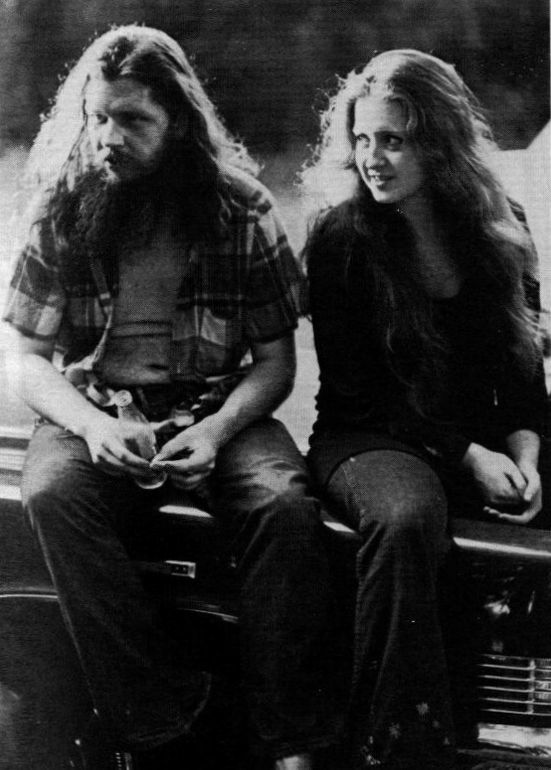
Willie Murphy and Bonnie Raitt – Insider Magazine, September 1971

In August, Bonnie rented a fishing camp on a Minnesota island, solicited the production services of Willie Murphy, the musical talent of his Bumblebees, and the fourtrack equipment of “Snaker” and Sylvia Ray. Bonnie then enticed Junior Wells and A.C. Reed from Chicago to join her regulars, bassist Freebo and guitarist-folk-singer Peter Bell. The sessions were done in a two-car garage and the product is good: a different album, a representative portrait of this artist.

Bonnie accompanies her folk-blues on a Mississippi National steel guitar. Her slide work is uncommonly good, equal to her straight acoustic stuff — in fact, it is simply among the best. Unfortunately, her ability is not fully captured on this album, because Bonnie’s guitar is not amply showcased — a major fault of the production.

There are two obvious idioms on the album — rock-soul and folk-blues. A third genre consists of three estranged numbers that are joined by the mood of their rendition. In their melancholy tone, these songs are the most consistently pleasing — Paul Seibel’s countrified quickie of an incredible lyric, “Any Day Woman,” “Spider” John Koerner’s rainy-day special, “I Ain’t Blue,” and Bonnie’s simple, personal piano ballad, “Thank You.” On these tunes, Bonnie’s thin, folk-founded voice is properly suited with a minimal amount of backing. Her ability to communicate emotion and involvement is most effective here.

Comparatively, the rock-soul treatments, reminiscent of Rod Stewart’s reworking of “I’m Losing You,” are heavily produced. Bonnie capitalizes on the soulful potential of Steve Stills’ “Bluebird” and the existent groove of a former Marvelettes single, “Danger Heartbreak Dead Ahead.” On these songs, the shift in emphasis goes from mood to delivery, and Bonnie succeeds best vocally on “Danger.” There’s an inkling of her electric slide talent there, too, as she weaves around the song, using the slide as an additive agent, not a gimmick. And this is an arrangement where you’d least expect to hear bottleneck. On “Bluebird,” Bonnie’s ability to use musical cliches tastefully is exemplified by the “bum-do-wadda” chorus that is carried in a joyful, respectful vein without the cynicism that so often undercuts such maneuvers.

In keeping with Bonnie’s image and preferences, there are five blues numbers. The selections are rare (Sippie Wallace’s “Women Be Wise,” “Mighty Tight Woman,” and Tommy Johnson’s “Big Road”) traditional (Robert Johnson’s “Walkin’ Blues”) and contemporary (Bonnie’s “Finest Lovin’ Man”). Arrangements are consistently good, the music solid. Yet congruent with the proverbial blues predicament, the songs fall short, into a gray area between the other cuts. Combining the elements scattered throughout the album is a bittersweet version of an old Lenny Welch hit, “Since I Fell For You,” and justice is done to it. As Bonnie says, “A.C. [tenor sax] blows his ass off on that one.” Reed, Jimmy’s brother, is the stellar sideman throughout the album. When the back-up occasionally absorbs Bonnie’s role as primary figure, A.C. stands out as most likely successor.

At times, Bonnie is a self-conscious vocalist and the tension in her voice is evident. So are the good times, struggles, exhaustion, creativity caught by this informal, somewhat bizarre recording. The weirdness of the whole affair is best summed up in the sound reproduction. When played on a low quality system at high volume or a high quality box through earphones, the results are best. It wouldn’t be surprising if that was intentional too.

Original 1971 album liner notes

Musicians:

Bonnie Raitt: vocals, acoustic and slide guitar
Junior Wells: harp
A.C. Reed: tenor sax solo
Willie Murphy: piano
Freebo: fretless bass
Peter Bell: electric guitar
Douglas “Toad” Spurgeon: trombone

The Bumblebees

Russell Hagen: electric guitar
Steven Bradley: drums
Voyle Harris: trumpet
Maurice Jacox: baritone sax, flute*
Eugene Hoffman: tenor sax
John Beach: piano
___________________________________________________________

Side One

Bluebird  3:26
(Stephen Stills)

Bonnie, A.C., Peter, Freebo, Steve, Eugene (cowbell), Willie
Background vocals: Bonnie, Peter, Paul Pena (bass), Reeve Little

Mighty Tight Woman  4:19
(Sippie Wallace, arr. John Beach)

Bonnie, John, Freebo, Steve, Junior

Thank You  2:48
(Bonnie Raitt)

Bonnie (piano), Willie (guitar), Freebo, Steve, Maurice*, Voyle

Finest Lovin’ Man  4:41
(Bonnie Raitt)

Bonnie, Junior, Russell, Willie, Freebo, Steve, A.C., Voyle, Eugene, Maurice

Any Day Woman  2:19
(Paul Seibel)

Bonnie, Willie (vocal), Freebo, Steve
___________________________________________________________

Side Two

Big Road  3:31
(Tommy Johnson, arr. Bonnie Raitt)

Bonnie, Peter (acoustic), Junior, Freebo (tuba), Toad, Steve, Willie

Walking Blues  3:35
(Robert Johnson, arr. Bonnie Raitt)

Bonnie, Junior, Peter (hambone)

Danger Heartbreak Dead Ahead  2:50
(Ivy Hunter-Clarence Paul-William Stevenson)

Bonnie (electric slide), Willie, Russell, Freebo, Steve, A.C., Eugene, Voyle, Maurice
Background vocals: Bonnie, Peter, Chris Rhodes

Since I Fell For You  3:03
(Bud Johnson)

Bonnie, Willie, Freebo, Steve, Eugene, Voyle, Maurice, Russell, A.C. (sax solo)

I Ain’t Blue  3:35
(John Koerner)

Bonnie, Freebo, Maurice*
Percussion and background vocals: Peter (shingle), Willie (shuttlecock in cup), Steve Raitt (stick on plastic pitcher)

Women Be Wise  4:13
(Sippie Wallace, additional lyrics by John Beach)

Bonnie, John, Voyle (naked), Freebo, Steve
___________________________________________________________

PRODUCED BY WILLIE MURPHY

Engineers: Dave and Sylvia Ray
Remix Engineer: Kendall Pacios
Recorded at Sweet Jane, Ltd. Studios, Minneapolis, August, 1971

Personal Management: Dick Waterman, Avalon Productions

Dedicated to Barnaby Ray
___________________________________________________________

WB WS 1953

© 1971 Warner Bros. Records Inc. (P) 1971 Warner Bros. Records Inc.
Warner Bros. Records Inc., a Subsidiary & Licensee of Warner Bros. Inc., 4000 Warner Blvd., Burbank, Calif. 91505. 44 East 50th Street, New York, New York 10022. Made in U.S.A.


Source: © Copyright Rolling Stone

But wait, there's more!

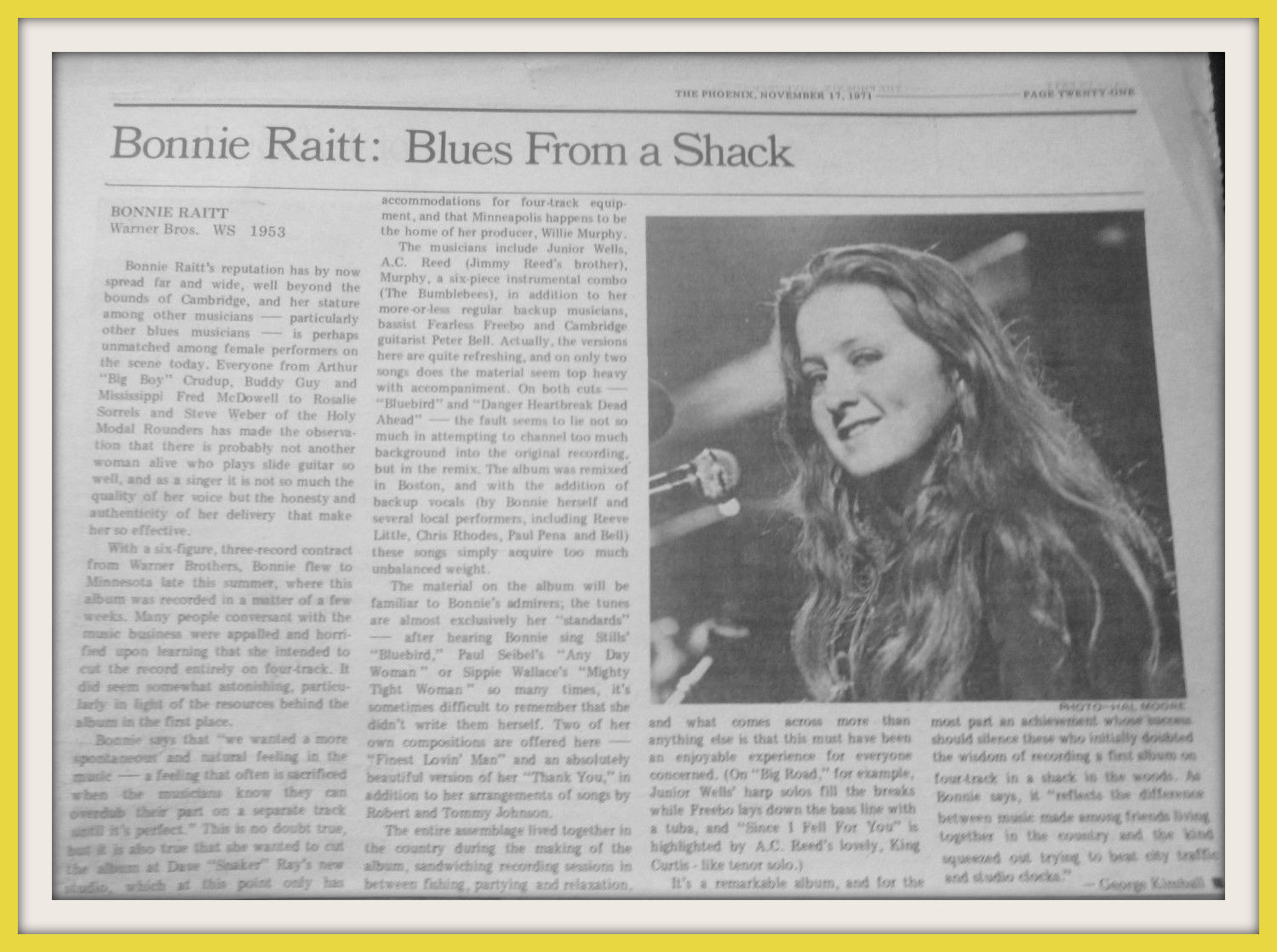
Bonnie Raitt: Blues From a Shack

on November 17, 1971 No comments
by George Kimball

BONNIE RAITT
Warner Bros. WS 1953

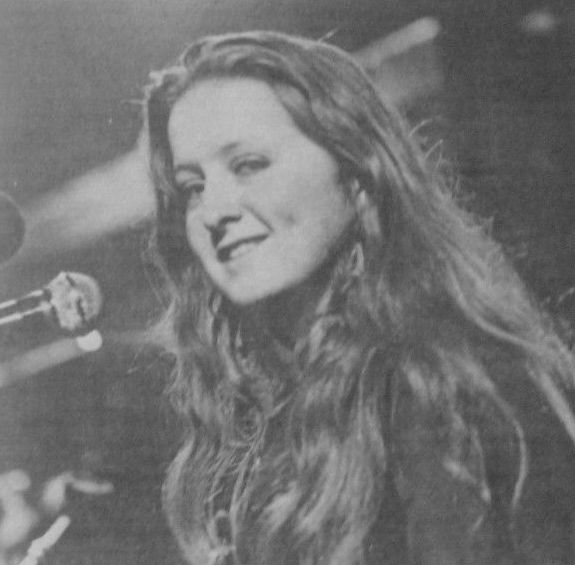
Bonnie Raitt 1971 © Hal Moore

Bonnie Raitt’s reputation has by now spread far and wide, well beyond the bounds of Cambridge, and her stature among other musicians — particularly other blues musicians — is perhaps unmatched among female performers on the scene today. Everyone from Arthur “Big Boy” Crudup. Buddy Guy and Mississippi Fred McDowell to Rosalie Sorrels and Steve Weber of the Holy Modal Rounders has made the observation that there is probably not another woman alive who plays slide guitar to well, and as a singer it is not so much the quality of her voice but the honesty and authenticity of her delivery that make her so effective.

With a six-figure, three-record contract from Warner Brothers, Bonnie flew to Minnesota late this summer, where this album was recorded in a matter of a few weeks. Many people conversant with the music business were appalled and horrified upon learning that she intended to cut the record entirely on four-track. It did seem somewhat astonishing, particularly in light of the resources behind the album in the first place.

Bonnie says that “we wanted a more spontaneous and natural feeling in the music — a feeling that often is sacrificed when the musicians know they can overdub their part on a separate track until it’s perfect.” This is no doubt true, but it is also true that she wanted to cut the album at Dave “Sneaker” Ray’s new studio, which at this point only has accommodations for four-track equipment, and that Minneapolis happens to be the home of her producer, Willie Murphy.

The musicians include Junior Wells, A.C. Reed (Jimmy Reed’s brother), Murphy, a six-piece instrumental combo (The Bumblebees), in addition to her more-or-less regular backup musicians, bassist Fearless Freebo and Cambridge guitarist Peter Bell. Actually, the versions here are quite refreshing, and on only two songs does the material seem top heavy with accompaniment. On both cuts ‘Bluebird” and “Danger Heartbreak Dead Ahead” — the fault seems to lie not so much in attempting to channel too much background into the original recording, but in the remix. The album was remixed in Boston, and with the addition of backup vocals (by Bonnie herself and several local performers, including Reeve Little, Chris Rhodes, Paul Pena and Bell) these songs simply acquire too much unbalanced weight.

The material on the album will be familiar to Bonnie’s admirers, the tunes are almost exclusively her “standards” — after hearing Bonnie sing Stills’ “Bluebird,” Paul Siebel’s “Any Day Woman” or Sippie Wallace’s “Mighty Tight Woman” so many times, it’s sometimes difficult to remember that she didn’t write them herself. Two of her own compositions are offered here — “Finest Lovin’ Man” and an absolutely beautiful version of her “Thank You,” in addition to her arrangements of songs by Robert and Tommy Johnson.

The entire assemblage lived together in the country during the making of the album, sandwiching recording sessions in between fishing, partying and relaxation, and what comes across more than anything else is that this must have been an enjoyable experience for everyone concerned. (On “Big Road,” for example, Junior Wells’ harp solos fill the breaks while Freebo lays down the bass line with a tuba, and “Since I Fell For You” is highlighted by A.C. Reed’s lovely, King Curtis – like tenor solo.)

It’s a remarkable album, and for the most part an achievement whose success should silence these who initially doubted the wisdom of recording a first album on four-track in a shack in the woods. As Bonnie says, it “reflects the difference between music made among friends living together in the country and the kind squeezed out trying to beat city traffic and studio clocks.”


But wait, there's more!

Mighty Tight Woman – SIPPIE WALLACE

on April 15, 1967 No comments

by Paul Oliver

{{svg_quality_icon}}
{{quality-options}}

A splendid anachronism, Sippie Wallace; a singular survivor of a long past blues tradition. There was a time, in the Forties, when almost the only form of blues which had any recognition was that called ‘classic blues’. The term itself is vague enough and does not carry in it any specific form, or style, or means of expression.
But though it lacks a real definition the classic blues has meant for collectors and jazz enthusiasts the singing of the blues artists who worked with the jazz bands of the 1920s. There were few enthusiasts of the blues in the early years of the traditional jazz ‘revival’ and, in consequence, the blues singers who had associations with jazz were those whose names appeared in the articles and the occasional books which mileposted the developing interest in this form of music. When the ‘trad’ boom was over and the Dixieland bands and the New Orleans bands had fought out their battles of authenticity and purity to meet at last over glasses of warm beer to rue the passing of a fad, attention to the classic blues went too.

In the past few years a rise in interest in the blues has echoed in some respects the traditional jazz phase, sustaining a large number of imitative musicians, developing a market for the issue and reissue of the music of the past, and promoting the rediscovery of veteran musicians.
In all this activity in the blues field there has been little attention to the work of the classic singers. Sadly their link with jazz which had inspired interest in the past is now contributory to the present disregard. Once again, the arguments over authenticity have produced artificial barriers, have classified, often meaninglessly, the categories into which musicians and singers conveniently fall and have imposed a highly artificial form of arbitrary evaluation. And the arguments have weighed heavily against the classic blues singers when indeed, they enter the discussion at all.

tip: most convenient way to listen while browsing along is to use the popup button of the player.

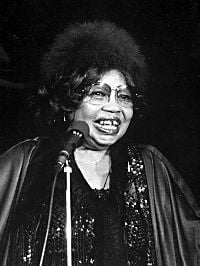
The appearance of Sippie Wallace at the Folk Blues Festival concerts in 1966 must be counted from any point of view, a conspicuous success. Her single appearance has caused critics to reconsider their opinions, some writers to admit grudgingly that there may after all, be some value in the work of singers of her type and generation. As the reviews and the spontaneous acclamation of the audiences revealed, Sippie Wallace’s majestic singing was both a personal triumph and a smashing blow against those who found the classic singer inadmissable to the blues pantheon.

To the extent that the term has any meaning, Sippie Wallace is a classic blues singer. But the term is elastic enough to include at one pole the work of artists of the stature of Bessie Smith and Gertrude Ma Rainey, and at the other the entertainment of Rosa Henderson and Viola McCoy. While the former showed in their every phrase the influence of the blues, the latter singers were vaudeville entertainers whose links were as much with white show business as they were with the Negro tradition of song. No derogatory implications are intended; only some indication of the looseness ot the terminology. Nearly all these singers were women and it is probably a reflection of the recording patterns of the day that while there were few rural women singers recorded in the Twenties the classic singers were almost exclusively female. Those who showed the greatest association with the blues tradition inevitably appeal today to a greater extent than do those whose singing was a part of the vaudeville entertainment of the early years of the century, and for this reason Lillian Glinn, Cleo Gibson or Clara Smith are among the few that are remembered. Standing pre-eminently in their company is Sippie Wallace.

But wait, there's more!