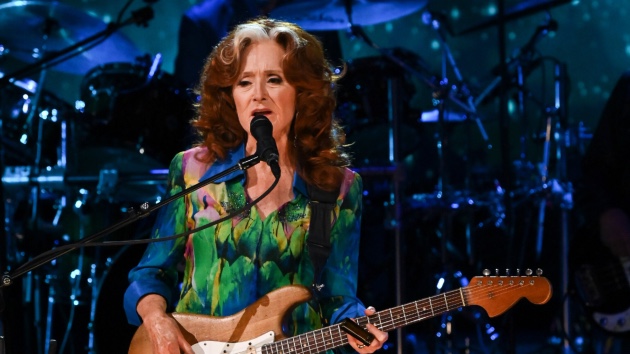
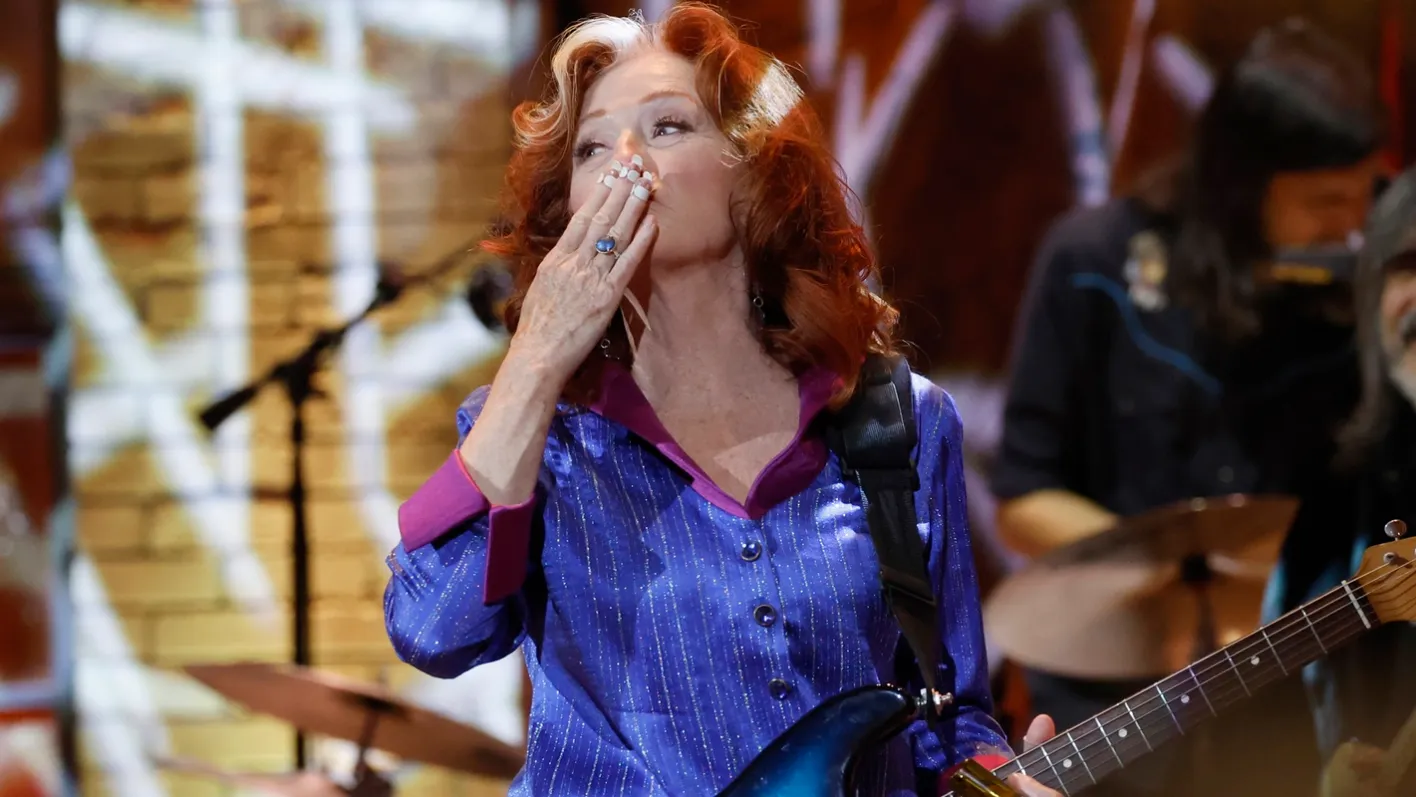
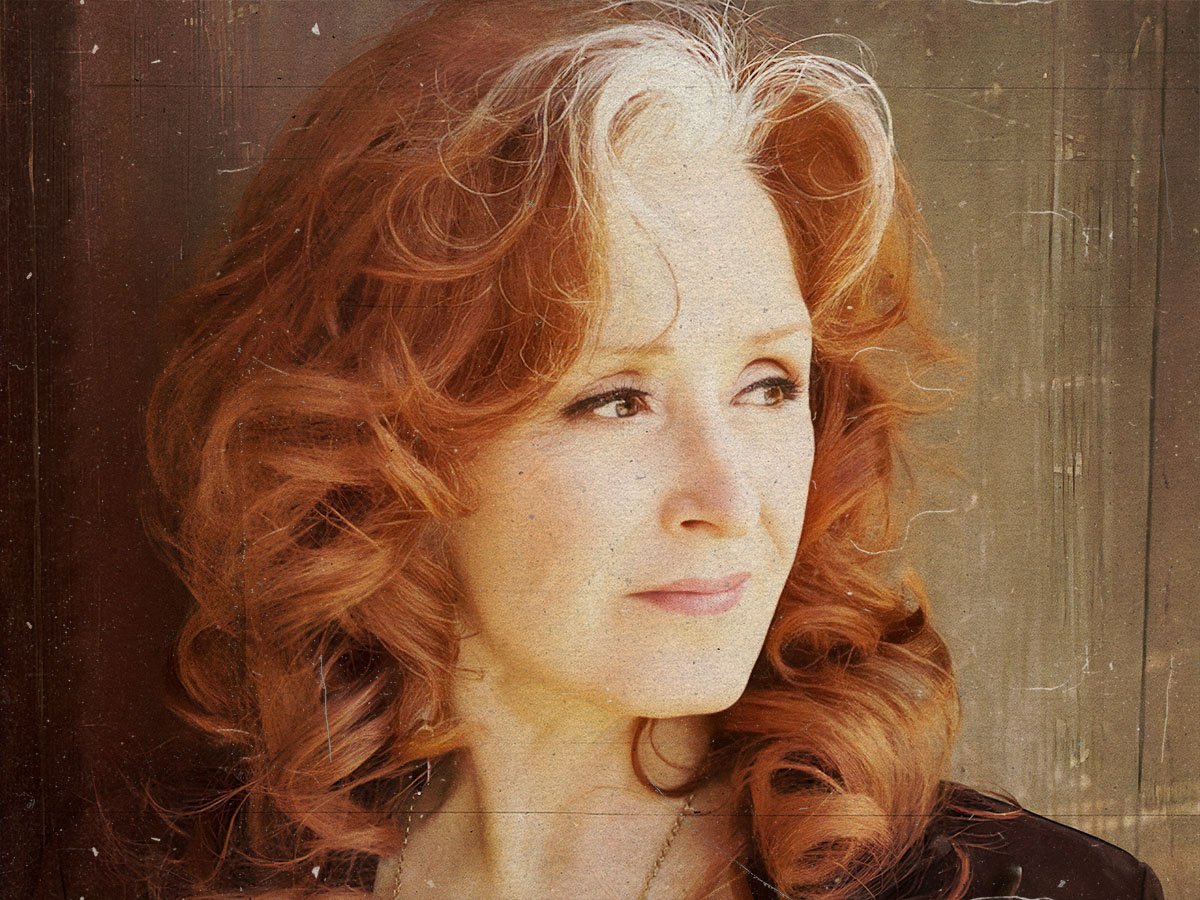
On the eve of the release of her sixth album, Sweet Forgiveness, Bonnie Raitt still remains something of an anomaly in a music biz that usually relegates women to the role of backup “chick” singers. There simply aren’t many women fronting their own bands and playing badass guitar to boot–not to mention the nastiest Delta-styled bottleneck work this side of Muddy Waters–around these days. Add her staunch feminism and socialist political stance–though she doesn’t advertise them in her music save for the implications of an assertive woman telling her man what she wants from him in song–and you have one unusually serious, talented performer in the midst of the “That’s Entertainment” music world mentality.
If you turn the clock back about a decade or so, one of the burning questions in the rock world at the time was, “Can a blue man sing the whites?”–or, more prosaically, “Can a white man sing the blues?” Prompted by the Stones’ frequent use of old blues standards on their early albums and the influence of The Butterfield Blues Band, Blues Project and a host of British bands spearheaded by Cream, there was a full-fledged blues boom going on in the late ’60’s. Many of the veteran bluesmen, Muddy Waters Howlin’ Wolf, B.B. and Albert King among them, found the audiences expanding beyond what B.B. termed “the chitlin circuit” to include crowds of white, middle-class kids at rock auditoriums like the Fillmores.
It’s not surprising that the inspiration for most of the blues-rock of that period came from the gritty urban blues born on Chicago’s South Side. The electric energy and instrumentation of those bands matched the lineups and inclinations of most rock groups and lent itself perfectly to the extended jamming and guitar heroics so beloved of that era. And the macho bravado of songs like “I’m Ready” was custom made for the arrogant outlaw stance cultivated by most rockers.
But, save for the staunch folkic crowd who had been into the music all along, two facets of the blues tradition were largely passed over at the time—the acoustic bottleneck guitar stylings of the country bluesmen from the Mississippi Delta and the legacy of the blueswomen. Though Cream may have made the names of Robert Johnson and Skip James familiar to many by recording versions of “Crossroads” and I’m So Glad”, their high energy, high decibel interpretations bear little resemblance to the original versions. Likewise, Janis Joplin became the symbol of the blueswoman for most rock fans but her music seemed to rise more from the need to be accepted and loved than the inner strength one senses in the original ladies who sang the blues.
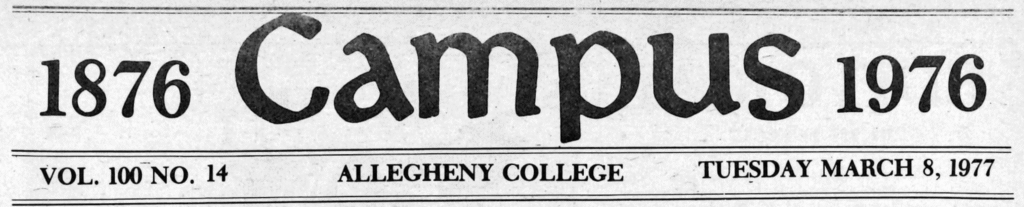
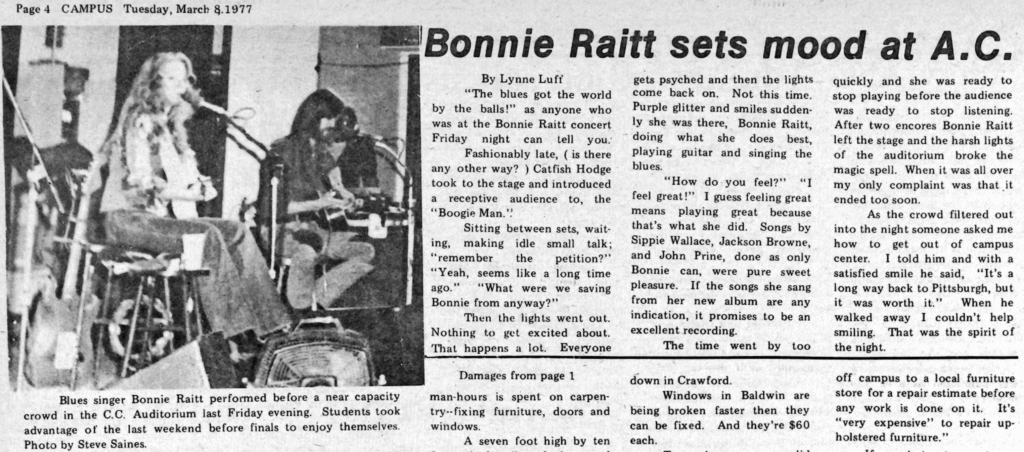
“The blues got the world by the balls!” as anyone who was at the Bonnie Raitt concert Friday night can tell you. Fashionably late, ( is there any other way? ) Catfish Hodge took to the stage and introduced a receptive audience to, the “Boogie Man.’! Sitting between sets, waiting, making idle small talk; “remember the petition?” “Yeah, seems like a long time ago.” “What were we saving Bonnie from anyway?” Then the lights went out. Nothing to get excited about. That happens a lot. Everyone gets psyched and then the lights come back on. Not this time. Purple glitter and smiles suddenly she was there, Bonnie Raitt, doing what she does best, playing guitar and singing the blues. “How do you feel?” “I feel great!” I guess feeling great means playing great because that’s what she did. Songs by Sippie Wallace, Jackson Browne and John Prine, done as only Bonnie can, were pure sweet pleasure. If the songs she sang from her new album are any indication, it promises to be an excellent recording. The time went by too quickly and she was ready to stop playing before the audience was ready to stop listening. After two encores Bonnie Raitt left the stage and the harsh lights of the auditorium broke the magic spell. When it was all over my only complaint was that it ended too soon. As the crowd filtered out into the night someone asked me how to get out of campus center. I told him and with a satisfied smile he said, “It’s a long way back to Pittsburgh, but it was worth it.” When he walked away I couldn’t help smiling. That was the spirit of the night.
If events such as this past weekend’s Kutztown Arts and Music Festival are to serve as a criterion, then the summer of 1976 may well become known as a time when the contemporary outdoor music festival successfully re-emerged.
A few years back, the mere rumor of such an event was enough to send almost any community running for cover and court injunctions. After the media veneration paid to Woodstock, and the violence of Altamont, festivals fell upon hard times. Things reached a low point several years back when the Newport Festivals, probably the best known throughout the world, were forced out of the city of Newport.
{{svg_quality_icon}}
{{quality-options}}
1
http://i3.ytimg.com/vi/3alSLLKAlB8/hqdefault.jpg
Perhaps the major reason for the recent successful string of festivals is the fact that “rock,” either in word or deed, is no longer a particularly welcome part of the proceedings. True, many of the musicians and bands appearing at these events were at one time on at least the fringe of the genre — and the festivals themselves have incorporated most of the sound, lighting and crowd-control techniques garnered from years of “rock festival” trial and error — mostly error. But events such as the highly successful (financially, aesthetically and legally) Kutztown affair bode well for the “non-rock” music festival of future summers.
The talent lineup at Kutztown was quite unique also. For the first time in recent memory, some 60,000 listeners between the ages of 15 and 70 shared a music festival, due in no small part to the fact that the bookings were as multigenerational as the crowd. Progressive, youth-oriented acts the likes of Nitty Gritty Dirt Band, Emmylou Harris and Bonnie Raitt vied for at least the grudging attention of the audience elders, and frequently won a good portion of them over.
Bonnie Raitt plays for thousands during the Kutztown Good-time Arts & Music Festival at the Kutztown Fairgrounds in 1976
Concurrently, the Nashville-oriented acts, such as Tammy Wynette, Ferlin Huskey, Donna Fargo and Freddy Fender, to name but a few, drew considerable response from those . . . under 40?
Highlights of the three-day affair were numerous. Aside from the excellent facilities, seldom even approached by any other such festival, the crafts, workshops and spontaneous music-making of all types throughout the Kutztown Fairgrounds showed remarkable vitality and diversity.
For this, credit would have to be given to the artistic and logistical foresight shown by those in the Kutztown State College Alumni Association, who more or less planned the entire event from a drawing board that goes back to the beginning of the year.
But it was the performers who graced the main stage in non-stop fashion, day and night, who would make or break the festival, and, perhaps sensing much of the special flavor of the event, they gave performances that, in some cases, transcended even their own abilities.
Over 30 of the finest progenitors of country-rock, bluegrass, traditional “old time” music and Nashville “Opry” style shows brought various factions of the 56,000 ticket buyers to their feet numerous times.
Fiddler Vassar Clements showed up with a band of scintillating “pickers,” and the Earl Scruggs Revue found a way to perform even the oldest Earl Scruggs’ original, some dating back to the 40s and 50s, with a newfound flair and high-energy style.
Bluegrass virtuoso Don Reno, along with Bill Harrell and the fervent fiddling of Buck Ryan, proved almost unbelievably “hot” for this performance. Bonnie Raitt, always a crowd-pleaser, delivered a particularly emotive and sensitive set, and the crystalline voice of new country-rock star Emmylou Harris was matched only by her exquisite and finely matched band.
Finally, as festival closers, a more symbolic or all-encompassing act than the Nitty Gritty Dirt Band could not have been found. Perhaps the most feverish response was garnered by the eclectic and educationally entertaining NGDB of the entire festival. But then, as a closing act for so memorable a three-day event as the Kutztown Festival, the band was undoubtably receiving its tumultuous response as much for its performance as for the entire event itself.
1976 Music Festival in Kutztown. Hell of a line up for $8 a day.
Bandana Blues is and will always be a labor of love. Please help Spinner deal with the costs of hosting & bandwidth. Visit www.bandanablues.com and hit the tipjar. Any amount is much appreciated, no matter how small. Thank you.
Bonnie Raitt is nothing if not loyal. And when she caught wind of the fact that Mike Reid and I were writing and recording together, she was quick to volunteer to sing on our song “The Bridge.” It’s one of my favorite songs Mike and I have written. And I can no longer imagine it without her heroic spirit present. ~ Joe Henry
Released on: 2025-09-05 Producer: Joe Henry Music Publisher: Rivers and Roads Music (ASCAP - admin by Endurance Music Group) Music Publisher: Mule Rider (ASCAP) Music Publisher: Blue Raincoat Music (ASCAP) ℗ 2025 Work Song Inc. marketed and distributed by Thirty Tigers
{{svg_quality_icon}}
{{quality-options}}
1
http://i3.ytimg.com/vi/VWNoTHkp6_k/hqdefault.jpg
Prison Bound Blues · Bonnie Raitt
Bonnie has contributed a new recording of "Prison Bound Blues" written by Leroy Carr to a project called Better Than Jail, an extraordinary new album benefiting Free Hearts and Equal Justice USA. Better Than Jail is available everywhere today and features covers of iconic prison songs from Steve Earle, Taj Mahal,Margo Price, The War and Treaty and many more. The album seeks to raise awareness and support for the urgent need to reduce the harm of the criminal justice system. https://found.ee/BetterThanJail.
I'm so proud to have joined in with so many illustrious artists in creating this very special album in support of rural prison reform. Overlooked for far too long, this issue cuts across all cultural and political divides and deserves all our focused attention to finally bring about some swift and meaningful action. Better Than Jail is one of the most inspired and heartfelt albums I've been blessed to be a part of and I hope it sets a fire in hearts far and wide to join in our efforts." ~ Bonnie Raitt
Released on: 2024-10-04 Executive Producer: Brian Hunt Producer: Kenny Greenberg Producer: Wally Wilson Producer: Bonnie Raitt Recording Engineer: Jason Lehning at Sound Emporium Mastering Engineer: Alex McCollough at True East Mastering Production Assistant: Shannon Finnegan Mixer: Justin Niebank at Hounds Ear Music Publisher: Universal Music Corp. Composer, Lyricist: Leroy Carr ℗ Believe Entertainment Group and Wyatt Road Records
{{svg_quality_icon}}
{{quality-options}}
1
http://i3.ytimg.com/vi/xC2BJuQbO8w/hqdefault.jpg
The Fabulous Thunderbirds - Nothing in Rambling Ft. Bonnie Raitt, Taj Mahal, Keb' Mo' & Mick Fleetwood
In celebration of the band’s 50th Anniversary, The Fabulous Thunderbirds have just released Struck Down, their first studio album in eight years on Stony Plain Records. The ten-track album includes a wonderful cover of Memphis Minnie’s “Nothing in Rambling,” featuring longtime friends, T-Birds founding member Kim Wilson, along with Bonnie, Keb’ Mo’, Taj Mahal and Mick Fleetwood. — BRHQ
{{svg_quality_icon}}
{{quality-options}}
1
http://i3.ytimg.com/vi/YmW-bgcbvQI/hqdefault.jpg
Little Feat - Long Distance Call
“I’ve always loved Little Feat and this new incarnation of the band is bringing some serious heat, cred and new blood to their enduring legacy. Every Feat fan loves us some Sam. I’m so glad he’s now gotten a chance to step out front and center and put his spin on these wonderful blues songs. I loved singing "Long Distance Call" with him, always one of my favorites, and Scott slayed on slide. Know you’ll enjoy hanging out with us at Sam’s Place!" -- Bonnie Raitt
“Long Distance Call” was written by blues legend, Muddy Waters. It has Sam Clayton and Bonnie Raitt on vocals, Scott Sharrard on Dobro, Fred Tackett on acoustic guitar, Tony Leone on drums, and Michael “The Bull” LoBue on harmonica. The album also features Bill Payne on piano and Kenny Gradney on bass.
Little Feat have composed an album that’s their love letter to the blues entitled, ‘Sam’s Place.’ “Long Distance Call” plus many other blues classics are on this album. You can stream and order ‘Sam’s Place’ here: https://orcd.co/samsplace
Broken Hearts & Dirty Windows: Songs of John Prine, Vol. 2, the anticipated new John Prine tribute record from Oh Boy Records, is out today. Stream/purchase HERE.
Created as a celebration of Prine’s life and career, the album features new renditions of some of Prine’s most beloved songs performed by Brandi Carlile (“I Remember Everything”), Tyler Childers (“Yes I Guess They Oughta Name A Drink After You”), Iris DeMent (“One Red Rose”), Emmylou Harris (“Hello In There”), Jason Isbell (“Souvenirs”), Valerie June (“Summer’s End”), Margo Price (“Sweet Revenge”), Bonnie Raitt (“Angel From Montgomery”), Nathaniel Rateliff & The Night Sweats (“Pretty Good”), Amanda Shires (“Saddle in the Rain”), Sturgill Simpson(“Paradise”) and John Paul White (“Sam Stone”). Proceeds from the album will benefit twelve different non-profit organizations, one selected by each of the featured artists.
{{svg_quality_icon}}
{{quality-options}}
1
http://i3.ytimg.com/vi/Z71L4JdrVBY/hqdefault.jpg
Bonnie Raitt - Write Me a Few of Your Lines/Kokomo Blues
60 years anniversary celebration of Arhoolie
December 10, 2020
{{svg_quality_icon}}
{{quality-options}}
1
Arhoolie Foundation celebrates it's 60th anniversary (1960-2020) with an online broadcast.
Bonnie Raitt - Shadow of Doubt
Hardly Strictly Bluegrass Festival
October 3, 2020
Hardly Strictly Bluegrass celebrates it's 20th anniversary with an online broadcast titled “Let The Music Play On”.
{{svg_quality_icon}}
{{quality-options}}
1
http://i3.ytimg.com/vi/hCJa0505jZk/hqdefault.jpg
Bonnie Raitt & Boz Scaggs - You Don't Know Like I Know
Farm Aid 2020 On the Road
Sam & Dave classic written by Isaac Hayes and David Porter.
{{svg_quality_icon}}
{{quality-options}}
1
http://i3.ytimg.com/vi/jXG6ULcK-qs/hqdefault.jpg
Sheryl Crow & Bonnie Raitt - Everything Is Broken
[Eric Clapton’s Crossroads 2019]
Eric Clapton, one of the world’s pre-eminent blues/rock guitarists, once again summoned an all-star team of six-string heroes for his fifth Crossroads Guitar Festival in 2019. Held at the American Airlines Center in Dallas, Texas, the two-day concert event raised funds for the Crossroads Centre in Antigua, the chemical dependency treatment and education facility that Clapton founded in 1998.
{{svg_quality_icon}}
{{quality-options}}
1
http://i3.ytimg.com/vi/yHeBLEo4TOM/hqdefault.jpg
'A Tribute To Mose Allison'
Celebrates The Music Of An Exciting Jazz Master
Raitt contributed to a new album, If You're Going To The City: A Tribute To Mose Allison, which celebrates the late singer and pianist, who famously blended the rough-edged blues of the Mississippi Delta with the 1950s jazz of New York City.
NPR's Lulu Garcia-Navarro talks to Bonnie Raitt about her friendship with the Mose Allison. They're also joined by Amy Allison — his daughter, who executive produced the album — about selecting an unexpected list of artists to contribute songs to the album.
Recorded on tour June 3, 2017 - Centennial Hall, London - Ontario Canada




 Users Today : 8