Concerts

Bonnie Raitt And The Ghosts Of The Ryman Auditorium
Spirits in the rafters and slide-guitar magic in Nashville

on May 10, 2016 No comments
CLA_MTV_640x455_

“You know there are ghosts in there. They don’t tell you about the ghosts when you take the tour.”

In the back of a taxi in Nashville, I am listening to a story from an eager taxi driver about the Ryman Auditorium – the “true story,” he said. “The one they won’t tell you when you walk inside.”

Businessman Thomas Ryman and preacher Samuel Porter Jones fought long and hard for the soul of Nashville in the late 1800s: Ryman with his tent revivals and Jones with his fleet of riverboats. Whiskey, music, and gambling sent men straight from one to the other and back again. One night in 1885, the legend goes, Ryman dropped in to hear Jones preaching in a tent at the corner of Eighth and Broad, fully intending to heckle. Jones, knowing this, preached a passionate sermon on the evils of drink and the cleansing power of faith. Ryman, instantly converted, walked from the tent that night and went back to his boats, sacrificing all of his whiskey to the Tennessee River and repenting for his sins. He was so convinced by this single night of preaching that he dedicated the next several years to building and opening the Union Gospel Tabernacle, a space where the people of Nashville could attend Jones’s large-scale revival meetings indoors. When Ryman died, in 1904, Samuel Porter Jones named the Tabernacle after him, and his ghost was the first of many to take up residence in the pews. This, my cab driver tells me, is the true story of the Ryman Auditorium. A story of haunting, like so many others in America.
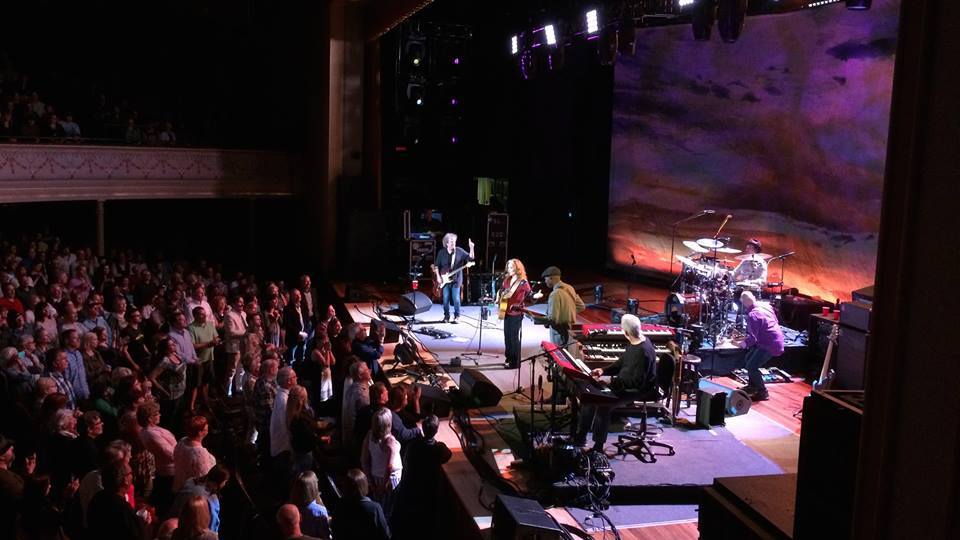
GREAT SHOW tonight @ The Ryman/Nashville w/BONNIE RAITT and BAND! © ‎Bob Seaman

If you are big enough in Nashville, everyone calls you by your first name only. I learn this by the way the locals address me when I look most lost. I stare at my GPS downtown at a stoplight, and a woman glances over out of the corner of her eye to ask, “You here to see Bonnie?” I ask a server what the best thing on the menu is at an iconic BBQ restaurant, and she smirks at the Ohio button on my bag: “You must be here to see Bonnie.” By the fourth time this happens, when I hit full tourist mode and stop to take multiple pictures of a statue, I confirm with a street musician that yes, I am in town to see the second night of Bonnie Raitt’s two-show stand at the Ryman. “Man, good ol’ Bonnie,” he replies. “She’s gonna put on a hell of a show, if she don’t do nothin’ else.”

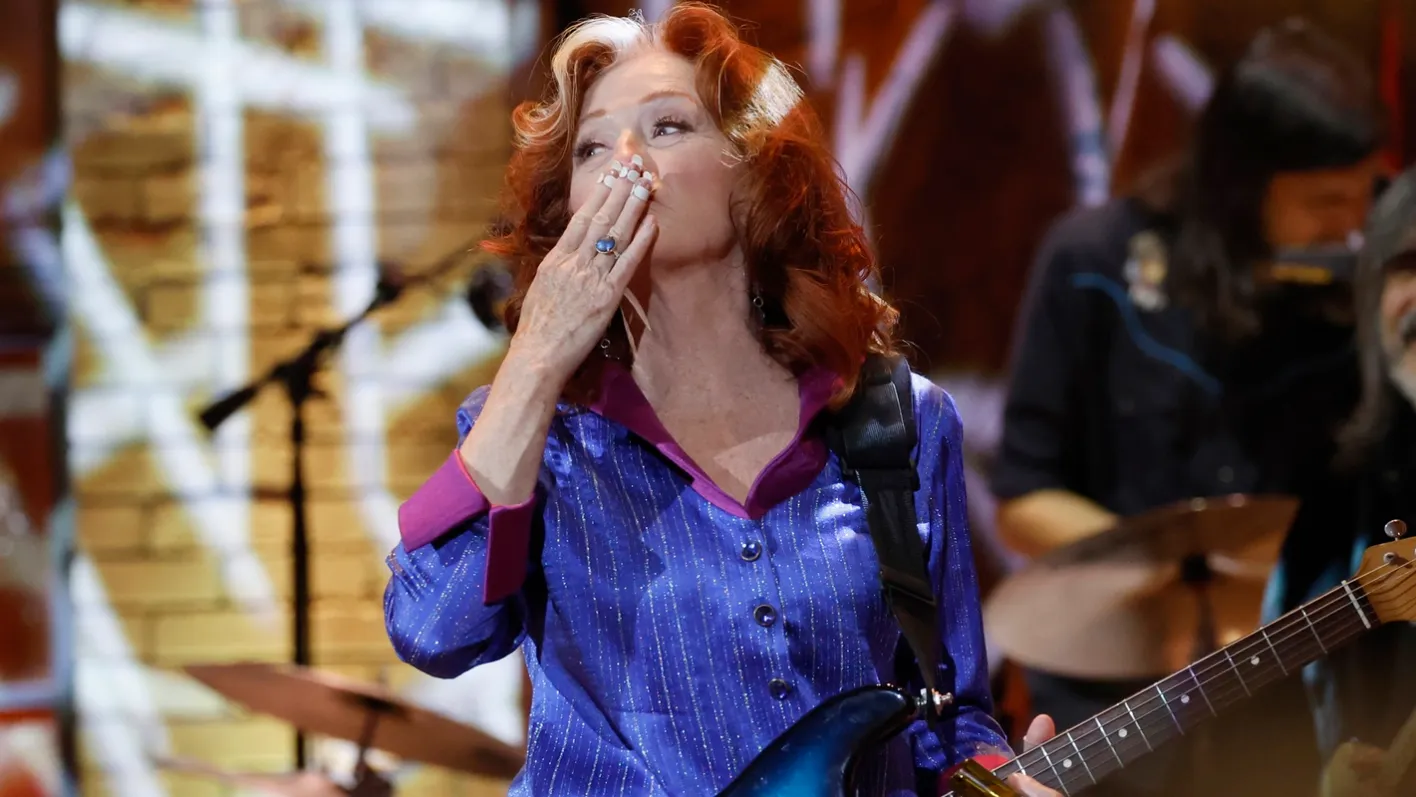
By the time Raitt takes the stage, the church pews are as full as possible. Ryman employees run down each aisle with signs reminding attendees that they cannot, under any circumstances, take out their cell phones or yell anything at the stage during the performance. This doesn’t stop someone in the pew behind me from yelling “I LOVE YOU, BONNIE!!” as Raitt settles in and checks with her band before leaning into the mic and saying “Well, we greased the pan real good last night, and now I get y’all for dessert.”

After all is said and done in Raitt’s career, the thing most worth remembering will be how the slide was an extension of her body. The slide guitar, for Raitt, is the voice beyond her own — one that, like her own voice, she is capable of fitting into any box she wishes it to rattle around in. Her primary guitar has been beaten and worn down to a harsh pale auburn color, close to the tone of Raitt’s own skin. When she breaks into an extended slide solo on a cover of Gerry Rafferty’s “Right Down the Line,” it’s hard to tell where her hands end and the guitar begins. All of it blends into a wave of notes, folding into each other and rushing off the stage to drown the eager audience. Her performance becomes sharper as the show goes on, an alarming feat when considering that this show was the second of a back-to-back engagement. It is a set that honors ghosts — the dead who influenced her sound, and the dead who once occupied this space. There are covers of J.B. Lenoir and Sippie Wallace, and a flawless cover of B.B. King’s “Don’t Answer the Door,” accompanied by a memory of seeing King at the Ryman in 2009. “He tore this goddamn place apart,” she says, before looking skyward and saying, “Whoops. Sorry. Forgot I’m in a church.”
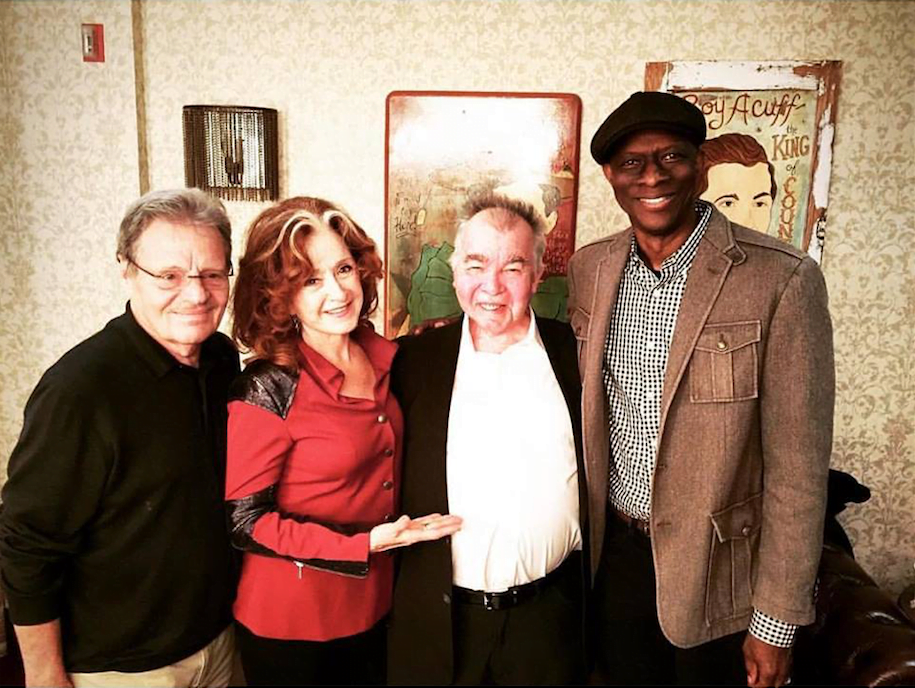
Delbert McClinton, Bonnie, John Prine and Keb' Mo' - Ryman Auditorium Nashville May 4, 2016
Delbert McClinton, Bonnie, John Prine and Keb’ Mo’ – Backstage at the Ryman Auditorium Nashville – May 4, 2016

If most of us tell our friends, “I’m coming into town for the night, you should come out,” we’ll get a nice room full of people we love. Most of us are not Bonnie Raitt, and the town that we are coming into is not Nashville, music capital, city of overwhelming talent. Martina McBride is in the audience tonight, along with Bonnie Bishop, Pat MacLaughlin, and a host of other writers and musicians who have played on albums throughout Raitt’s career. On the stage, the parade of guests is equally stunning. Raitt first trots out John Prine for a version of “Angel From Montgomery” that is, admittedly, too clearly unrehearsed and a bit clumsy on timing, but in an endearing way. Next is Delbert McClinton, joining Raitt on their 1991 hit “Good Man, Good Woman,” which sounds just as clean as it always did. Here’s Keb’ Mo’, who Raitt says was “just down the street,” popping in for a cover of Aretha Franklin’s “Baby I Love You.” It is a magic that can only happen in a handful of other cities — a room full of guest players who can cause even the most revered audience members to gasp, to sit up and take notice. Something to impress even the ghosts, their fading photos hanging in the halls.

{{svg_quality_icon}}
{{quality-options}}

There’s no bigger fan of these guys than Bonnie! Check out The California Honeydrops singing their version of “Love Sneakin’ Up On You” during the encore at the Ryman Auditorium.

The highlight of the night comes during the encore, when Raitt comes back to the stage without a guitar. She sits at a stool with a microphone and gives thanks to the spirit of Prince, gives thanks to Adele and Kacey Musgraves, Sheryl Crow and Norah Jones, all while talking about what it means to be the artist she is — a woman who has lived 66 years, trying to make songs that push the door open a little wider for other women. After this, she sings a quiet, chilling rendition of “I Can’t Make You Love Me,” a song that began with her, and that has since lived with many other women. It occurs to me that this is the enduring quality of Bonnie Raitt. Throughout her career, she’s had this ability to honor various pasts with an eye still toward the future. In a building soaked with history — with the ghosts of Thomas Ryman, Samuel Porter Jones, and an entire congregation of musicians above her head — Bonnie Raitt spent a night throwing a rope down from the top of the mountain and asking a whole room to climb to the top with her.


Source: © Copyright MTV But wait, there's more!

Bonnie Raitt and the Fugitive Emotions Evoked by Slide Guitar

on April 9, 2016 No comments
By Paul Elie

Bonnie Raitt has dodged the crush of fame that did in the Eagles; she has beaten the devils that snared Warren Zevon, found the third act that eluded Linda Ronstadt and Jackson Browne, tended to her vocal cords better than Joni Mitchell, escaped the undertow of the sixties that holds Crosby, Stills & Nash, and kept clear of the Rushmore-y eminence now granted Neil Young. At sixty-six, she’s the real survivor of the California rock scene of the seventies, and to see her perform, as I did, at the Beacon Theatre, the other night, is to see—to strange and powerful effect—an artist from the album-rock era fully intact. But I wasn’t at the Beacon on a nostalgia tour. I was there to hear Raitt play electric slide guitar—to hear her run a narrow glass tube up and down the neck of a Fender Stratocaster tuned to an open chord. If you ask me, Raitt is the greatest living slide player, and I didn’t want to miss a chance to hear a sound that has only a few masters.

She took the stage, and there it was: a blue-glass slide, flashing on the second finger of her left hand. The opening number was one I needed two verses to recognize as “Need You Tonight,” originally by INXS—a song I heard five hundred times in college bars in the eighties and not ten times since. It ought to have been cringe-inducing. But it wasn’t; it was now a Bonnie Raitt song, a sharp woman’s swagger over big guitar chords and a strong kick drum. And then she stepped out and put slide to strings, and the last traces of eighties synthesized glam were banished by the low snake moan of the electric slide guitar.

For Raitt, slide is a second voice, much like her first: tough, physical, subtle, and frankly emotional. It’s a voice cultivated somewhere off to the side of the place where male and female, solo and accompaniment, roots music and new sounds, are distinguished from each other. Raitt’s main guitar, a Stratocaster from the sixties, stripped of its factory finish, is now worn to approximately the same color and texture as her hair, and this contributes to the second-voice effect. Her slide solos are clusters of notes pulled out after the second verse, echoing and underscoring her vocals. At the Beacon, she played slide that way on a tremolo-drenched song from her new record; on a cover of “Shakin’ Shakin’ Shakes,” a Los Lobos party song about earthquakes; and on a reggaeish version of Gerry Rafferty’s 1978 radio hit “Right Down the Line.” And then a stool was brought out and she swapped the Stratocaster for a six-string acoustic guitar.

The fact that B. B. King once called Raitt the “best damn slide player working today” isn’t, in itself, reason to think of her as the greatest living slide guitarist. Ry Cooder is more versatile and innovative—the Yo-Yo Ma of slide, a world traveller with a bottleneck. David Lindley (he of the overdriven lap-steel solo on Jackson Browne’s “Running on Empty”) has opened quarries of old-time music and brought new life to the Weissenborn, a hollow-necked six-string acoustic instrument designed for Hawaiian music. Ben Harper has linked the lap steel to heavy rock. Derek Trucks has stirred the ghost of Duane Allman during a thousand shows with the Allman Brothers and his Tedeschi Trucks Band, making the Beacon Theatre a temple of slide.

But wait, there's more!

With Bonnie Raitt, There’s Always One Thing to Hold on To

on April 4, 2016 No comments

qrpfzmyxc9etccmtvctc

Kate Dries

I knew I was going to cry during Bonnie Raitt’s show, I just didn’t know how much. It settled at somewhere around four or five times during a two-hour set, which I’ll assume for my own benefit is an amount Raitt would be okay with, given that she was right there with me for some of those tears.

“You don’t want to have people rushing to the doors weeping,” Raitt told Entertainment Weekly of her new album, Dig in Deep, her first in five years. The first decade of the 2000s was rough for Raitt; she notably lost her father, mother, brother and a good friend, prompting her to take take a break before getting to work on her 2012 album Slipstream, a which won a Grammy for Best Americana Album and features tracks like a searing cover of Gerry Rafferty’s “Right Down the Line.

{{svg_quality_icon}}
{{quality-options}}

”Those who are more familiar with Raitt’s earlier work—classics like “Something to Talk About” and “I Can’t Make You Love Me”—might have missed Slipstream. It’d be naive to say that Raitt, at 66, is regularly garnering the attention of younger crowds; her fanbase sits very much with the type of audience attending Bruce Springsteen and James Taylor shows (Dig in Deep is currently #1 on the Blues charts, and peaked at 6th on the Rock charts). Baby boomers, despite any concern about the state of Social Security, have money to burn on the artists that shaped their youth, and they’ll spend it. And while publications like Rolling Stone cover artists like Raitt next to acts like Lady Gaga, newer media forms dominated by young people will always be caught up in those who are in their cohort.

As such, a Raitt show garners the attendees you’d expect; at her Saturday performance at the Beacon Theatre on Manhattan’s Upper West Side, there was quite a showing of middle-aged women sporting blonde highlights, some of whom really got loose during Raitt’s cover of INXS’s “Need You Tonight,” in which Raitt sings to a lover that there’s something about them that “makes me sweat.” But while Raitt readily thanked her loving audience for allowing her to continue to tour, acknowledging the many who don’t have the opportunity, to ascribe all of her musical relevance to the relatively silent group supporting it downplays her wondrous talent.

In a list of seemingly endless natural gifts, Raitt’s ability to effortlessly shift between jammin’ grooves, political statements (of which there are several on this album), and stirring lyrics cannot be overstated. “This record has probably some of my deepest personal digging,” she told Brittany Spanos last month. “(I did) some grief work with a support person and I just really felt all the things that had been pushed aside by all that loss and trauma. And I came out of it really grateful,” she told the AP.

But wait, there's more!