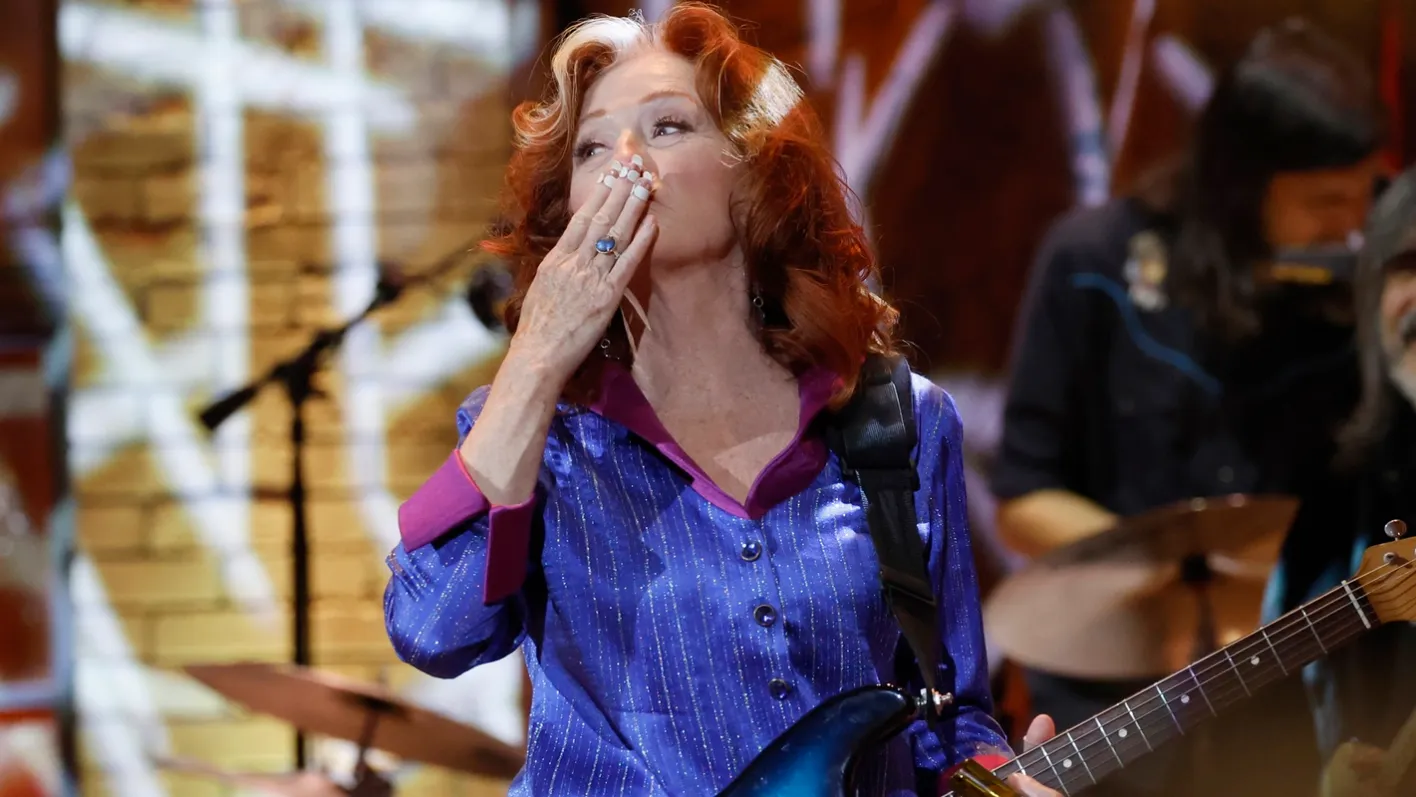
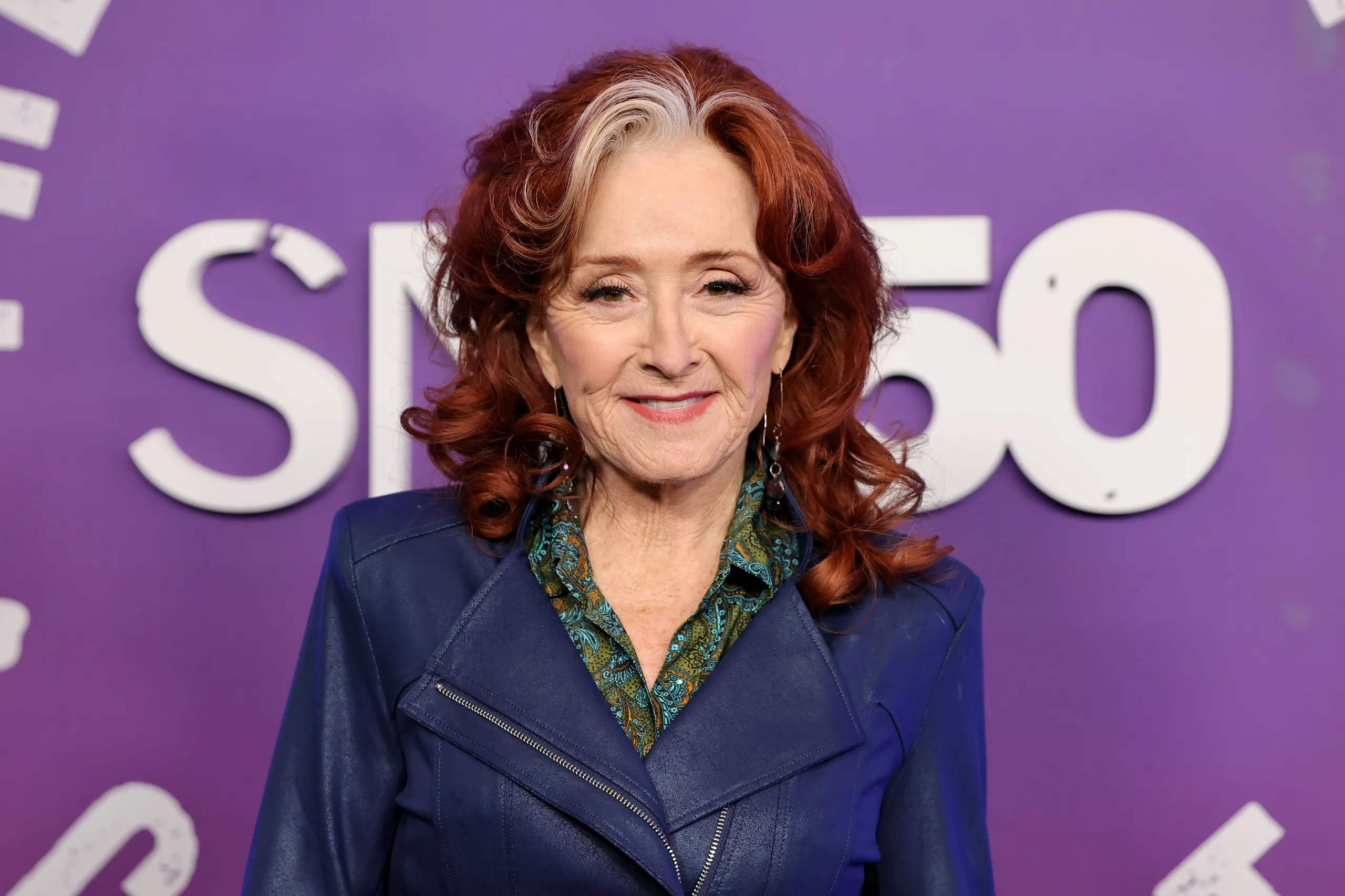
Bonnie Raitt started out in the 1970’s as a blues singer. Two decades later, her songs still hold on to the forthrightness and the pained determination of the blues. But at Radio City Music Hall on Wednesday night, when she opened a two-night stand, the most telling moments came during her ballads.
Ms. Raitt is one of the least showy singers in rock; she makes the song seem to tell its story by itself. Her voice has a girlish sweetness deepened by a grainy sense of experience; it can cut through a full band in a rock song, but it can also make ballads float in their own world.
She sets forth melodies clearly and plainly, adding a slide, a blues turn or a hint of vibrato only when a word needs illumination. Within such artful simplicity, every detail becomes vivid. And in songs like Richard Thompson’s “Dimming of the Day” or her own “I Can’t Make You Love Me,” all it took was a crescendo or a quiver of vibrato to fill a song with aching honesty. John Prine’s “Angel From Montgomery” was a marvel, mixing hymnlike purity with conversational directness.
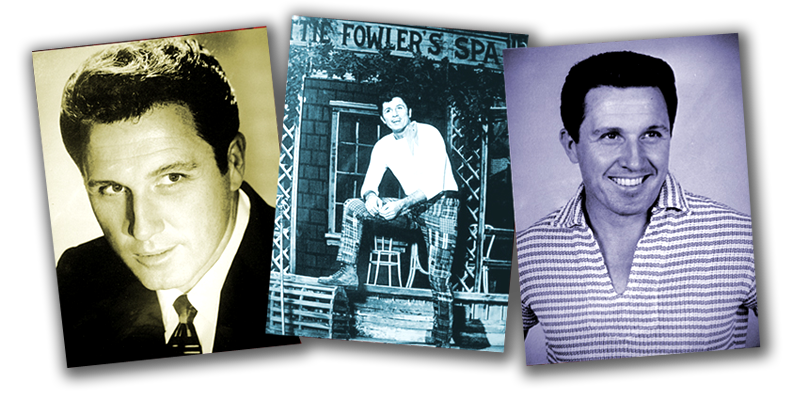
In a way, Ms. Raitt has returned to her heritage. She is a second-generation performer, the daughter of John Raitt, who played Broadway leads in “Oklahoma!” and “Carousel.” And she grew up in Los Angeles, where in the 1970’s, a school of songwriters and performers perfected a style that gave down-home Americana — country and blues, along with Brill Building pop — a Hollywood sheen. When Ms. Raitt and her producer, Don Was, picked up the lessons of Peter Asher’s mid-1970’s productions of Linda Ronstadt for her 1989 album, “Nick of Time,” Ms. Raitt became a million-seller.
Mass success, after years of a steady cult following, seems to have given Ms. Raitt new confidence as a songwriter. Through the years she has usually recorded a song or two of her own per album, and by now she has amassed a sizable catalogue. Her songs have had a consistent persona: that of a woman who’s both loving and self-reliant, both sensual and, almost despite herself, sensible. One of her new songs, “Feeling of Falling,” confesses to missing wilder times but refusing to go “over the ledge.” In songs like “Nick of Time” and “Circle Dance,” she acts her age (44), examining questions of mortality and forgiveness across generations.
Ms. Raitt still seems surprised by the size of her audience. At Radio City, she started by urging the audience to “pretend we’re at a club tonight,” and throughout the show she spoke to the audience casually, taking pains to credit other songwriters and her band members. She singled out James (Hutch) Hutchinson, on bass, for bringing African and Celtic music into her songs.
For most of her summer tour, Ms. Raitt is performing at large outdoor halls (including the Jones Beach Theater in Wantagh, L.I., on Aug. 18 and 19), and she had a stage backdrop and lighting effects that were occasionally distracting. But she’s reluctant to play the rock star; only in an encore, John Hiatt’s “Thing Called Love,” did she carry her guitar to the edge of the stage and strut through a solo.
She also had a show-business finale: a guest appearance by her father. The 77-year-old Mr. Raitt, his voice still hearty and accurate, joined his daughter for a duet in “They Say It’s Wonderful,” from “Annie Get Your Gun,” and took over for “Oklahoma!” Ms. Raitt’s own style, reserved and confessional, is a generation away from her father’s gusto, but her filial pride was obvious.
Voters for Choice fundraiser for Roe v. Wade Anniversary with Jimmy Dale Gilmore, CSN, The Story – Constitution Hall, Washington, D.C. 1-22-1994
When the Supreme Court handed down the Roe v. Wade decision on Jan. 22, 1973, Bonnie Raitt’s career was just getting underway. To celebrate the 21st anniversary of that ruling at Saturday’s Voters for Choice benefit concert in Constitution Hall, Raitt revisited those days. Accompanied only by guitarist-bassist Johnny Lee Schell, she built her set around old blues tunes by Fred McDowell, J.B. Lenoir and Chris Smither. “I haven’t played these songs in so long,” she exclaimed. “This is a powerful night for me.”
It was a welcome reminder of the long, glorious career Raitt had before she became an “overnight” success in 1990. Raitt may fill another shelf with Grammies from her new album due next month, but it’s unlikely she will ever give a performance more forceful than Saturday’s rendition of John Prine’s “Angel From Montgomery.” On this song about what happens to a woman with not enough choices, Raitt delivered some verses talking-blues style and belted out the chorus in that blues-soaked, daughter-of-Broadway voice of hers. Later she was joined by David Crosby and Graham Nash for harmonies on “Love Has No Pride,” and she joined them on the finale, “Teach Your Children.”
Crosby, Stills & Nash, the evening’s headliners, are little more than a nostalgia act these days. At least they faithfully re-created their earlier recordings Saturday — something they have often failed to do over the past 10 years. Opening the show was the Story, sort of a young, female version of Crosby & Nash. Like the headliners, Jonatha Brooke and Jennifer Kimball offered earnest politics and ethereal harmonies untethered to any particular tradition.
Well rooted in traditions was Jimmie Dale Gilmore, who preceded Raitt. The evening’s emcee, Gloria Steinem, introduced him as a “bridge builder,” and the long, tall Texan proved it by stitching his blues, honky-tonk and bohemian-folk sources into a sound unified by its warbling beauty. Backed by guitarist Chris Gage and percussionist Paul Pearcy, Gilmore sang songs by Johnny Cash, Butch Hancock and Lucinda Williams and made them all sound like acts of confession.
You expect to hear the names of such folk music landmarks as Woody Guthrie, Leadbelly and the Weavers invoked at a folk festival. But Elvis Presley?
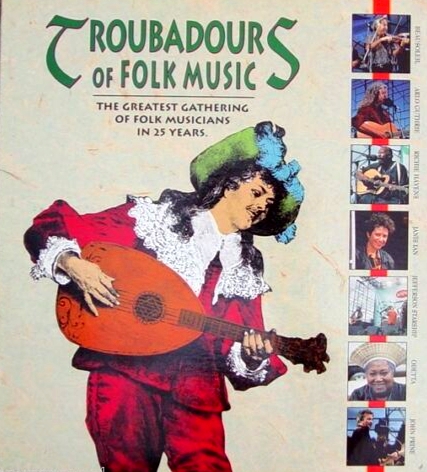
It was Woody’s son, Arlo Guthrie, who brought up Elvis during the opening day of the “Troubadours of Folk” festival Saturday at UCLA’s Drake Stadium–and his story and song proved one of the most illuminating moments in the sometimes unwieldy but generally endearing 11-hour affair, which ended around 10 p.m.
+ 10
Joni Mitchell and John Prine contributed the day’s most rewarding performances, and guest appearances by Bonnie Raitt and Tom Petty added glamour, but Guthrie’s story about Elvis defined the magic that is folk music.
Guthrie told of being with folk music icon Pete Seeger at a European festival after the fall of the Berlin Wall. Knowing that many in the crowd of 30,000 couldn’t speak English, Seeger sang folk classics so familiar around the world that the audience had no trouble singing along.
{{svg_quality_icon}}
{{quality-options}}
1
http://i3.ytimg.com/vi/5NvZfX72_HY/hqdefault.jpg
John Prine – “Live at the Troubadours of Folk Festival 1993” UCLA, Los Angeles, CA. 1993-06-05
This is a nice John Prine concert recorded by Rick Williams. John introduced “Ain’t Hurtin’ Nobody” as a new song, written just a couple of weeks ago. Also nice to hear Bonnie Raitt joining Prine on a couple of songs.
00:00 Intro 00:20 Spanish Pipedream 03:33 Picture Show 07:49 You Got Gold 12:31 All the Best 16:59 Angel From Montgomery [w/ Bonnie Raitt] 22:21 Ain’t Hurtin’ Nobody [w/ Bonnie Raitt] 28:21 My Old Man (Steve Goodman cover) 32:51 It’s a Big Old Goofy World
John Prine – acoustic guitar, vocals Bill Bonk – harmonica, electric guitar, mandolin Phil Parlapiano – keyboards, accordion, mandolin, slide guitar Benmont Tench – keyboards Howie Epstein – bass Debra Dobkin – percussion Bonnie Raitt – vocals on “Angel From Montgomery” and “Ain’t Hurtin’ Nobody” Lili Haydn – fiddle on “My Old Man”
After doing the obvious ones, including “We Shall Overcome,” Seeger good-naturedly challenged Arlo to come up with some more folk tunes with similar universality. Seeger, a folk purist, bristled when Guthrie said he was going to sing a Presley song.
As Guthrie began “Can’t Help Falling in Love,” the story went, the audience joined in as easily as before. Guthrie glanced over at Seeger, who was aghast. However, Seeger then slowly stepped to the microphone with his banjo–and began playing the song that he, too, knew so well.
The point, Guthrie said Saturday, is to forget all the definitions of folk music–and the snobbery that grows out of the idea that the music is the private property of a select group of artists or fans. One should simply look for songs that bind people together by underscoring their mutual humanity and heart.
Guthrie then sang the Presley ballad and was joined by much of the crowd, which was estimated at 6,000–a turnout probably reduced from the organizers’ 15,000 goal by the threat of rain.
Saturday’s lineup–ranging from Janis Ian and Ted Hawkins to Leon Redbone and the Kingston Trio–echoed the message of Guthrie’s story. In fact, the show, which was taped for a PBS special, served as such a valuable primer on the breadth of folk music that it was fitting that the event–with its accompanying crafts exhibits and issue booths–was held on a university campus.
In her well-received, mid-afternoon set, Judy Collins touched on both matters of the heart and the conscience, opening with the romantic longing of her ‘60s hit “Someday Soon,” then focusing on the idealistic “Last Night I Had the Strangest Dream.”
The Folksmen, who followed, are the Spinal Tap gang in the striped shirts associated with the Kingston Trio and with the slightly archivist aura associated with the collegiate, hootenanny boom of the ‘60s. While in the right context the humor may prove as uproarious as the trio’s classic assault on heavy-metal music, it seemed underdeveloped Saturday.
Roger McGuinn, who was a Chicago folkie before moving to Los Angeles in the mid-’60s and helping pioneer folk-rock with the Byrds, was joined on various numbers by Richard Thompson, Odetta and Petty as he exhibited a winning respect for the folk music form on songs from both his Byrds and solo days.
After Guthrie, the Jefferson Starship delivered an “unplugged” edition that may reflect some wing of folk music. But there was no need to take more than an hour (including stage set-up time) to document their ham-fisted approach on a day when far more important artists were limited to 30 minutes or less.
If there were strong nostalgia components to many of the day’s performances and a strong ‘60s-wannabes vibe to the mostly thirtysomething and above crowd, Eric Andersen injected a ‘90s reality with a striking new song about the rise of neo-Nazi sentiments in Europe.
Similarly, the sets by Prine and Mitchell–two master songwriters–included a few old favorites, but concentrated on new material.
Backed by a four-piece band that included Benmont Tench on keyboards and Howie Epstein on bass, Prine sang two songs from his last album, the Grammy-winning “The Missing Years,” and one new, unrecorded tune. He was joined by Raitt on the new song and on “Angel From Montgomery,” which she recorded years ago.
It was late (almost 9 p.m.) and cold by the time Mitchell came on stage with her guitar for a rare performance that featured several new, unrecorded compositions–tunes that confirmed that Mitchell, whose “Night Ride Home” album last year was her most acclaimed in years, is going through another productive period.
In a surprise twist near the end of her set, she even gave Arlo Guthrie something to tell Pete Seeger about. She sang a song called “How Do You Stop,” which she learned from a 1986 album by another great folk-singer . . . James Brown.
Bandana Blues is and will always be a labor of love. Please help Spinner deal with the costs of hosting & bandwidth. Visit www.bandanablues.com and hit the tipjar. Any amount is much appreciated, no matter how small. Thank you.
Bonnie Raitt is nothing if not loyal. And when she caught wind of the fact that Mike Reid and I were writing and recording together, she was quick to volunteer to sing on our song “The Bridge.” It’s one of my favorite songs Mike and I have written. And I can no longer imagine it without her heroic spirit present. ~ Joe Henry
Released on: 2025-09-05 Producer: Joe Henry Music Publisher: Rivers and Roads Music (ASCAP - admin by Endurance Music Group) Music Publisher: Mule Rider (ASCAP) Music Publisher: Blue Raincoat Music (ASCAP) ℗ 2025 Work Song Inc. marketed and distributed by Thirty Tigers
{{svg_quality_icon}}
{{quality-options}}
1
http://i3.ytimg.com/vi/VWNoTHkp6_k/hqdefault.jpg
Prison Bound Blues · Bonnie Raitt
Bonnie has contributed a new recording of "Prison Bound Blues" written by Leroy Carr to a project called Better Than Jail, an extraordinary new album benefiting Free Hearts and Equal Justice USA. Better Than Jail is available everywhere today and features covers of iconic prison songs from Steve Earle, Taj Mahal,Margo Price, The War and Treaty and many more. The album seeks to raise awareness and support for the urgent need to reduce the harm of the criminal justice system. https://found.ee/BetterThanJail.
I'm so proud to have joined in with so many illustrious artists in creating this very special album in support of rural prison reform. Overlooked for far too long, this issue cuts across all cultural and political divides and deserves all our focused attention to finally bring about some swift and meaningful action. Better Than Jail is one of the most inspired and heartfelt albums I've been blessed to be a part of and I hope it sets a fire in hearts far and wide to join in our efforts." ~ Bonnie Raitt
Released on: 2024-10-04 Executive Producer: Brian Hunt Producer: Kenny Greenberg Producer: Wally Wilson Producer: Bonnie Raitt Recording Engineer: Jason Lehning at Sound Emporium Mastering Engineer: Alex McCollough at True East Mastering Production Assistant: Shannon Finnegan Mixer: Justin Niebank at Hounds Ear Music Publisher: Universal Music Corp. Composer, Lyricist: Leroy Carr ℗ Believe Entertainment Group and Wyatt Road Records
{{svg_quality_icon}}
{{quality-options}}
1
http://i3.ytimg.com/vi/xC2BJuQbO8w/hqdefault.jpg
The Fabulous Thunderbirds - Nothing in Rambling Ft. Bonnie Raitt, Taj Mahal, Keb' Mo' & Mick Fleetwood
In celebration of the band’s 50th Anniversary, The Fabulous Thunderbirds have just released Struck Down, their first studio album in eight years on Stony Plain Records. The ten-track album includes a wonderful cover of Memphis Minnie’s “Nothing in Rambling,” featuring longtime friends, T-Birds founding member Kim Wilson, along with Bonnie, Keb’ Mo’, Taj Mahal and Mick Fleetwood. — BRHQ
{{svg_quality_icon}}
{{quality-options}}
1
http://i3.ytimg.com/vi/YmW-bgcbvQI/hqdefault.jpg
Little Feat - Long Distance Call
“I’ve always loved Little Feat and this new incarnation of the band is bringing some serious heat, cred and new blood to their enduring legacy. Every Feat fan loves us some Sam. I’m so glad he’s now gotten a chance to step out front and center and put his spin on these wonderful blues songs. I loved singing "Long Distance Call" with him, always one of my favorites, and Scott slayed on slide. Know you’ll enjoy hanging out with us at Sam’s Place!" -- Bonnie Raitt
“Long Distance Call” was written by blues legend, Muddy Waters. It has Sam Clayton and Bonnie Raitt on vocals, Scott Sharrard on Dobro, Fred Tackett on acoustic guitar, Tony Leone on drums, and Michael “The Bull” LoBue on harmonica. The album also features Bill Payne on piano and Kenny Gradney on bass.
Little Feat have composed an album that’s their love letter to the blues entitled, ‘Sam’s Place.’ “Long Distance Call” plus many other blues classics are on this album. You can stream and order ‘Sam’s Place’ here: https://orcd.co/samsplace
Broken Hearts & Dirty Windows: Songs of John Prine, Vol. 2, the anticipated new John Prine tribute record from Oh Boy Records, is out today. Stream/purchase HERE.
Created as a celebration of Prine’s life and career, the album features new renditions of some of Prine’s most beloved songs performed by Brandi Carlile (“I Remember Everything”), Tyler Childers (“Yes I Guess They Oughta Name A Drink After You”), Iris DeMent (“One Red Rose”), Emmylou Harris (“Hello In There”), Jason Isbell (“Souvenirs”), Valerie June (“Summer’s End”), Margo Price (“Sweet Revenge”), Bonnie Raitt (“Angel From Montgomery”), Nathaniel Rateliff & The Night Sweats (“Pretty Good”), Amanda Shires (“Saddle in the Rain”), Sturgill Simpson(“Paradise”) and John Paul White (“Sam Stone”). Proceeds from the album will benefit twelve different non-profit organizations, one selected by each of the featured artists.
{{svg_quality_icon}}
{{quality-options}}
1
http://i3.ytimg.com/vi/Z71L4JdrVBY/hqdefault.jpg
Bonnie Raitt - Write Me a Few of Your Lines/Kokomo Blues
60 years anniversary celebration of Arhoolie
December 10, 2020
{{svg_quality_icon}}
{{quality-options}}
1
Arhoolie Foundation celebrates it's 60th anniversary (1960-2020) with an online broadcast.
Bonnie Raitt - Shadow of Doubt
Hardly Strictly Bluegrass Festival
October 3, 2020
Hardly Strictly Bluegrass celebrates it's 20th anniversary with an online broadcast titled “Let The Music Play On”.
{{svg_quality_icon}}
{{quality-options}}
1
http://i3.ytimg.com/vi/hCJa0505jZk/hqdefault.jpg
Bonnie Raitt & Boz Scaggs - You Don't Know Like I Know
Farm Aid 2020 On the Road
Sam & Dave classic written by Isaac Hayes and David Porter.
{{svg_quality_icon}}
{{quality-options}}
1
http://i3.ytimg.com/vi/jXG6ULcK-qs/hqdefault.jpg
Sheryl Crow & Bonnie Raitt - Everything Is Broken
[Eric Clapton’s Crossroads 2019]
Eric Clapton, one of the world’s pre-eminent blues/rock guitarists, once again summoned an all-star team of six-string heroes for his fifth Crossroads Guitar Festival in 2019. Held at the American Airlines Center in Dallas, Texas, the two-day concert event raised funds for the Crossroads Centre in Antigua, the chemical dependency treatment and education facility that Clapton founded in 1998.
{{svg_quality_icon}}
{{quality-options}}
1
http://i3.ytimg.com/vi/yHeBLEo4TOM/hqdefault.jpg
'A Tribute To Mose Allison'
Celebrates The Music Of An Exciting Jazz Master
Raitt contributed to a new album, If You're Going To The City: A Tribute To Mose Allison, which celebrates the late singer and pianist, who famously blended the rough-edged blues of the Mississippi Delta with the 1950s jazz of New York City.
NPR's Lulu Garcia-Navarro talks to Bonnie Raitt about her friendship with the Mose Allison. They're also joined by Amy Allison — his daughter, who executive produced the album — about selecting an unexpected list of artists to contribute songs to the album.
Recorded on tour June 3, 2017 - Centennial Hall, London - Ontario Canada











 Users Today : 286