Concerts

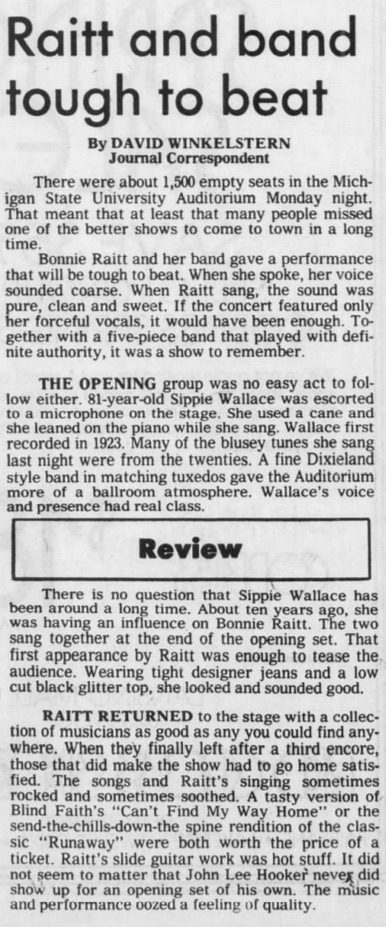
Raitt and band tough to beat

on April 29, 1980 No comments

Raitt and band tough to beat

by DAVID WINKELSTERN – Journal Correspondent


There were about 1,500 empty seats in the Michigan State University Auditorium Monday night. That meant that at least that many people missed one of the better shows to come to town in a long time.

Bonnie Raitt and her band gave a performance that will be tough to beat. When she spoke, her voice sounded coarse. When Raitt sang, the sound was pure, clean and sweet. If the concert featured only her forceful vocals, it would have been enough. Together with a five-piece band that played with definite authority, it was a show to remember.

THE OPENING group was no easy act to follow either. 81-year-old Sippie Wallace was escorted to a microphone on the stage. She used a cane and she leaned on the piano while she sang. Wallace first recorded in 1923.
Many of the blusey tunes she sang last night were from the twenties. A fine Dixieland style band in matching tuxedos gave the Auditorium more of a ballroom atmosphere.
Wallace’s voice and presence had real class.

There is no question that Sippie Wallace has been around a long time. About ten years ago, she was having an influence on Bonnie Raitt. The two sang together at the end of the opening set.
That first appearance by Raitt was enough to tease the audience.
Wearing tight designer jeans and a low cut black glitter top, she looked and sounded good.

RAITT RETURNED to the stage with a collection of musicians as good as any you could find anywhere. When they finally left after a third encore, those that did make the show had to go home satisfied.
The songs and Raitt’s singing sometimes rocked and sometimes soothed.
A tasty version of Blind Faith’s “Can’t Find My Way Home” or the send-the-chills-down-the spine rendition of the classic “Runaway” were both worth the price of a ticket.
Raitt’s slide guitar work was hot stuff. It did not seem to matter that John Lee Hooker never did show up for an opening set of his own.
The music and performance oozed a feeling of quality.

Source: © Copyright Lansing State Journal Archive
Lansing State Journal – April 29, 1980

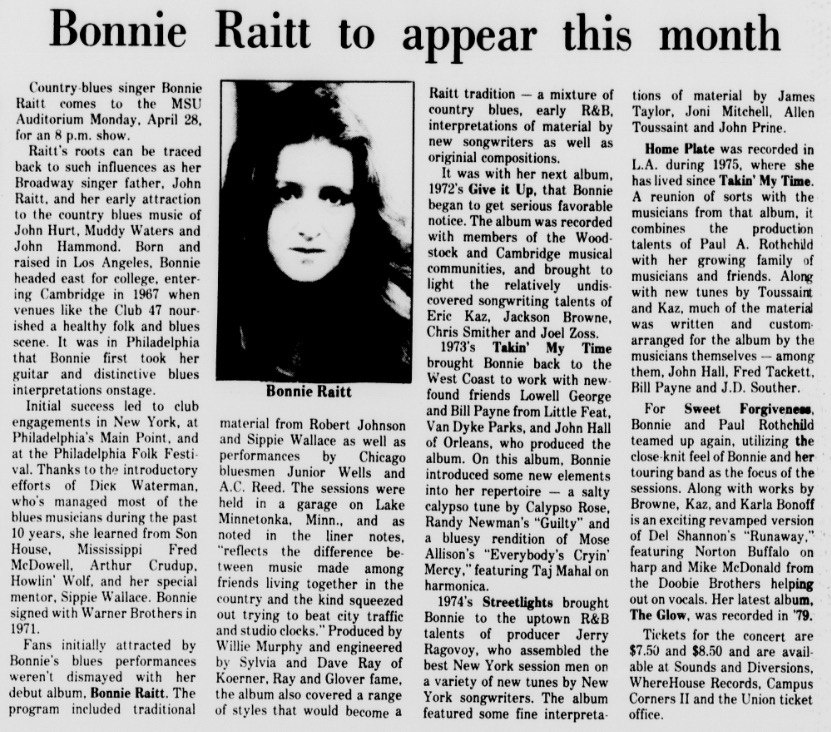
Bonnie Raitt to appear this month

Country blues singer Bonnie Raitt comes to the MSU Auditorium Monday, April 28, for an 8 p.m. show.

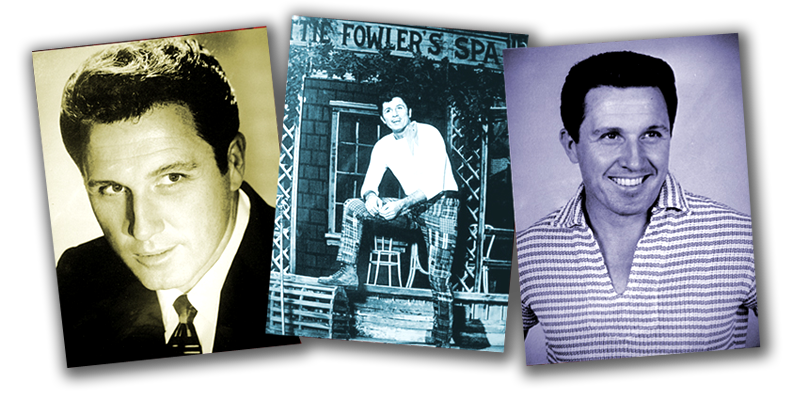
Raitt’s roots can be traced back to such influences as her Broadway singer father, John Raitt and her early attraction to the country blues music of John Hurt, Muddy Waters and John Hammond. Born and raised in Los Angeles, Bonnie headed east for college, entering Cambridge in 1967 when venues like the Club 47 nourished a healthy folk and blues scene. It was in Philadelphia that Bonnie first took her guitar and distinctive blues interpretations onstage.
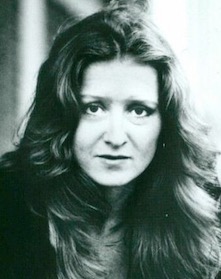
© Michael Dobo

Initial success led to club engagements in New York, at Philadelphia’s Main Point, and at the Philadelphia Folk Festival. Thanks to the introductory efforts of Dick Waterman, who’s managed most of the blues musicians during the past 10 years, she learned from Son House, Mississippi Fred McDowell, Arthur Crudup, Howlin’ Wolf and her special mentor, Sippie Wallace. Bonnie signed with Warner Brothers in 1971.

Fans initially attracted by Bonnie’s blues performances weren’t dismayed with her debut album, Bonnie Raitt. The program included traditional material from Robert Johnson and Sippie Wallace as well as performances by Chicago bluesmen Junior Wells and A.C. Reed. The sessions were held in a garage on Lake Minnetonka, Minn., and as noted in the liner notes, “reflects the difference between music made among friends living together in the country and the kind squeezed out trying to beat city traffic and studio clocks.” Produced by Willie Murphy and engineered by Sylvia and Dave Ray of Koerner, Ray and Glover fame, the album also covered a range of styles that would become a Raitt tradition — a mixture of country blues, early R&B, interpretations of material by new songwriters as well as originial compositions.

It was with her next album, 1972’s Give it Up, that Bonnie began to get serious favorable notice. The album was recorded with members of the Woodstock and Cambridge musical communities, and brought to light the relatively undiscovered songwriting talents of Eric Kaz, Jackson Browne, Chris Smither and Joel Zoss.

1973’s Takin’ My Time brought Bonnie back to the West Coast to work with new found friends Lowell George and Bill Payne from Little Feat, Van Dyke Parks and John Hall of Orleans, who produced the album. On this album, Bonnie introduced some new elements into her repertoire — a salty calypso tune by Calypso Rose, Randy Newman’s “Guilty” and a bluesy rendition of Mose Allison’s “Everybody’s Cryin’ Mercy,” featuring Taj Mahal on harmonica.

1974’s Streetlights brought Bonnie to the uptown R&B talents of producer Jerry Ragovoy, who assembled the best New York session men on a variety of new tunes by New York songwriters. The album featured some fine interpretations of material by James Taylor, Joni Mitchell, Allen Toussaint and John Prine.

Home Plate was recorded in L.A. during 1975, where she has lived since Takin’ My Time. A reunion of sorts with the musicians from that album, it combines the production talents of Paul A. Rothchild with her growing family of musicians and friends. Along with new tunes by Toussaint and Kaz, much of the material was written and custom arranged for the album by the musicians themselves — among them, John Hall, Fred Tackett, Bill Payne and J.D. Souther.

For Sweet Forgiveness, Bonnie and Paul Rothchild teamed up again, utilizing the close knit feel of Bonnie and her touring band as the focus of the sessions. Along with works by Browne, Kaz, and Karla Bonoff is an exciting revamped version of Del Shannon’s “Runaway,” featuring Norton Buffalo on harp and Mike McDonald from the Doobie Brothers helping out on vocals. Her latest album, The Glow, was recorded in ’79.

Tickets for the concert are $7.50 and $8.50 and are available at Sounds and Diversions, WhereHouse Records, Campus Corners II and the Union ticket office.

Source: © Copyright The State News
The State News – April 15, 1980
But wait, there's more!

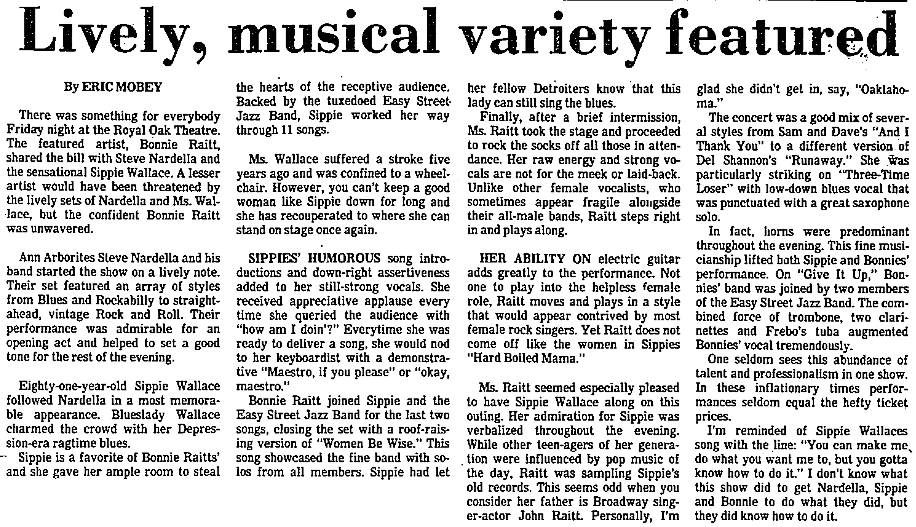
Lively, musical variety featured

on April 25, 1980 No comments

Bonnie Raitt, Sippie Wallace and Steve Nardella – Royal Oak Music Theatre, Royal Oak, Michigan

By ERIC MOBEY

There was something for everybody Friday night at the Royal Oak Theatre. The featured artist, Bonnie Raitt, shared the bill with Steve Nardella and the sensational Sippie Wallace. A lesser artist would have been threatened by the lively sets of Nardella and Ms. Wallace, but the confident Bonnie Raitt was unwavered.

Ann Arborites Steve Nardella and his band started the show on a lively note. Their set featured an array of styles from Blues and Rockabilly to straightahead, vintage Rock and Roll. Their performance was admirable for an opening act and helped to set a good tone for the rest of the evening.

Eighty-one-year-old Sippie Wallace followed Nardella in a most memorable appearance. Blueslady Wallace charmed the crowd with her Depression-era ragtime blues.
Sippie is a favorite of Bonnie Raitts’ and she gave her ample room to steal the hearts of the receptive audience. Backed by the tuxedoed Easy Street Jazz Band, Sippie worked her way through 11 songs.

Ms. Wallace suffered a stroke five years ago and was confined to a wheelchair. However, you can’t keep a good woman like Sippie down for long and she has recouperated to where she can stand on stage once again.

SIPPIES’ HUMOROUS song introductions and down-right assertiveness added to her still-strong vocals. She received appreciative applause every time she queried the audience with “how am I doin’?” Everytime she was ready to deliver a song, she would nod to her keyboardist with a demonstrative “Maestro, if you please” or “okay, maestro.”

Bonnie Raitt joined Sippie and the Easy Street Jazz Band for the last two songs, closing the set with a roof-raising version of “Women Be Wise.” This song showcased the fine band with solos from all members. Sippie had let her fellow Detroiters know that this lady can still sing the blues.

Finally, after a brief intermission, Ms. Raitt took the stage and proceeded to rock the socks off all those in attendance. Her raw energy and strong vocals are not for the meek or laid-back. Unlike other female vocalists, who sometimes appear fragile alongside their all-male bands, Raitt steps right in and plays along.

HER ABILITY ON electric guitar adds greatly to the performance. Not one to play into the helpless female role, Railt moves and plays in a style that would appear contrived by most female rock singers. Yet Raitt does not come off like the women in Sippies “Hard Boiled Mama.”

Ms. Raitt seemed especially pleased to have Sippie Wallace along on this outing. Her admiration for Sippie was verbalized throughout the evening. While other teen-agers of her generation were influenced by pop music of the day, Raitt was sampling Sippie’s old records. This seems odd when you consider her father is Broadway slnger-actor John Raitt. Personally, I’m glad she didn’t get in, say, “Oaklahoma.”

The concert was a good mix of several styles from Sam and Dave’s “And I Thank You” to a different version of Del Shannon’s “Runaway.” She was particularly striking on ‘Three-Time Loser” with low-down blues vocal that was punctuated with a great saxophone solo.

In fact, horns were predominant throughout the evening. This fine musicianship lifted both Sippie and Bonnies’ performance. On “Give It Up,” Bonnies’ band was joined by two members of the Easy Street Jazz Band. The combined force of trombone, two clarinettes and Freebo’s tuba augmented Bonnies’ vocal tremendously.

One seldom sees this abundance of talent and professionalism in one show. In these inflationary times performances seldom equal the hefty ticket prices.

I’m reminded of Sippie Wallaces song with the line: “You can make me do what you want me to, but you gotta know how to do it.” I don’t know what this show did to get Nardella, Sippie and Bonnie to do what they did, but they did know how to do it.


But wait, there's more!

Rise of The 2nd Raitt

on November 14, 1979 No comments

Rise of The 2nd Raitt

By Joseph McLellan

Bonnie Raitt passed her 30th birthday four days ago. In the mythology of the ’60s she grew up in, it is time to stop trusting herself. But in the hit-today, gone-tomorrow realities of a pop music career, she has never been more confident.

Warming up for last night’s sold-out concert at Constitution Hall, she was worried only about signs of advancing age. When a friend offered to carry her bag, she pointed to a (mostly imaginary) pouch under her left eye and asked, “this one?”

“Look — gray hairs,” she said, fingering three or four in the long, luxuriant red mane that had become slightly damp in yesterday afternoon’s weather.

Silver threads among the gold are only part of a changing image of the singer. She began in the late ’60s as a minor cult figure — the whiskey queen of barroom blues whose down-home style and repertoire attracted a devoted following, but not the top-40 audience. Now, after 10 years and six albums, she finally has a shot at the big time with her new Warner Bros. record, “The Glow.”

Some diehard fans of Raitt’s earlier image have complained that she is “going glossy” with her latest album, produced by Peter Asher, who also produced Linda Ronstadt and James Taylor. But yesterday she wasn’t putting on any gloss.

“Get a picture of this,” she told a photographer, pointing to a small pimple on her left cheek. “I got all these birthday cakes and I didn’t eat any of them, but I’m getting the zits anyway.”

Then she grew pensive. “It’s lack of sex that does it. I’ve been living with the same old man in California for the last seven years, and I want to get back and see him. My skin will clear up by the time I get to Phoenix.”

Nearing the end of a long East Coast tour, Raitt is going home for Thanksgiving. And she wants to go home permanently: “I’ve been on the road pretty solidly for the last 10 years, and I’m getting tired. But I don’t have hit records, so touring is the only way I make money — and now there’s no money in that. Expenses are up 45 percent over last year, but if the new record isn’t a hit, I’ll have to go back on the road again.”

For an old woman of 30 who yearns to retire from touring and just make hit records, Raitt still has the air of a ’60s activist. Dressed in jeans, high-heel boots and a knit cardigan festooned with anti-nuclear power buttons, her conversation is peppered with her current cause — safe energy, for which she has put the women’s movement in a temporary holding pattern.

“Today is the anniversary of Karen Silkwood’s death, and I’m supposed to be at a demonstration right now,” she said. “You know, when they found her in her car, she had two tickets to a concert that I was giving — that’s one of the things that turned me on to the anti-nuclear movement. But I was raised as a Quaker, and in school I used to refuse to participate in air raid drills.”

The Quaker upbringing came from her father, Broadway singer John Raitt, who starred in the original casts of such shows as “Carousel” and “Oklahoma!” and is now touring the country in a one-man show that is a sort of musical autobiography.

“Try being his daughter when he sings that monologue from ‘Carousel’ about ‘my little girl,'” she says. “That song makes me cry every time I hear it. He’s a hard act to follow, but it’s real neat to be doing the same thing as your old man.”

She will be seeing her father in a few days when he and she are both performing around Durham, N.C. “Our paths criss-cross pretty constantly,” she says. “A while ago, he left his coat in a hotel room in Buffalo, and I picked it up for him there a few days later.”

A few years ago, she was telling the press, “I don’t want to be a star. I don’t want hit records. I’m trying . . . to have a good time and survive.” But increasingly, she links survival, and the political causes she espouses, to star status.

“I think it’s important for us to speak out,” she says, “because we get attention — but it’s not right to take advantage of that unless you really know what you’re talking about. I have to do my homework. One good thing about being on the road is that you spend so much time on the bus and you can get a lot of reading done.”

This is not Bonnie Raitt’s first appearance in Constitution Hall. The last time, one of her friends — an 82-year-old black blues singer — had trouble getting in, and she made some inflammatory remarks from the stage about the DAR and their hall. But this time she planned to keep the evening non-inflammatory — at least on the subject of the DAR.

“We had to book this place at the last minute. We thought we had the Georgetown gym, but we forgot to check with the basketball coach. The DAR was very nice. I won’t criticize them, but I will talk about nuclear power between songs.

“Usually, I have an information booth in the lobby with material on the anti-nuclear movement, but I don’t know whether they will let me do it here.”

Constitution Hall is small compared to the Capital Centre, where Raitt does not aspire to play (“If I ever get that popular, I’d rather do three or four nights in a smaller place”). But it’s still a far cry from the converted garage near Minneapolis where she made her first record. “Bonnie Raitt.” At some point in the years since then, the time came when she stopped being called her father’s daughter and he started being called her father — a situation which bothers her a little, and will continue in the wake of her new record.

“He sings in halls that hold 1,500 to 3,000 people — and he does it without a microphone,” Raitt says of her father.

“I wish I could do that.”

Source: © Copyright The Washington Post

Raitt in Concert

By Geoffrey Himes
November 14, 1979

For those who felt that Bonnie Raitt sorely missed her old bassist, Freebo, on her newest album, his presence at her Constitution Hall show last night was reassuring. The presence of other longtime Raitt associates — guitarist Will McFarlane, drummer Dennis Whitted and keyboardist Marty Grebb — further dispelled any fears that Raitt had gone Hollywood with her recent Peter Asher-produced record.

Both Raitt and her band came out spitting fire on “Baby I Love You.” If possible their version was even funkier than the Aretha Franklin original. As if she had to reassert her blues credentials, Raitt’s singing and slide-guitar playing were rawer and rowdier than recent records or shows.

On “The Glow,” Raitt arched her back and boomed out the crying lines with a bottomless bellow. Then she leaned forward to stretch the intimate lines into jazz nuances. On John Prine’s “Angel From Montgomery,” McFarlane’s lyrical lead guitar and Freebo’s promenading bass were as eloquent as second and third vocals.

Raitt dedicated the sassy Dixieland challenge of “Give It Up” to Karen Silkwood, the nuclear-plant worker who died in an auto crash five years ago yesterday, and to Raitt’s colleagues in Musicians United for Safe Energy (MUSE). She encored with a moving rock-‘n’-roll version of John Hall’s anti-nuke anthem, “Power.”

The show was opened by the Lamont Cranston Band, a seven-man blues group from Minnesota, where Raitt recorded her first album. The band proved its versatility as it segued from a harmonica-wailing, horn-punching version of Muddy Waters’ “Got My Mojo Working” to a long, rolling, jazz instrumental. The band’s standout was Bruce McCabe; who sang and pounded his piano in the best tradition of Chicago blues legend Otis Spann.

Source: © Copyright The Washington Post But wait, there's more!