Concerts

Bonnie Is First ‘Raitt’

on May 11, 1974 No comments
By PETER GELZINIS

The low down sounds of Bonnie Raitt’s blues and the sophisticated “grease” rock of Bruce Springsteen and his E St. Band, carried on till the wee hours Friday morning.

If the crowd who packed the Harvard Sq. Theater for the Cambridge Blues Queen’s second show had its way, we all would have stayed for breakfast.

At 2:40 a.m. the square wore the effects of a “Blitzkrieg” launched by two thousand weary fans, who shuffled into the morning drizzle like fatigued troops who’d just taken an enemy stronghold.

Four hours earlier a primed regiment waited at the stage entrance where the doorkeeper became the most important person in Cambridge. The pleas began.

“Hey, man, did this dude with shoulder-length hair just go in. I gotta know, man, cuz like he said it was cool for the gig, ya know? I mean like I know Clarence and Springsteen’s cool, too, man.”

And the keeper’s reply never faltered. “Look . . ., don’t keep pounding these doors, because nobody gets in till 10. Nobody!”

Bruce Springsteen, introduced as “the man from Asbury Park,” opened the marathon show with a two-hour opening set.

He began with his musical credo “The E Street Shuffle.” It’s a vivid tale of streetcorner life, complete with gangs, cruising, drinking, fighting, loving and over-all survival.

Springsteen is not a narrator of what he sings, he is a character. His lengthy, Dylanesque numbers become a philosophy of a “greaser” life-style. Their complex, often incoherent images, go way beyond the simple woes told in a “fast rocker.” It works because the orchestration is so good.

Clarence Clemons, a superb tenor sax man, helps fashion numbers like “Jenny’s Back in Town,” “Born to Run,” and “Jackie,” with a lovely jazz bent, or when the talents of Danny Federici, Garry Tallent and David Sancious, merge on “Jenny” it takes on the dimensions of a show tune.

The image fits, for the short, lean figure in the black T shirt and corduroys, white Panama hat and electric guitar looks like a plugged in Sky Masterson. He’s greased , but he’s polished. His voice is raw and gravely enough to be convincing, but his guitar and his music is zestfully imaginative.

Bonnie Raitt came to study at Harvard University in 1967 with the hopes of being a social reformer. In the late 1960’s and early 1970’s she also became a fixture in the Boston and Cambridge music community playing local clubs. Her introduction to blues musician manager Dick Waterman set the stage for a long relationship which found her performing along side such blues greats as Howlin’ Wolf and Mississippi Fred McDowell. Though a local favorite her early records achieved only moderate success though critically acclaimed by many.

In the early 1970’s the word was out around town about this young girl who could sing the blues and play a nasty slide guitar to boot. I had seen Bonnie perform at Jack’s, a local club in Mass Ave. in Cambridge where she was a regular. Boston and Cambridge had a vibrant music scene at the time with many clubs having an emphasis on blues music. The area’s rich heritage of folk and acoustic music created an audience hungry for that genre and Bonnie fit right in. But there was a sense of hope and wonder if she would make it beyond the local scene.
She was clearly a fan favorite and her rise to popularity would continue as she continued to build a strong following in the local bar scene. She would always command a good crowd at local venues but when she started to play theatre engagements she was often relegated to opening for more established artists of the time. She remained a local star often bringing up on stage other local musicians when she performed. She was dedicated to preserving a traditional blues style in her work while exploring other genres as well.
Working with her management I probably photographed her more than any other local artist at the time. Stopping by at sound checks the band always warmly greeted me and I soon began to feel like a regular around them. In the spring of 1974 her management finally broke the pattern of her being a supporting act and booked her as a headliner. They felt it was finally her time to stand on her own.
In the following year she would adopt a more mainstream style with the release of Home Plate, appear on the cover of Rolling Stone magazine and soon after bid farewell to Cambridge as her home. Eventually her manager Dick Waterman would end his relationship as manager allowing Bonnie to move on with others he felt could take her farther. He had done his job.
But it would be her 10th album, Nick of Time, released in 1989 that brought an infamous Grammy sweep.
Today she is considered one of the most respected musicians of her generation.
~ Barry Schneier

tip: most convenient way to listen while browsing along is to use the popup button of the player.

Bonnie Raitt – guitar, vocals
Freebo – bass
John Hall (Orleans) – guitar
John Payne – sax
Bill Payne (Little Feat) – piano
Dennis Whitted – drums

Taping Gear: Sony TC-55 with built in condenser mic and auto level control

JEMS 2013 transfer: SH master cassettes > Nakamichi CR-7A > Sound Devices USBPre2 > Peak 6.0 with iZotope Ozone > .wav (24/96) > resample via iZotope MBIT+ to .wav (16/44) > xACT to FLAC

Thanks yet again to Steve Hopkins for allowing JEMS to present his outstanding audience recordings in a fresh light.
BK for JEMS

This recording contains every minute Steve Hopkins recorded that fateful night in Cambridge. Bonnie performed a 10 PM late show as well, but there are no known recordings of that set, because, as Hopkins notes below, he was unsuccessful getting back into the venue.

As Hopkins’ himself wrote in his original post of the show: “This is a new transfer of a recording that has been in circulation for many years. I got in early with a friend who had a press pass. It was a general admission show and the first few rows were roped off for the press, so I sat down front and center and stayed there for the entire early show. Unfortunately, they cleared the house after the early show, and as the crowd was lined up around the block for the late show, I was unable to get back in.

This is the first time Steve’s master tapes have been digitized directly. Hopkins points out a “loud electrical buzz emanating from the stage throughout the show, mostly noticeable during quieter segments.” It is worse in Bonnie’s set than Bruce’s, and you can tune it out, but it is annoying at times.

What’s also gone under appreciated is the wonderful, talkative performance Raitt turns in this night. In hindsight, the Harvard Square Theatre show feels like a major Bruce Springsteen moment, but Raitt was the headliner and her star was rising faster than Bruce’s at the time. Here’s she’s touring in support of her third album, Takin’ My Time, released the previous October. The set is laden with wonderful covers of songs penned by Randy Newman, Jackson Browne, Mississippi Fred McDowell, Chris Smither and Mose Allison to name a few.

But even Bonnie recognized something special had occured. Before her first song she says of Springsteen, “He’s got the most incredible band and he’s one of the most amazing people I’ve ever heard. I just had to say that. He’s a real hard act to follow.”
Etree.org

When Bonnie Raitt came out the crowd was loose and ready to be lulled by her blues.

The lusty, bawdy redhead sat down, two cans of beer on an adjoining chair, fixed the large electric guitar across her lap and let out with “Love Me Like a Man.”

Blues is relative to the artist. It can be soulful, raucous or despairing, but it has to be felt. Bonnie Raitt can tear at your insides without leaving her seat. Her voice carries a range of personalities, from the plain rauchiness of Aretha Franklin’s “Baby, I Love You,” the quiet desperation of Eric Kaz’s “Love Has No Pride,” and a lilting tenderness of Jackson Browne’s “I Thought I Was a Child.”

When she draws back from the microphone to pick away at the guitar, her face seemed tired and worn. There’s a toughness about her when she wails out with “Give It Up or Let Me Go.” Yet when she ran her hands through her long red hair and threw it over her shoulder, there was sorrow in the face that filtered through her own song, “Nothing Seems to Matter.”

She was joined on stage by people who knew the message Bonnie Raitt was sending out. John Hall, a strong lead guitar, John Payne kicked in a searing clarinet on “You Got to Know How,” and Freebo on bass, put his foghorn vocal backing on her classic version of Stephen Stills’ “Bluebird.”

Her days in Cambridge are behind her now. She lives in Los Angeles, but the dawn-breakers let her know she was misled.

Ira Gold’s Windowpane Productions originally booked Bonnie Raitt to play Harvard Square Theatre in the spring of 1974 with no opening act. But after listening to the two albums by a young New Jersey up-and-comer, over at photographer Barry Schneier’s apartment, Ira’s plans changed. Windowpane invited Bruce Springsteen and his band onto the bill… and on May 9, 1974, Jon Landau was able to witness Rock and Roll Future. Here, Ira shares his recollections, with images of the night from Schneier’s book ‘Bruce Springsteen: Rock and Roll Future.’
Forty-six years ago, on May 9, 1974, Jon Landau saw “rock and roll future” when Bruce Springsteen & the E Street Band played Harvard Square Theatre in Cambridge, MA. Author Barry Schneier literally wrote the book on that night: ‘Bruce Springsteen: Rock and Roll Future,’ from Backstreets Publishing. To celebrate the anniversary on May 9, 2020 — since these troubled times prevent us from sending Barry back on the road for another book tour right now — we hosted an Instagram Live event with Barry, the only photographer present that night, sharing his unique photos and stories from the legendary concert. Schneier’s ‘Bruce Springsteen: Rock and Roll Future’ (hardcover) can be purchased here: Backstreets.com


But wait, there's more!

Bonnie Rates

on October 10, 1973 No comments
Lewis Clayton

JACKSON BROWNE topped the bill at the Aquarius Theatre Friday night, but Bonnie Raitt got there first and stole the show.

The crowds turned out to welcome Bonnie back to Boston, and her loyal partisans filled the opulent old Aquarius. Gleefully displaying her purple knee-length crushed velvet boots, Bonnie came out backed by some excellent saxophone work by John Payne, who appeared last week at Passim’s. By the time she was up and doing “You’ve Been In Love Too Long,” an old Martha and the Vandellas song (“this is my James Brown imitation”), the burly, long-haired security guards were having their troubles clearing the aisles.

A little drunk, and very glad to be in Boston, Bonnie sang with clarity and power, although it wouldn’t have taken much to please the thoroughly stoned crowd. Some of her admirers rushed the stage to present her with kisses, a rose, and an empty Schlitz bottle. Testing the range of her voice, she mixed ballads like “Love Has No Pride” and Browne’s “Under the Falling Sky” with boogie tunes like “You’ve Got to Know How” and “Love Me Like A Man,” building to two encores.

Bonnie Raitt backstage playing guitar, with John Payne (soprano saxophone) at the Aquarius Theater, Boston, October 5, 1973
+ 7
Bonnie Raitt backstage, clasping a rose and watching hockey on television at the Aquarius Theater, Boston, October 5, 1973
Bonnie Raitt warming up backstage with Freebo (bass) and unidentified guitarist at the Aquarius Theater, Boston, October 5, 1973

If Bonnie Raitt is earthy, then Jackson Browne is slick. He is tall and lean, his hair falls perfectly parted, he sports just a taste of hillbilly in his voice. Friday night Browne did a 40-minute set of his own songs. Plagued by technical difficulties–the worst of them an amp which turned his acoustic guitar into a tinny electric–and uneasy over his place on the bill, Browne seemed uncomfortable on stage and unsatisfied with his band’s performance.

He apologized to the crowd midway through the set. “Billing is one of those things that is decided in Hollywood,” he admitted. “I’d rather follow the atom bomb than Bonnie Raitt.”

Although small groups of Bonnie’s partisans left after each of Browne’s songs, his band played well, and he was brought back for two encores. But the careful orchestration of his hits like “Jamaica”–which was done beautifully–couldn’t compete with Bonnie’s performance.

Browne is one of the most accomplished young songwriters in the country, but his arrangements are too sweet and self-contained to generate enough excitement to follow a boogie band. Only on one or two of his numbers, like “Rock Me On the Water” did his band generate much more than polite applause.

The people who did the billing for Friday night made a classic mistake. They could have done everyone a favor by simply turning the tickets upside down.


Source: © Copyright The Harvard Crimson But wait, there's more!

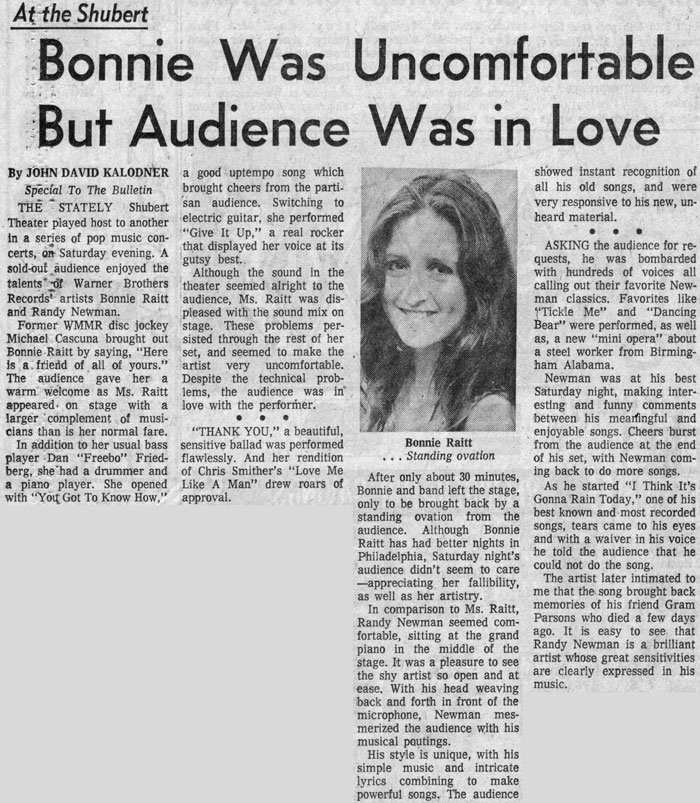
Bonnie was uncomfortable but audience was in love

on September 24, 1973 No comments

At the Shubert

By JOHN DAVID KALODNER


Special To The Bulletin

THE STATELY Shubert Theatre played host to another in a series of pop music concerts, on Saturday evening. A sold-out audience enjoyed the talents of Warner Brothers Records’ artists Bonnie Raitt and Randy Newman.

Former WMMR disc jockey Michael Cascuna brought out Bonnie Raitt by saying, “Here is a friend of all of yours.” The audience gave her a warm welcome as Ms. Raitt appeared on stage with a larger complement of musicians than is her normal fare.

In addition to her usual bass player Dan “Freebo” Friedberg, she had a drummer and a piano player. She opened with “You Got To Know How,” a good uptempo song which brought cheers from the partisan audience. Switching to electric guitar, she performed “Give It Up,” a real rocker that displayed her voice at its gutsy best.

Although the sound in the theater seemed alright to the audience, Ms. Raitt was displeased with the sound mix on stage. These problems persisted through the rest of her set, and seemed to make the artist very uncomfortable. Despite the technical problems, the audience was in love with the performer.


“THANK YOU,” a beautiful, sensitive ballad was performed flawlessly. And her rendition of Chris Smither’s “Love Me Like A Man” drew roars of approval.

…Standing ovation

Bonnie Raitt July, 1972 © David Gahr


After only about 30 minutes, Bonnie and band left the stage, only to be brought back by a standing ovation from the audience. Although Bonnie Raitt has had better nights in Philadelphia, Saturday night’s audience didn’t seem to care —appreciating her fallibility, as well as her artistry.
In comparison to Ms. Raitt, Randy Newman seemed comfortable, sitting at the grand piano in the middle of the stage. It was a pleasure to see the shy artist so open and at ease. With his head weaving back and forth in front of the microphone, Newman mesmerized the audience with his musical pourings.
His style is unique, with his simple music and intricate lyrics combining to make powerful songs. The audience showed instant recognition of all his old songs, and were very responsive to his new, unheard material.


ASKING the audience for requests, he was bombarded with hundreds of voices all calling out their favorite Newman classics. Favorites like “Tlckle Me” and “Dancing Bear” were performed, as well as, a new “mini opera” about a steel worker from Birmingham Alabama.
Newman was at his best Saturday night, making interesting and funny comments between his meaningful and enjoyable songs. Cheers burst from the audience at the end of his set, with Newman coming back to do more songs.
As he started “I Think It’s Gonna Rain Today,” one of his best known and most recorded songs, tears came to his eyes and with a waiver in his voice he told the audience that he could not do the song.
The artist later intimated to me that the song brought back memories of his friend Gram Parsons who died a few days ago. It is easy to see that Randy Newman is a brilliant artist whose great sensitivities are clearly expressed in his music.


Bonnie Raitt and Randy Newman at The Shubert in Philadelphia – Philadelphia Bulletin – Sept. 24, 1973
But wait, there's more!