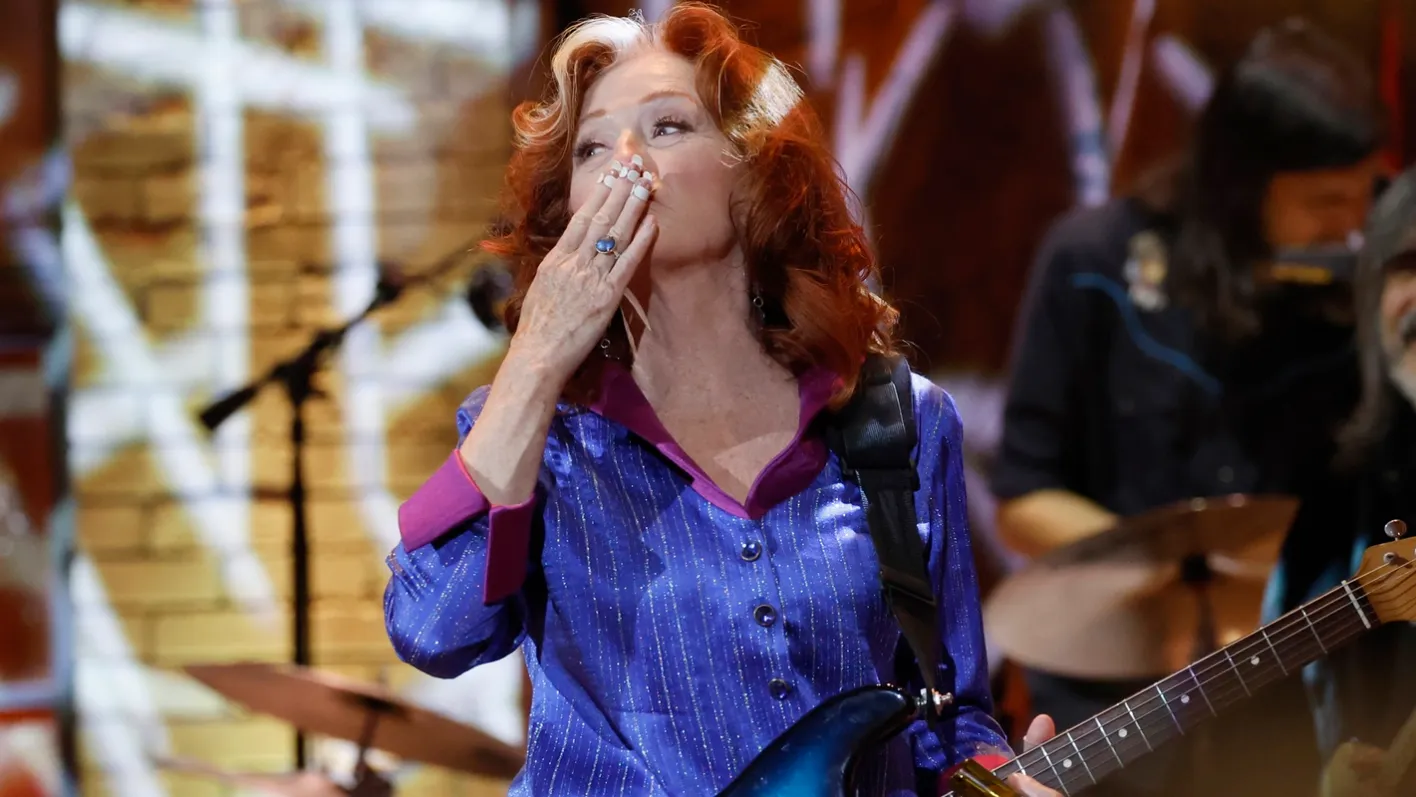
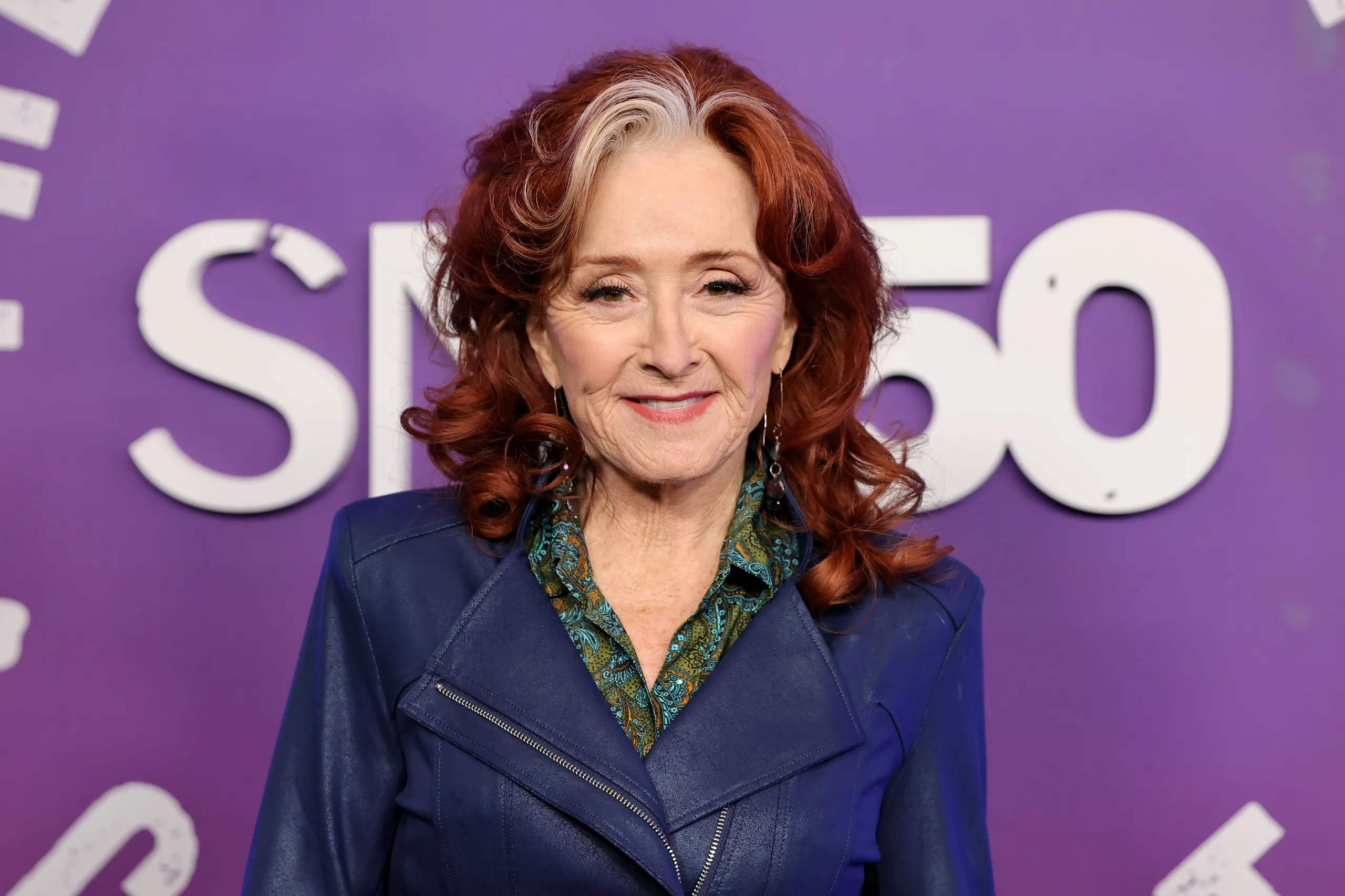
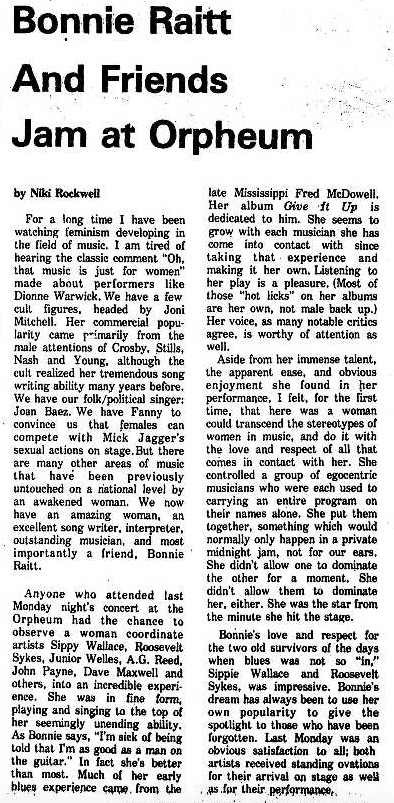
For a long time I have been watching feminism developing in the field of music. I am tired of hearing the classic comment “Oh, that music is just for women” made about performers like Dionne Warwick. We have a few cult figures, headed by Joni Mitchell. Her commercial popularity came primarily from the male attentions of Crosby, Stills, Nash and Young, although the cult realized her tremendous song writing ability many years before. We have our folk/political singer: Joan Baez, We have Fanny to convince us that females can compete with Mick Jagger’s sexual actions on stage. But there are many other areas of music that have been previously untouched on a national level by an awakened woman. We now have an amazing woman, an excellent song writer, interpreter, outstanding musician, and most importantly a friend, Bonnie Raitt.
Anyone who attended last Monday night’s concert at the Orpheum had the chance to observe a woman coordinate artists Sippie Wallace, Roosevelt Sykes, Junior Welles, A.G. Reed, John Payne, Dave Maxwell and others, into an incredible experience. She was in fine form, playing and singing to the top of her seemingly unending ability. As Bonnie says,
“I’m sick of being told that I’m as good as a man on the guitar.”
In fact she’s better than most. Much of her early blues experience came, from the late Mississippi Fred McDowell. Her album Give It Up is dedicated to him. She seems to grow with each musician she has come into contact with since taking that experience and making it her own. Listening to her play is a pleasure. (Most of those “hot licks” on her albums are her own, not male back up.) Her voice, as many notable critics agree, is worthy of attention as well.
Aside from her immense talent, the apparent ease, and obvious enjoyment she found in her performance, I felt, for the first time, that here was a woman could transcend the stereotypes of women in music, and do it with the love and respect of all that comes in contact with her. She controlled a group of egocentric musicians who were each used to carrying an entire program on their names alone. She put them together, something which would normally only happen in a private midnight jam, not for our ears. She didn’t allow one to dominate the other for a moment. She didn’t allow them to dominate her, either. She was the star from the minute she hit the stage.
Bonnie’s love and respect for the two old survivors of the days when blues was not so “in”, Sippie Wallace and Roosevelt Sykes, was impressive. Bonnie’s dream has always been to use her own popularity to give the spotlight to those who have been forgotten. Last Monday was an obvious satisfaction to all; both artists received standing ovations for their arrival on stage as well as for their performance.
Oct. 6 – Jackson Brown, Bonnie Raitt concert at Popejoy Hall, 8 p.m.
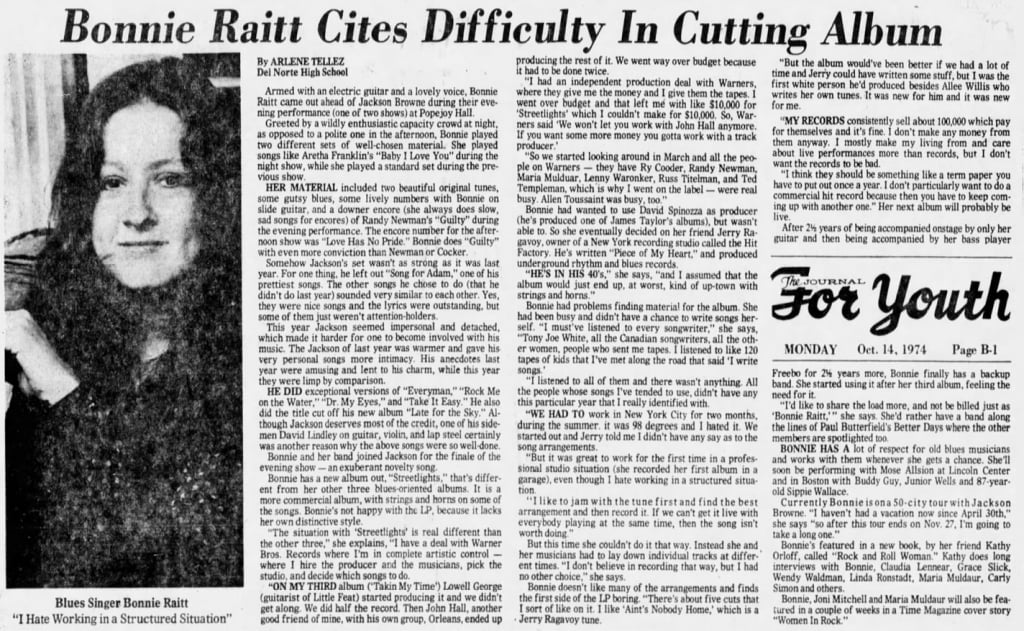
Blues Singer Bonnie Raitt “I Hate Working in a Structured Situation”
Armed with an electric guitar and a lovely voice, Bonnie Raitt came out ahead of Jackson Browne during their evening performance (one of two shows) at Popejoy Hall. Greeted by a wildly enthusiastic capacity crowd at night, as opposed to a polite one in the afternoon. Bonnie played two different sets of well-chosen material. She played songs like Aretha Franklin’s “Baby I Love You” during the night show, while she played a standard set during the previous show.
HER MATERIAL included two beautiful original tunes, some gutsy blues, some lively numbers with Bonnie on slide guitar, and a downer encore (she always does slow, sad songs for encores) of Randy Newman’s “Guilty” during the evening performance. The encore number for the afternoon show was “Love Has No Pride.” Bonnie does “Guilty” with even more conviction than Newman or Cocker.
Somehow Jackson’s set wasn’t as strong as it was last year. For one thing, he left out “Song for Adam,” one of his prettiest songs. The other songs he chose to do (that he didn’t do last year) sounded very similar to each other. Yes, they were nice songs and the lyrics were outstanding, but some of them just weren’t attention-holders. This year Jackson seemed impersonal and detached, which made it harder for one to become involved with his music. The Jackson of last year was warmer and gave his very personal songs more intimacy. His anecdotes last year were amusing and lent to his charm, while this year they were limp by comparison.
HE DID exceptional versions of “Everyman,” “Rock Me on the Water,” “Dr My Eyes,” and “Take It Easy.” He also did the title cut off his new album “Late for the Sky.” Although Jackson deserves most of the credit, one of his side-men David Lindley on guitar, violin, and lap steel certainly was another reason why the above songs were so well-done. Bonnie and her band joined Jackson for the finale of the evening show — an exuberant novelty song.
Bonnie has a new album out. “Streetlights,” that’s different from her other three blues-oriented albums. It is a more commercial album, with strings and horns on some of the songs. Bonnie’s not happy with the LP, because it lacks her own distinctive style. “The situation with ‘Streetlights’ is real different than the other three,” she explains, “I have a deal with Warner Bros. Records where I’m in complete artistic control — where I hire the producer and the musicians, pick the studio, and decide which songs to do. –ON MY THIRD album (‘Takin My Time’) Lowell George (guitarist of Little Feat) started producing it and we didn’t get along We did half the record. Then John Hall, another good friend of mine, with his own group, Orleans, ended up producing the rest of it. We went way over budget because it had to be done twice. “I had an independent production deal with Warners, where they give me the money and I give them the tapes. I went over budget and that left me with like $10,000 for ‘Streetlights’ which I couldn’t make for $10,000. So, Warners said ‘We won’t let you work with John Hall anymore. If you want some more money you gotta work with a track producer.’ “So we started looking around in March and all the people on Warners — they have Ry Cooder, Randy Newman, Maria Muldaur, Lenny Waronker, Russ Titelman, and Ted Templeman, which is why I went on the label — were real busy. Allen Toussaint was busy, too.” Bonnie had wanted to use David Spinozza as producer (he’s produced one of James Taylor’s albums), but wasn’t able to. So she eventually decided on her friend Jerry Ragavoy, owner of a New York recording studio called the Hit Factory. He’s written “Piece of My Heart,” and produced underground rhythm and blues records. “HE’S IN HIS 40’s,” she says, “and I assumed that the album would just end up, at worst, kind of up town with strings and horns.” Bonnie had problems finding material for the album She had been busy and didn’t have a chance to write songs herself. “I must’ve listened to every songwriter.” she says, “Tony Joe White, all the Canadian songwriters, all the other women, people who sent me tapes. I listened to like 120 tapes of kids that I’ve met along the road that said ‘I write songs.’ “I listened to all of them and there wasn’t anything. All the people whose songs I’ve tended to use, didn’t have any this particular year that I really identified with. “WE HAD TO work in New York City for two months, during the summer, it was 98 degrees and I hated it. We started out and Jerry told me I didn’t have any say as to the song arrangements. “But it was great to work for the first time in a professional studio situation (she recorded her first album in a garage), even though I hate working in a structured situation.”
“I like to jam with the tune first and find the best arrangement and then record it. If we can’t get it live with everybody playing at the same time, then the song isn’t worth doing “
But this time she couldn’t do it that way. Instead she and her musicians had to lay down individual tracks at different times. “I don’t believe in recording that way, but I had no other choice,” she says. Bonnie doesn’t like many of the arrangements and finds the first side of the LP boring. “There’s about five cuts that I sort of like on it. I like ‘Ain’t Nobody Home,’ which is a Jerry Ragavoy tune. “But the album would’ve been better if we had a lot of time and Jerry could have written some stuff, but I was the first white person he’d produced besides Allee Willis who writes her own tunes. It was new for him and it was new for me. “MY RECORDS consistently sell about 100.000 which pay for themselves and it’s fine. I don’t make any money from them anyway. I mostly make my living from and care about live performances more than records, but I don’t want the records to be bad.” “I think they should be something like a term paper you have to put out once a year. I don’t particularly want to do a commercial hit record because then you have to keep coming up with another one.” Her next album will probably be live.
After 2½ years of being accompanied onstage by only her guitar and then being accompanied by her bass player Freebo for 2½ years more, Bonnie finally has a backup band. She started using it after her third album, feeling the need for it. “I’d like to share the load more, and not be billed just as ‘Bonnie Raitt,’” she says. She’d rather have a band along the lines of Paul Butterfield’s Better Days where the other members are spotlighted too. BONNIE HAS A lot of respect for old blues musicians and works with them whenever she gets a chance. She’ll soon be performing with Mose Allison at Lincoln Center and in Boston with Buddy Guy, Junior Wells and 87-year-old Sippie Wallace. Currently Bonnie is on a 50-city tour with Jackson Browne “I haven’t had a vacation now since April 30th,” she says “so after this tour ends on Nov 27, I’m going to take a long one.” Bonnie’s featured in a new book, by her friend Kathy Orloff, called “Rock and Roll Woman.” Kathy does long interviews with Bonnie, Claudia Lennear, Grace Slick, Wendy Waldman, Linda Ronstadt, Maria Muldaur, Carly Simon and others. Bonnie, Joni Mitchell and Maria Muldaur will also be featured in a couple of weeks in a Time Magazine cover story “Women In Rock.”
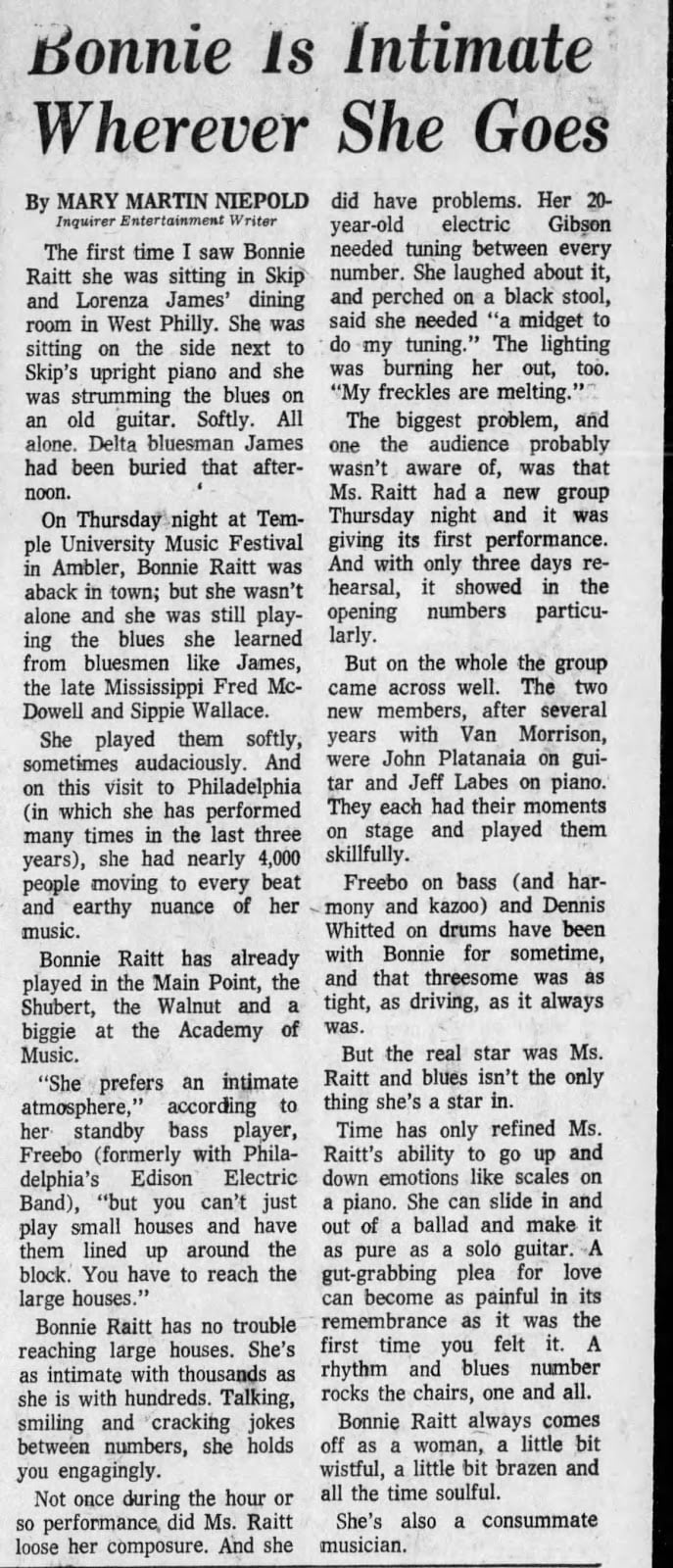
by Mary Martin Niepold Inquirer Entertainment Writer
The first time I saw Bonnie Raitt she was sitting in Skip and Lorenza James’ dining room in West Philly. She was sitting on the side next to Skip’s upright piano and she was strumming the blues on an old guitar. Softly, all alone. Delta bluesman James had been buried that afternoon.
On Thursday night at Temple University Music Festival in Ambler, Bonnie Raitt was aback in town; but she wasn’t alone and she was still playing the blues she learned from bluesmen like James, the late Mississippi Fred McDowell and Sippie Wallace. She played them softly, sometimes audaciously. And on this visit to Philadelphia (in which she has performed many times in the last three years), she had nearly 4,000 people moving to every beat and earthy nuance of her music.
“She prefers an intimate atmosphere,” according to her standby bass player, Freebo (formerly with Philadelphia’s Edison Electric Band), “but you can’t just play small houses and have them lined up around the block. You have to reach the large houses.” Bonnie Raitt has no trouble reaching large houses. She’s as intimate with thousands as she is with hundreds. Talking, smiling and cracking jokes between numbers, she holds you engagingly.
Not once during the hour or so performance did Ms. Raitt loose her composure. And she did have problems. Her 20-year-old electric Gibson needed tuning between every number. She laughed about it, and perched on a black stool, said she needed “a midget to do my tuning.” The lighting was burning her out, too. “My freckles are melting.”
The biggest problem, and one the audience probably wasn’t aware of, was that Ms. Raitt had a new group Thursday night and it was giving its first performance. And with only three days rehearsal, it showed in the opening numbers particularly.
But on the whole the group came across well. The two new members, after several years with Van Morrison, were John Platania on guitar and Jeff Labes on piano. They each had their moments on stage and played them skillfully.
Freebo on bass (and harmony and kazoo) and Dennis Whitted on drums have been with Bonnie for sometime, and that threesome was as tight, as driving, as it always was.
But the real star was Ms. Raitt and blues isn’t the only thing she’s a star in. Time has only refined Ms. Raitt’s ability to go up and down emotions like scales on a piano. She can slide in and out of a ballad and make it as pure as a solo guitar. A gut-grabbing plea for love can become as painful in its remembrance as it was the first time you felt it. A rhythm and blues number rocks the chairs, one and all.
Bonnie Raitt always comes off as a woman, a little bit wistful, a little bit brazen and all the time soulful. She’s also a consummate musician.
Bandana Blues is and will always be a labor of love. Please help Spinner deal with the costs of hosting & bandwidth. Visit www.bandanablues.com and hit the tipjar. Any amount is much appreciated, no matter how small. Thank you.
Bonnie Raitt is nothing if not loyal. And when she caught wind of the fact that Mike Reid and I were writing and recording together, she was quick to volunteer to sing on our song “The Bridge.” It’s one of my favorite songs Mike and I have written. And I can no longer imagine it without her heroic spirit present. ~ Joe Henry
Released on: 2025-09-05 Producer: Joe Henry Music Publisher: Rivers and Roads Music (ASCAP - admin by Endurance Music Group) Music Publisher: Mule Rider (ASCAP) Music Publisher: Blue Raincoat Music (ASCAP) ℗ 2025 Work Song Inc. marketed and distributed by Thirty Tigers
{{svg_quality_icon}}
{{quality-options}}
1
http://i3.ytimg.com/vi/VWNoTHkp6_k/hqdefault.jpg
Prison Bound Blues · Bonnie Raitt
Bonnie has contributed a new recording of "Prison Bound Blues" written by Leroy Carr to a project called Better Than Jail, an extraordinary new album benefiting Free Hearts and Equal Justice USA. Better Than Jail is available everywhere today and features covers of iconic prison songs from Steve Earle, Taj Mahal,Margo Price, The War and Treaty and many more. The album seeks to raise awareness and support for the urgent need to reduce the harm of the criminal justice system. https://found.ee/BetterThanJail.
I'm so proud to have joined in with so many illustrious artists in creating this very special album in support of rural prison reform. Overlooked for far too long, this issue cuts across all cultural and political divides and deserves all our focused attention to finally bring about some swift and meaningful action. Better Than Jail is one of the most inspired and heartfelt albums I've been blessed to be a part of and I hope it sets a fire in hearts far and wide to join in our efforts." ~ Bonnie Raitt
Released on: 2024-10-04 Executive Producer: Brian Hunt Producer: Kenny Greenberg Producer: Wally Wilson Producer: Bonnie Raitt Recording Engineer: Jason Lehning at Sound Emporium Mastering Engineer: Alex McCollough at True East Mastering Production Assistant: Shannon Finnegan Mixer: Justin Niebank at Hounds Ear Music Publisher: Universal Music Corp. Composer, Lyricist: Leroy Carr ℗ Believe Entertainment Group and Wyatt Road Records
{{svg_quality_icon}}
{{quality-options}}
1
http://i3.ytimg.com/vi/xC2BJuQbO8w/hqdefault.jpg
The Fabulous Thunderbirds - Nothing in Rambling Ft. Bonnie Raitt, Taj Mahal, Keb' Mo' & Mick Fleetwood
In celebration of the band’s 50th Anniversary, The Fabulous Thunderbirds have just released Struck Down, their first studio album in eight years on Stony Plain Records. The ten-track album includes a wonderful cover of Memphis Minnie’s “Nothing in Rambling,” featuring longtime friends, T-Birds founding member Kim Wilson, along with Bonnie, Keb’ Mo’, Taj Mahal and Mick Fleetwood. — BRHQ
{{svg_quality_icon}}
{{quality-options}}
1
http://i3.ytimg.com/vi/YmW-bgcbvQI/hqdefault.jpg
Little Feat - Long Distance Call
“I’ve always loved Little Feat and this new incarnation of the band is bringing some serious heat, cred and new blood to their enduring legacy. Every Feat fan loves us some Sam. I’m so glad he’s now gotten a chance to step out front and center and put his spin on these wonderful blues songs. I loved singing "Long Distance Call" with him, always one of my favorites, and Scott slayed on slide. Know you’ll enjoy hanging out with us at Sam’s Place!" -- Bonnie Raitt
“Long Distance Call” was written by blues legend, Muddy Waters. It has Sam Clayton and Bonnie Raitt on vocals, Scott Sharrard on Dobro, Fred Tackett on acoustic guitar, Tony Leone on drums, and Michael “The Bull” LoBue on harmonica. The album also features Bill Payne on piano and Kenny Gradney on bass.
Little Feat have composed an album that’s their love letter to the blues entitled, ‘Sam’s Place.’ “Long Distance Call” plus many other blues classics are on this album. You can stream and order ‘Sam’s Place’ here: https://orcd.co/samsplace
Broken Hearts & Dirty Windows: Songs of John Prine, Vol. 2, the anticipated new John Prine tribute record from Oh Boy Records, is out today. Stream/purchase HERE.
Created as a celebration of Prine’s life and career, the album features new renditions of some of Prine’s most beloved songs performed by Brandi Carlile (“I Remember Everything”), Tyler Childers (“Yes I Guess They Oughta Name A Drink After You”), Iris DeMent (“One Red Rose”), Emmylou Harris (“Hello In There”), Jason Isbell (“Souvenirs”), Valerie June (“Summer’s End”), Margo Price (“Sweet Revenge”), Bonnie Raitt (“Angel From Montgomery”), Nathaniel Rateliff & The Night Sweats (“Pretty Good”), Amanda Shires (“Saddle in the Rain”), Sturgill Simpson(“Paradise”) and John Paul White (“Sam Stone”). Proceeds from the album will benefit twelve different non-profit organizations, one selected by each of the featured artists.
{{svg_quality_icon}}
{{quality-options}}
1
http://i3.ytimg.com/vi/Z71L4JdrVBY/hqdefault.jpg
Bonnie Raitt - Write Me a Few of Your Lines/Kokomo Blues
60 years anniversary celebration of Arhoolie
December 10, 2020
{{svg_quality_icon}}
{{quality-options}}
1
Arhoolie Foundation celebrates it's 60th anniversary (1960-2020) with an online broadcast.
Bonnie Raitt - Shadow of Doubt
Hardly Strictly Bluegrass Festival
October 3, 2020
Hardly Strictly Bluegrass celebrates it's 20th anniversary with an online broadcast titled “Let The Music Play On”.
{{svg_quality_icon}}
{{quality-options}}
1
http://i3.ytimg.com/vi/hCJa0505jZk/hqdefault.jpg
Bonnie Raitt & Boz Scaggs - You Don't Know Like I Know
Farm Aid 2020 On the Road
Sam & Dave classic written by Isaac Hayes and David Porter.
{{svg_quality_icon}}
{{quality-options}}
1
http://i3.ytimg.com/vi/jXG6ULcK-qs/hqdefault.jpg
Sheryl Crow & Bonnie Raitt - Everything Is Broken
[Eric Clapton’s Crossroads 2019]
Eric Clapton, one of the world’s pre-eminent blues/rock guitarists, once again summoned an all-star team of six-string heroes for his fifth Crossroads Guitar Festival in 2019. Held at the American Airlines Center in Dallas, Texas, the two-day concert event raised funds for the Crossroads Centre in Antigua, the chemical dependency treatment and education facility that Clapton founded in 1998.
{{svg_quality_icon}}
{{quality-options}}
1
http://i3.ytimg.com/vi/yHeBLEo4TOM/hqdefault.jpg
'A Tribute To Mose Allison'
Celebrates The Music Of An Exciting Jazz Master
Raitt contributed to a new album, If You're Going To The City: A Tribute To Mose Allison, which celebrates the late singer and pianist, who famously blended the rough-edged blues of the Mississippi Delta with the 1950s jazz of New York City.
NPR's Lulu Garcia-Navarro talks to Bonnie Raitt about her friendship with the Mose Allison. They're also joined by Amy Allison — his daughter, who executive produced the album — about selecting an unexpected list of artists to contribute songs to the album.
Recorded on tour June 3, 2017 - Centennial Hall, London - Ontario Canada








 Users Today : 305