magazine

All posts tagged magazine

Interview with Bonnie from Guitar Player Online Edition

on February 9, 2006 No comments
logo_2x

By Michael Molenda

New Orleans Jazz & Heritage Festival (New Orleans, Louisiana) April 23, 2004 © David Redfern /Redferns

In a field dominated by men, men, and more men, Bonnie Raitt has managed to kick hellacious ass all over the brotherhood of guitar since her eponymous debut album unveiled her soulful slide playing and singing back in 1971. Using the blues as a launching pad, Raitt fearlessly explored folk, R&B, Americana, and world music styles, while accumulating—as a writer herself, an interpreter of cover tunes, and a discoverer of transcendent songwriters—a stunning collection of heartfelt musical poems of the human condition. About as far from a pop princess as a whale is to a guppy, Raitt’s restless creative spirit, devotion to activism (she co-founded Musicians for Safe Energy, and is a founding member of the Rhythm and Blues Foundation), and no-compromise demeanor shackled her to a long tenure as a critic’s fave who didn’t exactly set any album-sales records.

That all changed in 1989, when the Don Was-produced Nick of Time topped the U.S. charts, and captured a trio of Grammys (including Album of the Year). Not surprisingly, Raitt didn’t play the uber-star game for long. After 1991’s Luck of the Draw and 1994’s Longing in Their Hearts—which were also hits—Raitt went native, hiring on the sonically adventurous production team of Tchad Blake and Mitchell Froom to helm 1998’s Fundamental.

“I approached Tchad and Mitchell because I loved the sounds Tchad was getting—these organic, funky sounds that use a lot of analog pedals mixed with Mitchell’s arsenal of unbelievable keyboards,” she says. “I also wanted to put myself in slightly uncomfortable situations, because I didn’t want to end up sounding the same. Those guys have a healthy respect for things that have gone before, but in a very interesting way.”

{{svg_quality_icon}}
{{quality-options}}

While the brilliant and edgy collaboration effectively tanked Raitt’s gargantuan record sales, it inspired her creatively—to the point where she is still pushing the envelope, and still embracing Blake’s sonic alchemism. She took over the production gig herself for the first time in her career on her latest release, Souls Alike [Capitol]—Blake is credited as co-producer—proving once again that this “Ferocious Female” (as voted by GP readers in 2004) is one of America’s uncompromising musical treasures.

What was your overall plan for tackling the production duties for Souls Alike?
I’m the team leader, so I was driving, but being a woman and a bandleader can be a delicate thing. I may not be the most extraordinary musician in the room, and everybody in the band will have opinions about where the music should go. They know it’s basically my record—and that they’re collaborating with me to come up with the music I want to make—but I want to give them a lot of rope. I need to try different things on, you see, and until they give me different things to try, I can’t tell what fits. I’m sure that if you talked to my band they’d say the process is a bit frustrating—“Can you just let us play before you ‘86’ it?” But I have a fast mind, and I can tell when things are going in a direction that might be fun for them, but isn’t what I’m looking for. It’s a living, organic process that demands a lot of diplomacy and subtlety. As the leader, you don’t want to squash creativity, and you don’t want to feel like you’re being didactic. Basically, I think the trick to good production and arrangement is getting the right people in the room with the right material.

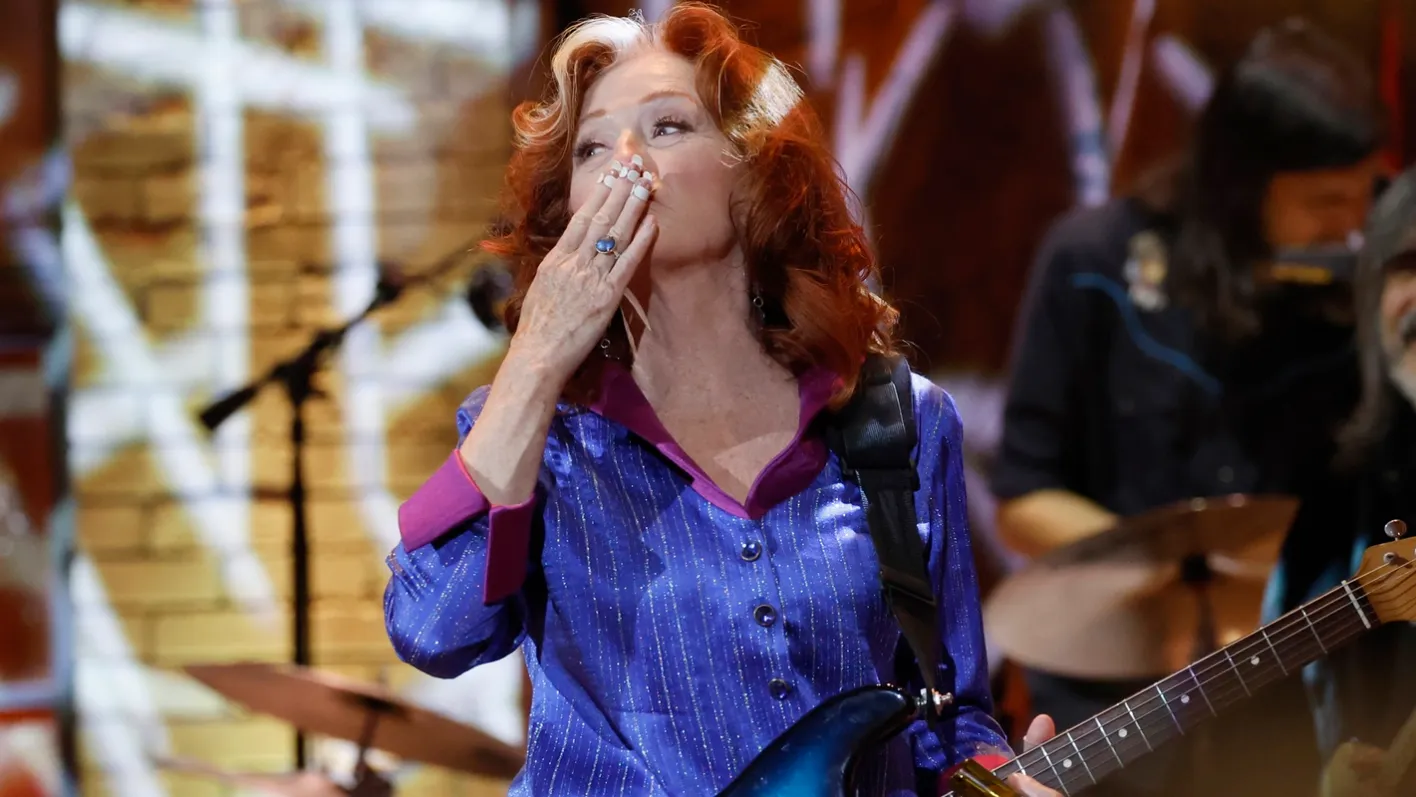
Bonnie Raitt, guitar, performs at the North Sea Jazz Festival on July 12th 2003 in The Hague, The Netherlands. © Frans Schellekens /Redferns

So how do you find the “right people?”
I look at a player’s musical vocabulary, but I also consider the kind of person they are. To me, you can’t separate who someone is from the way he or she plays. It makes complete sense to me that Jon Cleary is so badass on the keyboards, and that he also reads Graham Greene. I look for soul, intelligence, funk, and the ability to handle an extraordinary range of music styles. By the time I bring somebody into the fold, I already know they can do the things I need them to. I know George [Marinelli, guitarist in Raitt’s band] can do everything from Jimi Hendrix and Keith Richards to Richard Thompson, as well as being completely inventive in his own style.

The things I love most in rock and roll are the loosey-goosey parts where the drummer is hitting it a little behind. It’s that back-and-forth shuffle against the straight time that makes it sexy

Did you develop the song arrangements before you entered the studio?
They are so not thought out! I sit down with the guitar in my lap, we start singing—perhaps we’ll play a couple of R&B tunes—and I pick the key for the song. Then we just play together. Most of the time, I’m singing while I’m trying the song on, and we basically get the arrangement the same day we record it. It comes out of the players pretty much the way it’s going to sound on the record.

In a Pro Tools world where tracks can be scrupulously arranged and rearranged to death, you’ve obviously decided to undertake somewhat of a loose, organic, and more immediate approach.
Oh man, that reminds me of a joke. What did the Pro Tools engineer say to the band? “That sucked. Come on in!”
You know, I don’t want everything perfect. I like accidents. The solo in “Crooked Crown” was that way. We happened to be recording a run-through on Pro Tools, and I was in a completely different key when I went to the solo. That was a happy accident, and we kept it. I learned that from Tchad and Mitchell, who don’t fix things. I mean, you’d better be prepared when they turn that tape on, because they’re going to say, “Oh, no. You’re not doing that again. It sounds great.” I’ll fix stuff that’s really out, but I’ve learned to love the first and second takes. We rarely play anything better the third time than we did the first time, and I don’t like to belabor songs. If it’s not happening, perhaps that means you’re not supposed to do that song.

{{svg_quality_icon}}
{{quality-options}}


Also, the things I love most in rock and roll are the loosey-goosey parts where the drummer is hitting it a little behind. It’s that back-and-forth shuffle against the straight time that makes it sexy. I don’t want to pass judgment on people who like quantized loops and stuff, but rock music without the “and roll” is pretty Teutonic.

Although many players strive to forge a signature sound that hardly ever evolves, you seem to flourish when you’re thrown a bit off balance.
Someone put it best when they said, “You can’t change the noodle, but you can change the sauce.” I play the way I play, just like I sing the way that I sing. I’m not a schooled guitar player, and I can’t say I’m getting appreciably better, but I know how to do what I do. It’s the songs that change. For me to play slide guitar over the Zimbabwean groove of “Hear Me Lord” [from 2002’s Silver Lining] is a blast. It’s the context that makes it fresh for me. On Souls Alike, the most adventurous thing I did was run my guitar through an Amp Farm wah-wah loop for “God Was in the Water.”
Taking risks is how I keep moving forward—that and being open to hearing things in a different way. Ultimately, I know there’s a safety net, and that’s the fact that I trust my ears and my instincts. I’ll always try something different. That’s how you grow, and you also don’t want to be overly influenced by an inclination to dismiss something that’s new. So I may do something I’m not really into—out of respect for Tchad and the musicians—but if it’s not working for me after a few days of letting it sit, then I’ll go, “We gave it a try, but this song is sucking.”

Given the lock-step environment of today’s record industry, taking chances with musical hybrids is pretty brave.
Well, I don’t care if I’m a star, and I don’t care if I win another Grammy. If you truly don’t care about commercial considerations, that’s the most free you can be. This is why I really treasure having the validation of my fans. If I wanted to make records like Tom Waits makes, some of my fans would get it, and they’d dig my audaciousness. I mean, if you’re digging it, your real fans are probably going to like it, too.

Soul Mates

“My rig is pretty simple,” says Raitt. “I have my ’69 Fender Stratocaster — I haven’t missed one gig with that guitar since I got it in 1969 — as well as some Fender Bonnie Raitt Signature Stratocasters. I play in different keys, so rather than stop and retune, my tech runs out with a different guitar that’s tuned for a specific song. Then I have a Gibson ES-175, a Guild F-50, and a custom, purple-cutaway resonator made by Larry Pogreba. Larry is an eccentric guy — the body is recycled aircraft aluminum, and he used a ’51 Rambler hubcap for the resonator-cone cover. It sounds unbelievable. My current amp is a Bad Cat Hot Cat 30R.”
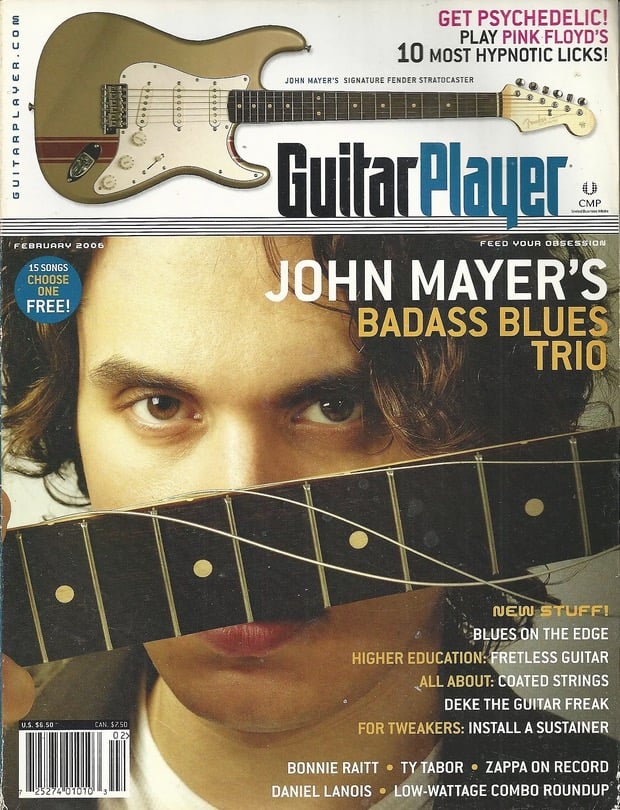
Guitar Player – Feb.2006

About The Author


Source: © Copyright GuitarPlayer.com
But wait, there's more!

Beyond the Blues

on November 5, 2005 No comments

by Jason MacNeil

There are a few musicians who after years of toiling, touring, trials and tribulations finally breakthrough into a new level of stardom. And it often seems to be that when they do, they push themselves even further to excel or at worse maintain a high level of consistently strong albums.

After close to two decades in the music business, Bonnie Raitt finally struck gold in 1990 with her Nick Of Time album, garnering four Grammy Awards. While her previous albums were very strong, it was as if Raitt gave critics and music fans something to talk about with that one.

“I can never say anything bad about that because it changed my life,” Raitt says on the line promoting her latest Souls Alike. “Suddenly everybody wanted to hear my record. It was a fantastic opening for people like me, Aaron Neville, Lyle Lovett and k.d. lang—we all won that year and commercial radio often doesn’t play artists like us.”

Since then, Raitt’s albums have often been championed for their swampy, bluesy rock style. But on her latest, she’s branched out somewhat into a melancholic yet quite soothing style on ‘The Bed I Made’ and the tender, reflective ‘I Don’t Want Anything To Change.’

“The songs are somewhat adult and quite complex and not really happy-go-lucky,” Raitt says. “I think the best songs to me are the ones about the things that rub and make you feel a little bit uncomfortable. Sometimes the song’s feelings aren’t always positive ones.”

And while the issue is never openly addressed, the sadness on some songs mirrors Raitt’s personal life over the last year. Her father and Broadway legend John Raitt passed away in February 2005 at the age of 88. Raitt says working on Souls Alike wasn’t an escape from the loss, but rather a welcomed change.

“It was someplace else to go that occupied my time,” she says. “It was a little bit more difficult to make a record in those circumstances of having such an ill parent. We were doing it in Los Angeles and that’s where my father was recuperating or still trying to recuperate.”

As for making Souls Alike, Raitt wasn’t too concerned with creating her own songs. Instead she opted to pour over piles of discs to showcase the hordes of talented but terribly underrated singer-songwriters.
“It is really difficult to find songs that fit and that thrill me,” she says. “Even though I love songwriting, some of my biggest thrills are to go on song hunts and just listen to hundreds of CDs. Sometimes it’s frustrating and when I think I’m not going to find anything I’ll turn up one of these jewels which are found on this record.”

The result is songs written by artists like Jon Cleary, Maia Sharp and Emory Joseph, sounding custom-made for Raitt, especially Joseph’s ‘Trinkets.’

“That was one of the first songs I found,” Raitt says. “I love that particular groove—there’s an element of Little Feat to that groove and I’ve always liked Wurlitzer and slide guitar.

“Emory is one of the most inventive and original songwriters I know. All of those songwriters I could have done five or six of their songs. When you can find a match where people are singing things you wouldn’t be able to access yourself and hearing the truth coming out of them, you know you’re going to sing it.”

Another song of note is the leadoff track, ‘I Will Not Be Broken,’ composed by the same songwriting team responsible for Eric Clapton’s ‘Change The World’ and Raitt’s 2002 hit ‘I Can’t Help You Now.’

“I Will Not Be Broken’ was such a perfect fit for me stylistically and also thematically,” she says. “I had actually recorded the record right after the [2004] election, so it was kind of soothing for me to be able to sing ‘I Will Not Be Broken’ after the election turned out a little different than what we had hoped for.”

Raitt, who performed on the Vote for Change tour in 2004, also wore another hat for Souls Alike, producing the album herself for the first time. But it wasn’t all that arduous a task.

“I’ve been working with the exact same band that was on Silver Lining and the rhythm section I’ve been on the road with since the early ‘80s,” Raitt says. “We really work like a great machine now, almost like a jazz group in the sense that we don’t work things out beforehand, we let the spontaneity, versatility and chops of each member of the band flow.”

Aside from the album, Raitt also released a Live at Montreux DVD in recent months. The DVD contains footage of a 1977 performance as well as a 1991 concert.

“We found out that somebody had filmed that years ago unbeknownst to me and they said we’re going to put it out,” she says. “I said, ‘Oh no, wait a minute, you got to give me a chance to check it out in case there’s something embarrassing on it.’ I pulled off a couple of songs that I thought were too fast.

“There’s some stuff that made me cringe, but there’s also stuff that brought me great joy to be able to see that it had been preserved. I don’t know if anybody enjoys watching themselves on TV. But it’s like dental work—you have to pay attention.”

After asking what her father would have thought of the album, Raitt seems more than eager to answer.

“He was around me for the 35 years I was playing and he was always appreciative of it, especially the older blues and the ballads,” she says. “He was as much a fan of mine as I was of his.

“I miss him very much and I’m so glad that somebody asked about him because he was so important to my life. I think he was incredibly accepting of all the aspects of my life—romantic and late nights—he never gave me a lot of grief about any of it. He just wanted me to be healthy and happy.” •


Source: © Copyright ft.Myers Magazine

But wait, there's more!

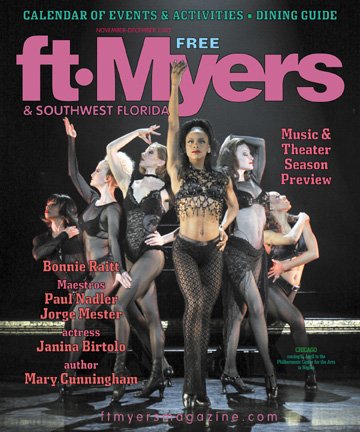
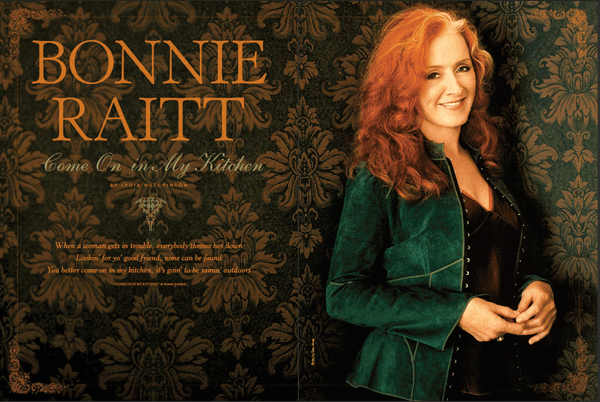
Come On in My Kitchen

on September 1, 2005 No comments
by Lydia Hutchinson
Bonnie Raitt extended interview
What follows are exclusive excerpts from our interview with Bonnie Raitt that didn’t make it in the printed version for
space reasons. Enjoy! 


On The New Album:
I noticed that this is the first time you’ve listed yourself as the producer of one of your albums.
Albums are always a collaboration, and in my case I pick partners in the studio—a producer or an engineer—because they have a real affinity musically and personally. But the vision and the song choice and to a great extent everything from the sound of the snares to which kind of strings and which bass on each song, sweetening—all that is basically my taste with the advice of whoever it is that I’m working with. Tchad Blake and his sensibility, mixing style, the fact that we cut it to API vintage analog board, and his choice of mics, his choice of pedals, but mostly his artistic taste and his great intelligence makes him a great producer, engineer and musician. So that maybe I’m the captain as producer, this is really a collaborative co-production effort between him and the other engineer and my band.

The feel of this album is so great and energetic and real—was most of it recorded live?
That’s pretty much how I always do it. The songs get minimal rehearsal for keys and arrangement ideas, and a lot of the concept of how they’ll sound I do before I get the band together. I sort of know what I’m gonna do with the song as I find it or as I’m writing it, and I have an idea of the instrumentation —whether it’s going to be an acoustic-type song or whether it’s going to go in this tabla djembe direction or whether it’s gonna be a rock and roll tune. So the band often can’t tell from the demo what I have in mind until I get ’em in the room. But we’ve been together for so long that I don’t tell them what to play because they already know.
As a producer and a bandleader I have to let the song breathe a little and see where we find what’s out there. It’s basically a creative process in the first or second time we play the song, and then we don’t do it again until we get in the studio—then it’s the first or second take. So it’s live, and we’ll overdub right after the take.

What is the time frame you worked on with this album?
They’re all about the same in terms of the year and a half it takes to tour behind the last record, then there’s a break hopefully, and then there’s time to start thinking about the next one. And in my case I start taking songs and listening to them pretty much from about six or seven months after my last album’s released; I listen to them recreationally on the road, and when I’m home or in the car I’ll go, “Well, I’d better go listen to the first batch.”

So you’re looking ahead to your next record during a current tour.
Yeah. Some people write all the time, but I started looking for ideas of what I might want to sing about while I’m on the road because I have the days to myself; I’m out hiking or walking or riding my bike. So once the big flush of promotion is up and ready and we’re just waning it down, there’s more recreational time to listen to new kinds of music and put my ear to the ground for new songwriters.

What is the schedule for releasing an album like for you?
I’d say it’s a year after the tour I start planning when I’m going to put the next record out, and I back up from there and put the studio time in. You can put it in September to make it for Christmas or you put it in February in time to make it for the summer tour. There’s only two times to release ’em, and if you miss one year then you’ve gotta go to the next. With my two consecutive years of international touring and then my family health crises, this album release got pushed up from when I felt like being on the road for a year. And I needed a break. So the album was recorded in October and November of last year, and then I tweaked it, and basically because of my family situation and because I needed some time off, I postponed the release until the fall.

On Inspiration:
[Bonnie talked in the printed article about how Joan Baez was her first inspiration. This is the dialogue that followed]
In my early college years I was exposed to James Taylor and Eric Andersen and Joni Mitchell. Judy Collins had been a big part of my growing up as well, and that’s another example. She and Joan interpreted other people’s material, and Aretha, too—they didn’t necessarily write all their own stuff. So when I was playing in my room, that’s where I got the model from. I didn’t come up with the singer-songwriter model, that didn’t happen until Joni Mitchell, and I was already doing “Since I Fell For You” and Motown songs on the guitar. And all along I’d loved Ray Charles and black gospel music, and I loved Jump blues and I loved Dinah Washington … as I became a young teenager, soul music and the Beatles and the Stones were what I really loved. When I heard Aretha Franklin that was a total experience—vocally, absolutely. I could get it all with her.
And you know, after Aretha there were people like Etta and look at Tina Turner still — she’s an incredible inspiration. But you know, it’s hard. There’s a lot more people than just the blues or female artists who were inspirational. I think James Taylor — those of us who were my age that were starting out — their soulfulness. The Joni Mitchells and Jackson Brownes and John Prines.

When did blues music hit your life?
The first blues records I heard, I wouldn’t be able to name one artist who was really it for me, because as a teenager I didn’t have the depth of knowledge about blues that I later developed. I mean, I can’t say that Muddy or John Hurt were more important than the other; it was the whole world of Delta blues. I got into blues—Delta folk blues—and then I heard Howlin’ Wolf and Muddy Waters through the Rolling Stones.

How old were you then?
Twenty when I first started. And all of my 20s I played with those guys. Incredible. So, you know, Sippie and Fred McDowell were probably the biggest inspiration, and Muddy Waters and John Lee Hooker were right up there.

Did you ever meet Alberta Hunter?
I did! I went to see her at the Cookery and just introduced myself—she didn’t know who I was, I just said I was a singer too and I loved her music. Those big earrings. Wasn’t she incredible? She was seminal for women blues singers because she just didn’t take any shit from anybody.

You talking about sitting in your room when you were young, playing your guitar, reminds me of a conversation that I had with Marilyn Bergman not too long ago. And she was saying how when she and Alan first moved to L.A. they lived right down the road from your family…
Yeah! They were right down the street…

And she was saying how she remembers looking out the window every day and seeing this little red-headed girl getting off the school bus to walk home—and you were probably heading up to your room to play that guitar… I just love that determined image of you.
I’m so glad she remembers that (laughs)! And I did play guitar every day in my room. I remember running into them later when I became a professional, and when “The Way We Were” was big I remember saying to my dad, “Isn’t that the people that lived down the street?” (Laughs) And we’d since run into each other at the Grammys or something, and my dad was with me a lot of the time, and they’ve just been so gracious to me and my family all this time. I think they’re fantastic as well.

About Her Faith:
Tell me about the Quaker faith—it seems to be such a cornerstone in your activism.
Well, there’s a religious aspect to it which is basically starting out with the premise that there’s God in every person. So if you love God, you can’t kill another person. And that’s really directed from Jesus or from Buddha or Mohammed. And that divinity exists within and you appeal and relate to the oneness that you all are. That sounds pretty “woo-woo,” but in fact a lot of religions are based on the same premise, that there is only love and if it behooves you to find that of God in the other person, then find a way to work it out.
So structurally Quakers were persecuted because they wouldn’t take their hat off to the king, they don’t have a minister.… There are Quakers like Richard Nixon, though, where they had ministers and a church and they were more traditional like Protestant religions. The Quakers that I grew up around—the Society of Friends is what we’re called—you basically sit in a circle with no altar and it’s called “centering in.” And if someone is moved to share something of a spiritual nature, then they stand up and say something. And then they sit back down and someone else will say something. And sometimes there’s nobody that stands up. So that’s what Quaker meetings are, people basically getting real quiet and meditating. It’s similar to a mystical eastern religion in that way.
In terms of beliefs, it’s that we are here to help each other, and not have more than we need; you’re supposed to be of service, and you’re not supposed to be greedy or focus on material goods. And like the Amish, which we’re confused with—the Shakers, the Quakers didn’t adorn themselves a lot in the old days. That wasn’t what it was about, you know, gussying up in push-up bras and mascara and all that stuff those of us rock chicks aspire to (laughs).
So anyway, over the years, Quakers have become especially known for their peace activism. A lot of the “Ban the Bomb” movement was spearheaded by them, and conflict resolution efforts. The American Friends Service Committee, which is the social help arm of the Society of Friends, is allowed in war-torn areas that the American government or the Peace Corp wouldn’t even be allowed, because they’re not aligned; they’re pacifists, they’re coming from a conciliatory point of view, and they don’t take sides. So it’s humanist, it’s altruistic, it’s mystical, it’s a reaction against organized religion, and spending money on real estate. … Quaker meeting houses are just really simple little rooms with benches; no choir, no minister. But they do great work, really great work.
The way that I’m Quaker isn’t so much that I go to church, but it’s my philosophy of conflict resolution, and being anti-war and pro-life and pro-respect. Everybody’s equal. Nobody’s above. It’s not like a hierarchy of the church, where these guys have the direct dial to God and they’re going to pass down what the law is. Sorry but that doesn’t float for me.

It’s easy to see how you’re someone who walks the walk, then, knowing that those beliefs are the core of who you are.
Peace and justice. I mean, basic religion is that you’re supposed to share what you have with someone who’s suffering. And if someone’s being bullied, then you do what you can to stop it in a way that doesn’t involve violence. Jesus had a really good idea; he changed the world. And Gandhi did, too. And Martin Luther King. And that’s all based on non-violence.

On Benefits:
How did the Vote For Change tour go?
It was great! It was a fantastic experience because obviously everybody who came really wanted to be there, and we had a mission bigger than just the musical thrill of the concert. Jackson [Browne], Keb’ [Mo’] and I love working together, and then Sheryl [Crow] was along for one of them. And we’re musical brethren, so we mesh perfectly and have a lot of respect for each other and the audience knew us—so it was bigger than the sum of its parts. And to know that simultaneously all these concerts were going on in different states was fantastic.

That’s where you really find your community, isn’t it?
Benefits. My favorite shows to do, because we’re making a difference and we love each other, plus we get a chance to hang out together and mix music in ways that you don’t get to otherwise.

On Learning About Music:
Last time we talked you were really getting into world music. Has that opened up a lot of creativity for you?
You know, that ear opening that happened in 2000 when I got to really spend some time in Ireland and Mali and then Cuba … it’s just been ongoing because my band is so well-versed in so many different kinds of music, especially Hutch and Jon Cleary. So riding on the bus is like a tutorial; they’ll bring this amazing stuff and we’ll be watching some black and white footage from the 1940s from Cuba. After our show we’re going down the highway and nobody’s getting any sleep because we’re like, “No, no, I’m next, I get the machine” (laughs).

So you watch a lot of DVDs with historical footage?
Oh yeah. The American Folk Blues Festival is this set of three DVDs that’s the most astonishing footage of blues artists who were brought over to Europe between ’62 and ’66 on these tours—so Lightnin’ Hopkins and Fred McDowell and Howlin’ Wolf, just everybody at their prime. So that’s been taking up a lot of my time just going back and unearthing all of this incredible video to go with the music that I love, and the footage I wouldn’t have known existed. And ones like Only The Strong Survive and Standing In The Shadows of Motown. There was a Mill Valley Film Festival that had Sophiatown, which was about the whole jazz scene in South Africa in the ‘50s, and that was a film that deserves to be seen. And there’s another great one called Calypso Dreams that features a lot of calypso music and Calypso Rose, who I cut a song with.

On What She’s Listening To:
There really are some incredible songs out there, aren’t there?
You know, someone just said to me a couple of days ago in an interview that there didn’t seem to be any great new songwriters coming up or that it seemed more bleak, and I just said, “Oh, no … it’s not bleak at all.” The Internet has made things so much more possible; it’s harder to wade through how many thousands of entries there are, but just when you think you’ve heard everything there’ll be the most unusual great new song. Like this guy Amos Lee, and there’s a guy Tom Brosseau—wait till you hear him. There’s a woman named Lauren Ellis who sent me her stuff, and she’s really good. And Richard Julian is one of my favorites—I just sat in with him the other night, and I can’t wait for his new album. My friend saw Jill Sobule and said she was just amazing. I love her stuff but haven’t seen her live yet. But I’ve gotta check her out—apparently it’s like the second coming (laughs)! And you know what I love? Those Nashville Underground CDs. Great artwork, mastering, incredible performances. Those are great—the hit songwriters playing the songs the way they were written. So that’s what I said to this journalist—get these records and you’ll see whether there are any good writers out there.
It’s like when Hutch said, “Have you heard of this guy Paul Brady” and aside from the Johnstones I hadn’t heard of his pop stuff. You know, there’s these seminal artists like Patty Griffin or Paul Brady who have been around for a while but I just didn’t know. The songwriters on this record, for me, are as fine a crop of any I’ve heard. I mean, I just can’t imagine not singing their songs for the rest of my life. So that’s one of the reasons I wanted to showcase them on this record in the way that I have and calling it Souls Alike—I took the lyric from “Deep Water.” Between my band and Tchad and this particular group of songwriters, I just wanted to be able to let people know that there isn’t any difference between my penning a song or my playing all the instruments … once it gets in this family of people, we’re saying the thing that is real and true for us.
But every one of the songwriters on this record, I could listen to their own solo record and they’re right up in my top list of people I’d love to be listening to. We’re putting Maia [Sharp] and Randall [Bramblett] on different dates of the tour to open, and Stephen Bruton is going, too. Wait till you hear his new album … [From the Five on New West]… it’s just so great. Billy Payne [from Little Feat] is playing on it. Oh, it’s really, really good. I try to get more enthusiastic about my friends, but I don’t think I could do it (laughs).

Does music have a very healing power for you, especially with everything you’ve gone through recently? Do you turn to it for comfort?
I listen to African music, real up-tempo gospel music, Hornsby always; I’ll go back and pick up albums that I haven’t heard for years from people like Danny O’Keefe. So in the sense that I surround myself in my non-working hours with the music of people I already know, that makes it like being wrapped in a blanket of familiarity. And lately I’ve been listening to a lot of the jazz stations, or shows like Thistle and Shamrock—I’ll listen to Celtic music or put Altan on, or maybe Alison Krauss … but I tend to listen to stuff that doesn’t have anything to do with what I’m singing.
So yeah, I think it can be incredibly healing. But so can silence.


Source: © Copyright Performing Songwriter But wait, there's more!